

Mon Coeur Se Recommande à Vous (I Give to You All of My Heart): 3-Part Mixed, a cappella Choral Octavo
French Madrigal attributed to Orlando di Lasso / arr., with English words, by Russell Robinson
Item: 00-PO-0002876
$2.25
Minimum order quantity: 20 copies
Pickup currently not available
Description
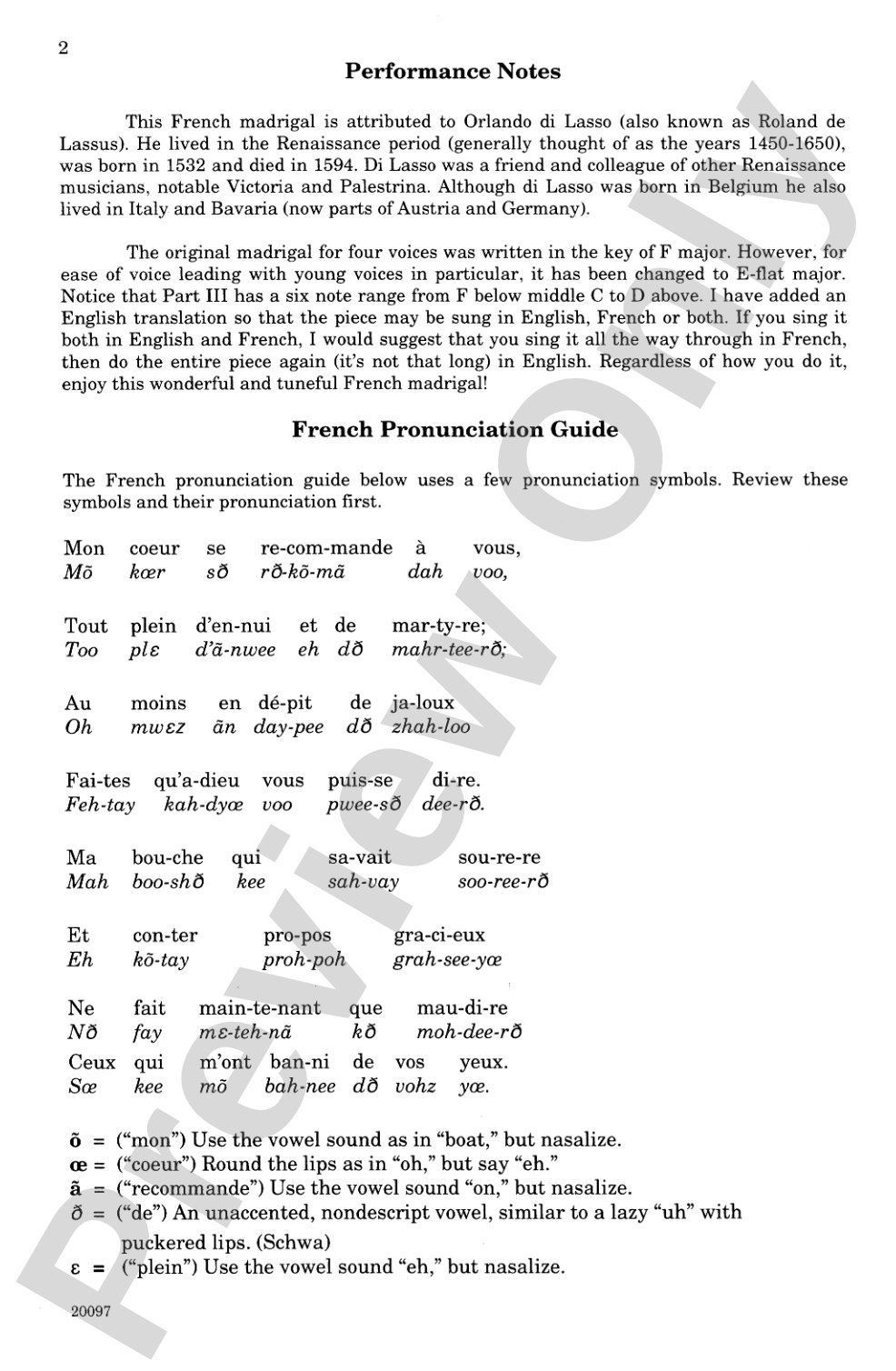
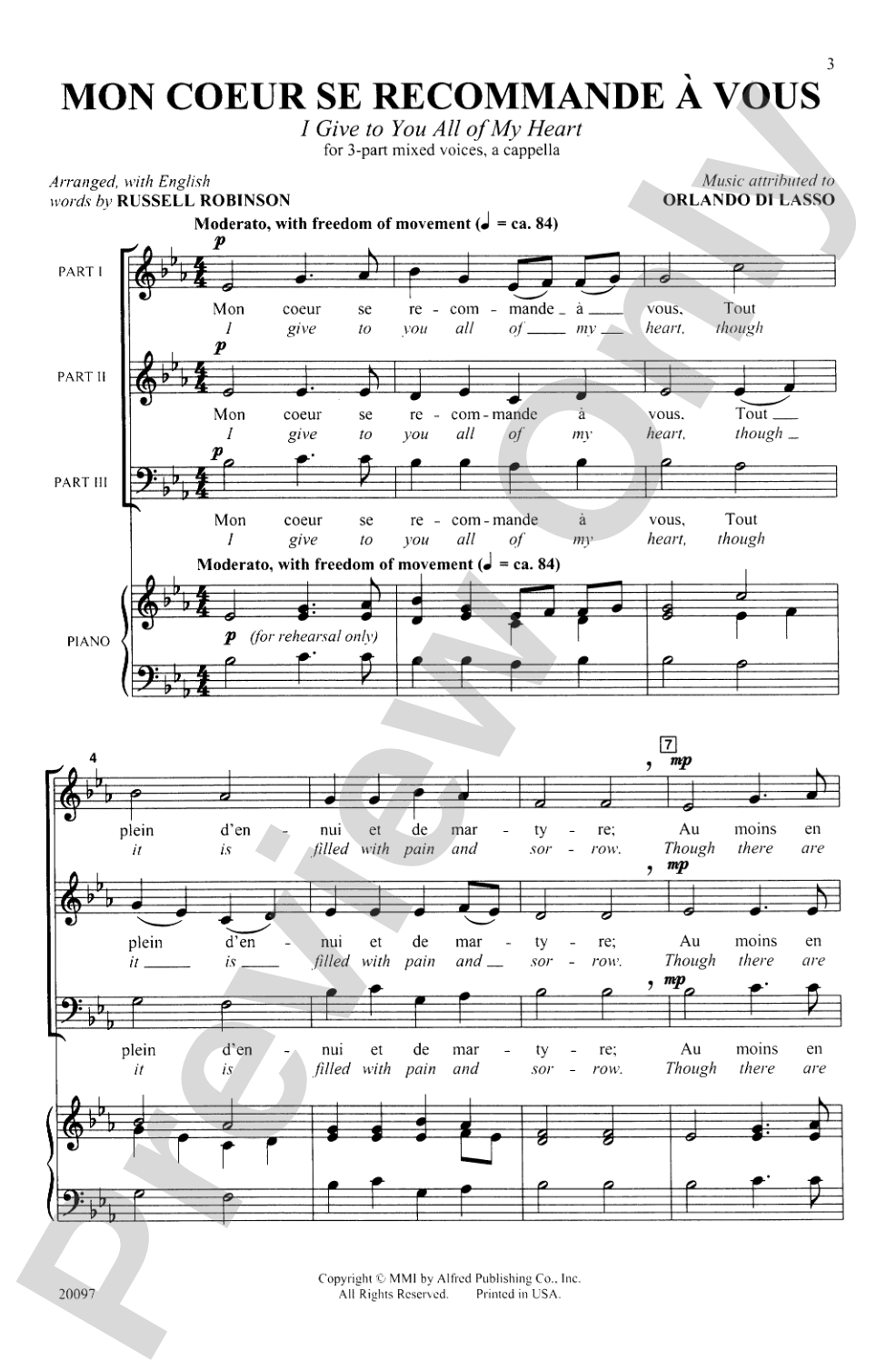
Although this work is sometimes referred to as a madrigal, it's really in the French chanson style: a polyphonic song popular in the fifteenth and sixteenth centuries. The subject, typical of a chanson, is love; the English translation is I Give to You All of My Heart. Included are a performance notes and a pronunciation guide for the eight lines of French...or use the sensitive English text provided by Dr. Robinson. Well edited for young and developing 3-part choirs.


Mon Coeur Se Recommande à Vous (I Give to You All of My Heart): 3-Part Mixed, a cappella Choral Octavo isn't in MakeMusic Cloud just yet...but it could be. Let us know you'd like to see it, and you'll help shape what comes next. In the meantime, start a free trial and dive into thousands of interactive titles your students can play along with today.
Request This Title
Tell us you want it.
Start Your Free Trial
Explore everything that's ready to play right now.
Sample Audio
1
Audio File
--:--
0:00
0:00
Sample Video
No sample videos found.
Additional Details
Series:
Alfred Archive Edition: Alfred Choral Designs
Publisher:
Alfred Music
Page Count:
8
SKU:
00-PO-0002876
More about this title
About the Composer: Orlando di Lasso
Orlando di Lasso (c. 1532-1594) was one of the Renaissance's most prolific and versatile composers, equally skilled in sacred and secular music. Born in the Flemish region and trained across Europe, he served at the Bavarian court in Munich for decades and composed thousands of works in every genre of his time, from motets to chansons to madrigals.
Lasso's chansons exemplify the wit, elegance, and emotional directness that made the form beloved across Europe. His ability to set French texts with both sophistication and accessibility made his secular works as essential to Renaissance choirs as his sacred music, and they remain performance staples for developing ensembles today.
Why we love this
This chanson captures everything that makes Renaissance polyphony rewarding for young choirs: a elegant melody, clear harmonic movement, and text that matters. The French language and love subject engage singers emotionally while the three-part writing stays transparent and singable, and Russell L. Robinson's arrangement includes both the original French and a sensitive English translation so you can choose the version that serves your choir best.
What to expect
Lasso's chanson unfolds with courtly grace and genuine warmth. The polyphonic texture allows multiple lines to breathe independently while still creating moments of convergence and harmony; singers experience both the intimacy of their individual line and the beauty of voices blending together.
Who it's for
This octavo works well for developing 3-part mixed choirs, whether in middle school, early high school, or adult community settings. It's straightforward enough that singers can focus on accurate part-singing and diction without struggling with complex harmonies or extended ranges.
How to get the most out of it
- Shape each phrase with gentle dynamic swell rather than dramatic contrast; Renaissance chansons rely on text clarity and melodic line over volume changes.
- Use the pronunciation guide closely during early rehearsals, then have singers internalize the French sound through repeated singing rather than constant reference.
- Balance the lines so that the top voice sings with bright tone but the middle and lower parts remain equally present; Renaissance polyphony dissolves when one part dominates.
How to use it
Program this alongside other Renaissance secular works to create a thematic concert section on love and courtship across centuries. Its modest length and accessibility also make it ideal for festival competitions or as an educational concert piece that showcases your singers' musicianship without demanding showpiece difficulty.
Skills your students will build
- Reading three independent vocal lines in a polyphonic texture
- French language pronunciation and sustained vowel tone
- Balancing ensemble lines while maintaining individual melodic awareness
- Interpreting Renaissance text expression without relying on dynamic extremes