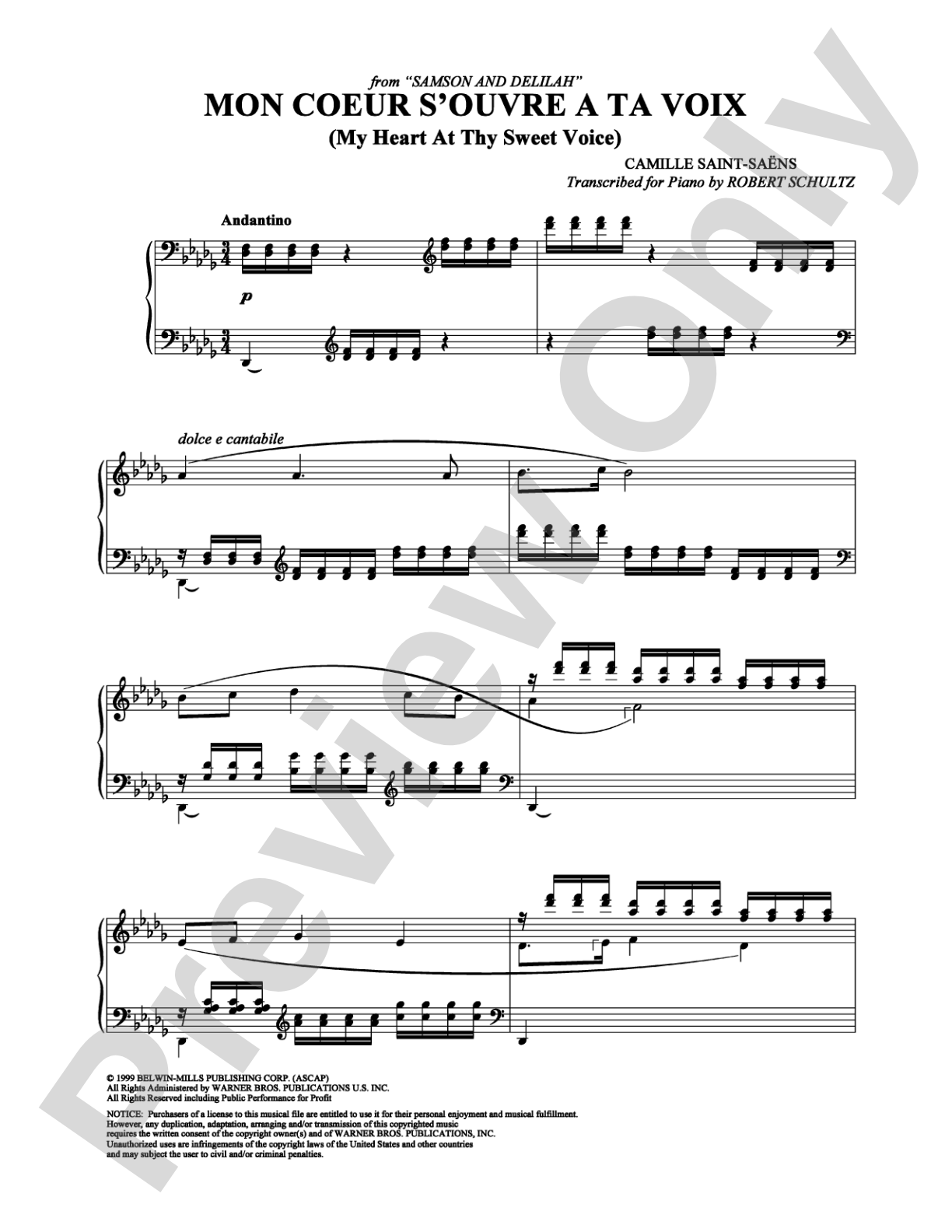
Mon Coeur S'Ouvre a Ta Voix: Piano Digital Sheet Music

Mon Coeur S'Ouvre a Ta Voix: Piano Digital Sheet Music

Camille Saint-Saëns

Item: 00-PS-0001776

Digital Download
$3.99
Description

Mon Coeur S'Ouvre a Ta Voix: Piano Digital Sheet Music isn't in MakeMusic Cloud just yet...but it could be. Let us know you'd like to see it, and you'll help shape what comes next. In the meantime, start a free trial and dive into thousands of interactive titles your students can play along with today.

Sample Audio
No sample audio found.
Sample Video
Additional Details
SKU: 00-PS-0001776

More about this title

About the Creator: Georges Bizet

Georges Bizet (1838, 1875) was a French composer whose gift for melody and dramatic orchestration defined the operatic stage of the nineteenth century. Though he composed symphonies, suites, and chamber works throughout his career, his opera Carmen remains his most enduring legacy and one of the most frequently performed operas worldwide.

Why we love this

This aria arrives as a solo vehicle for pianists who want to explore operatic storytelling without needing an ensemble. The emotional arc from tenderness to passion gives intermediate-advanced players a chance to shape drama through the keyboard alone, making it ideal for recitals where you're building a program around French Romantic repertoire.

What to expect

Sultry and intimate, with undercurrents of passion held just below the surface. The piece unfolds like a confession, moving from whispered tenderness to swelling emotion, wrapping the listener in the lush harmonic language of French Romantic opera.

Who it's for

Pianists at the intermediate-advanced level who are building recital repertoire and want exposure to 19th-century French opera beyond orchestral arrangements. Solo pianists preparing for competitions, auditions, or studio recitals will find this demands both technical control and interpretive maturity.

How to get the most out of it

  • Shape the opening phrases with a singer's legato; imagine Dalila's voice guiding your rubato and phrasing rather than locking to metronomic time.
  • Balance melody and harmony so the left hand supports without overwhelming; the accompaniment serves the vocal line even in its absence.
  • Explore the emotional shift carefully—transition from intimate and sensual in the beginning to more dramatic intensity later by adjusting tempo, dynamics, and pedal use rather than rushing.
  • Record yourself and listen critically to where the narrative feels clear versus where accompaniment drowns out lyricism.

How to use it

Place this as a recital centerpiece or closing piece on a program exploring 19th-century opera transcriptions for solo piano. It pairs naturally with other French operatic keyboard arrangements or with Romantic-era character pieces that share its emotional intensity.

Skills your students will build

  • Legato technique and sustained cantabile playing across longer phrases
  • Pedal control to maintain clarity while creating harmonic wash
  • Interpreting vocal phrasing and rhetoric when the original text is absent
  • Managing emotional arc and dramatic shape within a single-line melody
  • Balance between accompaniment figuration and melodic prominence

You May Also Like