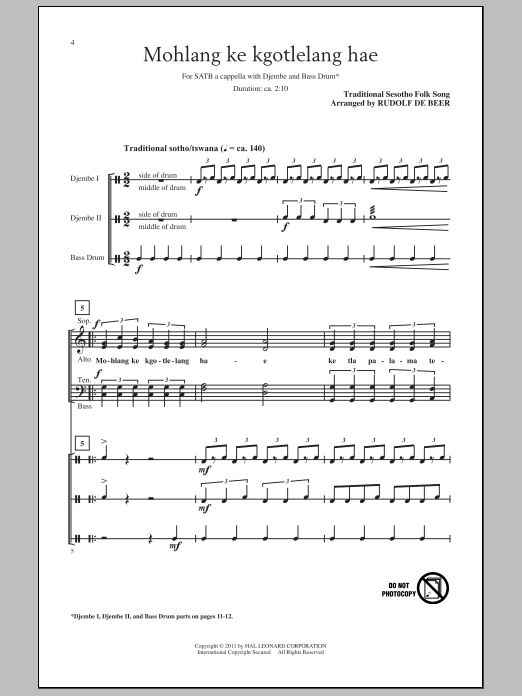
Mohlang Ke Kgotlelang Hae (When I Return Home) Sheet Music Preview

Mohlang Ke Kgotlelang Hae (When I Return Home): SATB Choral Octavo

Arranged by Rudolf de Beer

Item: 35-DS00175481

Digital Download
$2.99
Description

Mohlang Ke Kgotlelang Hae (When I Return Home): SATB Choral Octavo isn't in MakeMusic Cloud just yet...but it could be. Let us know you'd like to see it, and you'll help shape what comes next. In the meantime, start a free trial and dive into thousands of interactive titles your students can play along with today.

Sample Audio
No sample audio found.
Sample Video
Additional Details
Publisher: Hal Leonard
Page Count: 9
SKU: 35-DS00175481

More about this title

Why we love this

De Beer's arrangement brings a South African standard into contemporary choral settings without sacrificing its cultural authenticity. The SATB voicing sits comfortably for mixed ensembles while preserving the melodic character that makes this song resonate across communities.

What to expect

There is an intimate quality to this arrangement, as if the choir is gathered around sharing a memory. The harmonic language is accessible yet emotionally substantial, creating a sense of arrival and presence.

Who it's for

Mixed voice choirs seeking repertoire that expands beyond European art song traditions. This works for directors building diversity into contests, concert programs, or both.

How to get the most out of it

  • Let the text drive your phrasing. Sotho language has its own rhythmic shape; honor the natural word stress rather than imposing standard English speech patterns.
  • Balance the harmonic layers so the tune remains prominent. Many arrangements obscure the melody when all four voices sustain equally.
  • Record a rehearsal run and listen back for ensemble attacks on unfamiliar vowels. Uniform articulation on Sotho text requires intentional work.
  • Consider staging this piece with lighting or minimal movement that reflects its emotional journey. The title anchors the song in homecoming and belonging.

How to use it

Pair this with other African choral works to create a thematic set, or program it as a standalone piece that shifts the emotional tenor of a concert. It programs well in the second half of a concert when audiences are most engaged.

Skills your students will build

  • Singing non-English text with authentic phrasing and vowel placement
  • Balancing individual voice parts to maintain melodic prominence in four-part harmony
  • Building cultural awareness through performance of repertoire outside Western classical tradition
  • Listening for harmonic blend across unfamiliar tonal language

You May Also Like