
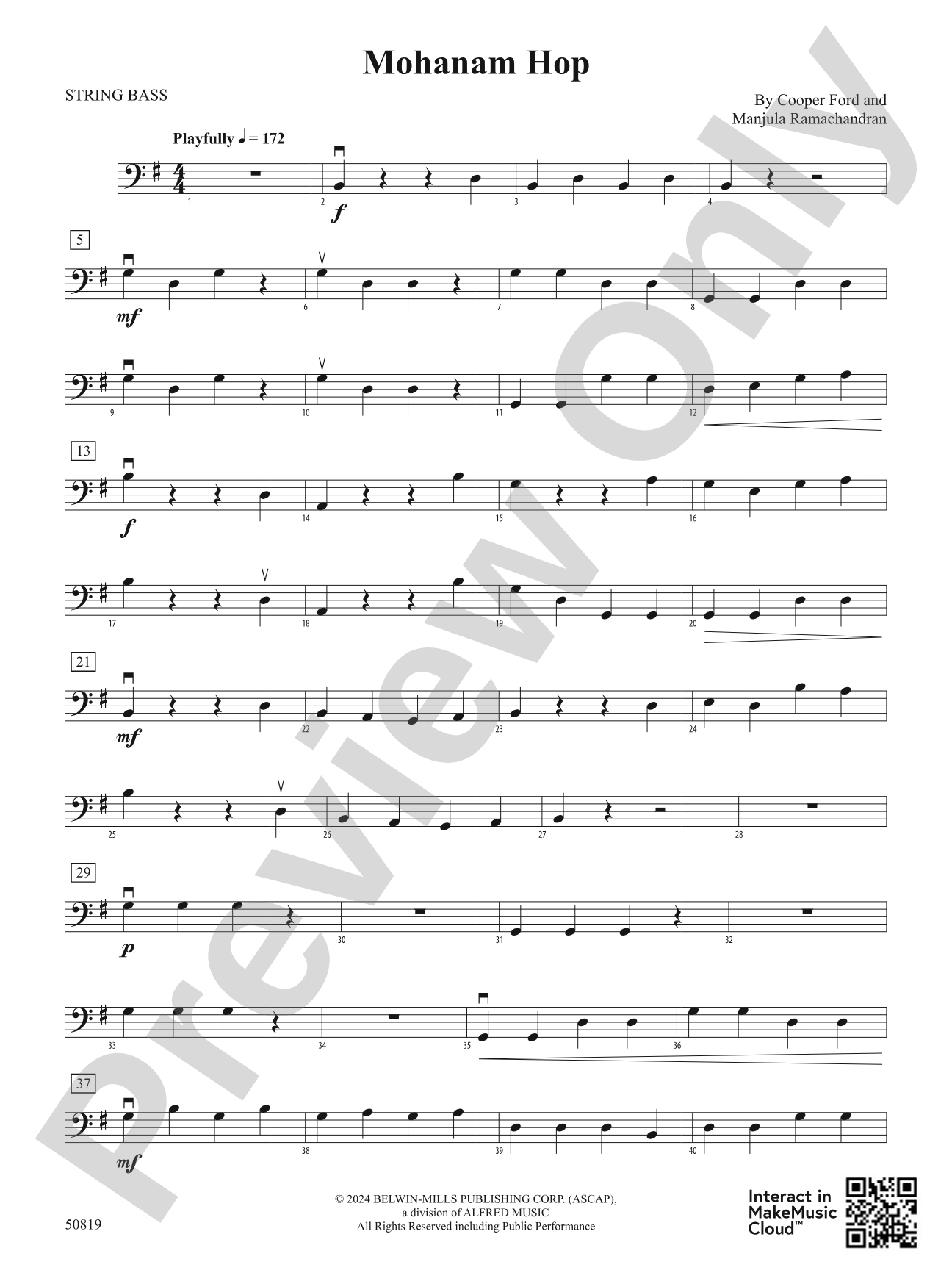

Mohanam Hop: String Bass
By Cooper Ford and Manjula Ramachandran
Grade: 1.5
Item: 00-PC-0019186_SB
$3.00
Pickup currently not available
Description
Mohanam Hop, by Cooper Ford and Manjula Ramachandran, is a light and fun Indian piece for young orchestras, based on Raaga Mohanam, which uses the pitches of a G pentatonic scale. The quarter-note rhythms may seem simple as the melody passes between sections, but players must be on their counting game! Parts for 2nd violin and viola are doubled, as well as cello and bass. Optional percussion is also included. This delightful piece will be enjoyable to play and open the door to the wonderful world of South Indian (Carnatic) classical music. (2:00)


Don't just read it, hear it, play along with it, and watch your students grow with it. In MakeMusic Cloud, Mohanam Hop: String Bass comes alive with professional accompaniment, adjustable tempo, and built-in practice tools that turn solo practice into real progress.
Open in the Player
Jump straight in and assign it today.
Start Your Free Trial
Open this title and explore the full library in minutes.
Sample Audio
1
Audio File
--:--
0:00
0:00
Sample Video
Additional Details
Series:
Belwin Beginning String Orchestra
Publisher:
Alfred Music
SKU:
00-PC-0019186_SB
More about this title
About the Composer: Cooper Ford

Cooper Ford grew up in Chatham, New Jersey, where school music programs introduced him to both violin and trumpet. His teachers recognized his compositional interests early on and supported him in pursuing that path alongside performance. He earned his Bachelor of Music in Music Education from The College of New Jersey and went on to complete a Master of Music in Music Education from the University of Florida. Ford currently serves as Orchestra Director at North Brunswick Township High School in New Jersey, where he also teaches Music Production. His experience extends to the conducting staff of the New Jersey Youth Symphony, where he worked extensively with middle school orchestras. He remains active as a guest conductor and clinician, and holds membership in both the American String Teachers Association and the National Association for Music Education.
Manjula Ramachandran brings expertise in South Indian classical music to this collaboration, grounding the piece in authentic Carnatic traditions while making them accessible to young string players.
Why we love this
This piece succeeds because it introduces genuine Indian classical music concepts without simplification or exoticization. Young players encounter Raaga Mohanam and its pentatonic palette organically, learning melodic content that actually matters in Carnatic tradition rather than a watered-down approximation. The writing respects both the raga system and the developmental needs of early orchestras, creating something musically honest that still fits comfortably at grade 1.5.
What to expect
Bright and animated, with a quality that feels both celebratory and exploratory. The G pentatonic scale creates a clarity that young players respond to instantly, while the raga foundation gives the melody an unmistakable character that sets it apart from typical beginner repertoire. Two minutes of genuine musical enjoyment, not a check-box exercise.
Who it's for
Grade 1.5 string orchestras looking to expand beyond European classical traditions and give young players meaningful exposure to world music repertoire. Conductors in schools with Indian heritage students, or those seeking to build a more diverse concert season, will find this especially valuable. It works equally well for orchestras with no prior multicultural experience, as the accessible writing and fun character make it engaging rather than intimidating.
How to get the most out of it
- Establish a steady pulse before rehearsing the melody; the quarter-note motion that seems simple becomes tricky when the raga's characteristic bends and ornamentations emerge in ensemble. Counting accuracy matters more here than in typical tonal repertoire because players need to track when the raga's specific pitch collection arrives in their section.
- Balance the doubled parts (2nd violin, viola, cello, bass) so the lower sections support but don't overwhelm the melodic voice. Doubled parts are often assigned to newer readers, so be intentional about blend rather than assuming the arrangement handles it automatically.
- If you include the optional percussion, rehearse it separately first. Percussion parts in multicultural pieces often follow rhythmic patterns unfamiliar to young players accustomed to standard time signatures and groove frameworks.
How to use it
Program this early in a concert focused on world music or cultural studies initiatives; its brevity and high energy make it an effective opener that energizes both audience and orchestra. It also serves well as a festival or contest piece, where the distinctive sound and solid grade 1.5 technique demonstrate both musical sophistication and ensemble maturity. Consider pairing it with other world music selections to build a thematic program, or use it to introduce students to multicultural concert programming.
Skills your students will build
- Reading and sustaining pitches from the G pentatonic scale (la-ti-do-re-mi in the context of Raaga Mohanam)
- Tracking melodic passages as they shift between first and second violins, viola, and lower strings
- Ensemble counting accuracy when quarter-note rhythms dominate and precision matters more than improvisation
- Understanding raga as a melodic system distinct from Western major/minor tonality
- Balance and blend in doubled string parts