
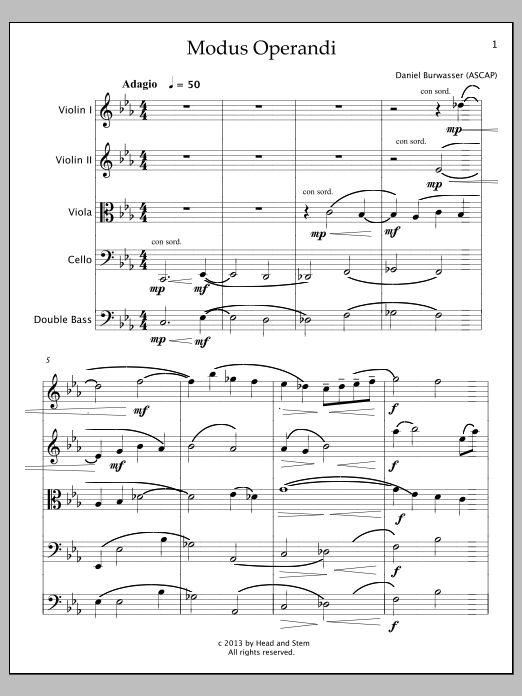

Modus Operandi: String Orchestra Conductor Score & Parts
Arranged by Daniel Burwasser
Item: 35-PK00288287
$7.40
Pickup currently not available
Buy Extra Parts (Digital PDF Download)
| Product | Price | Quantity |
|---|---|---|
| Modus Operandi - Full Score | $4.40 | |
| Modus Operandi - Violin | $2.60 | |
| Modus Operandi - Violin | $2.60 | |
| Modus Operandi - Viola | $2.60 | |
| Modus Operandi - Violoncello | $2.60 | |
| Modus Operandi - Contrabass | $2.60 |
Parts Added to Cart!
Description
One movement work for String orchestra Duration: 05:00


Modus Operandi: String Orchestra Conductor Score & Parts isn't in MakeMusic Cloud just yet...but it could be. Let us know you'd like to see it, and you'll help shape what comes next. In the meantime, start a free trial and dive into thousands of interactive titles your students can play along with today.
Request This Title
Tell us you want it.
Start Your Free Trial
Explore everything that's ready to play right now.
Sample Audio
No sample audio found.
Sample Video
No sample videos found.
Additional Details
Publisher:
Hal Leonard
SKU:
35-PK00288287
More about this title
Why we love this
Burwasser crafts a single-movement work that respects string writing fundamentals while delivering musical substance. Five minutes of focused material means no padding, no filler; every section earns its place in the score.
What to expect
The work unfolds with classical restraint and architecture. Structured around coherent thematic ideas, it engages players through traditional melodic and harmonic language without relying on virtuosity or experimental techniques.
Who it's for
String orchestras and chamber string ensembles looking for substantial single-movement repertoire that doesn't require massive forces. This works well for programs building toward larger works or standing alone as a focused concert offering.
How to get the most out of it
- Balance the texture between sections by adjusting bow pressure rather than overall dynamics. A single melody line shouldn't disappear when supported by accompanying voices.
- Mark all bowings clearly in the parts before rehearsal. String players will interpret articulation based on bow guidance, not just note heads.
- Establish the harmonic rhythm early. Have players identify chord changes and listen through texture to the underlying progression.
How to use it
Place this as an anchor piece in a concert featuring contrasting string works. Its contained duration and clear formal design pair well with longer ensemble pieces or provide a sturdy opening that establishes ensemble tone before moving to lighter or more contemporary selections.
Skills your students will build
- Intonation control in sustained harmonic passages
- Phrasing across multiple phrase units within a single movement
- Part independence and awareness of accompanimental versus melodic roles
- Bow control for both sustained tones and articulated figures