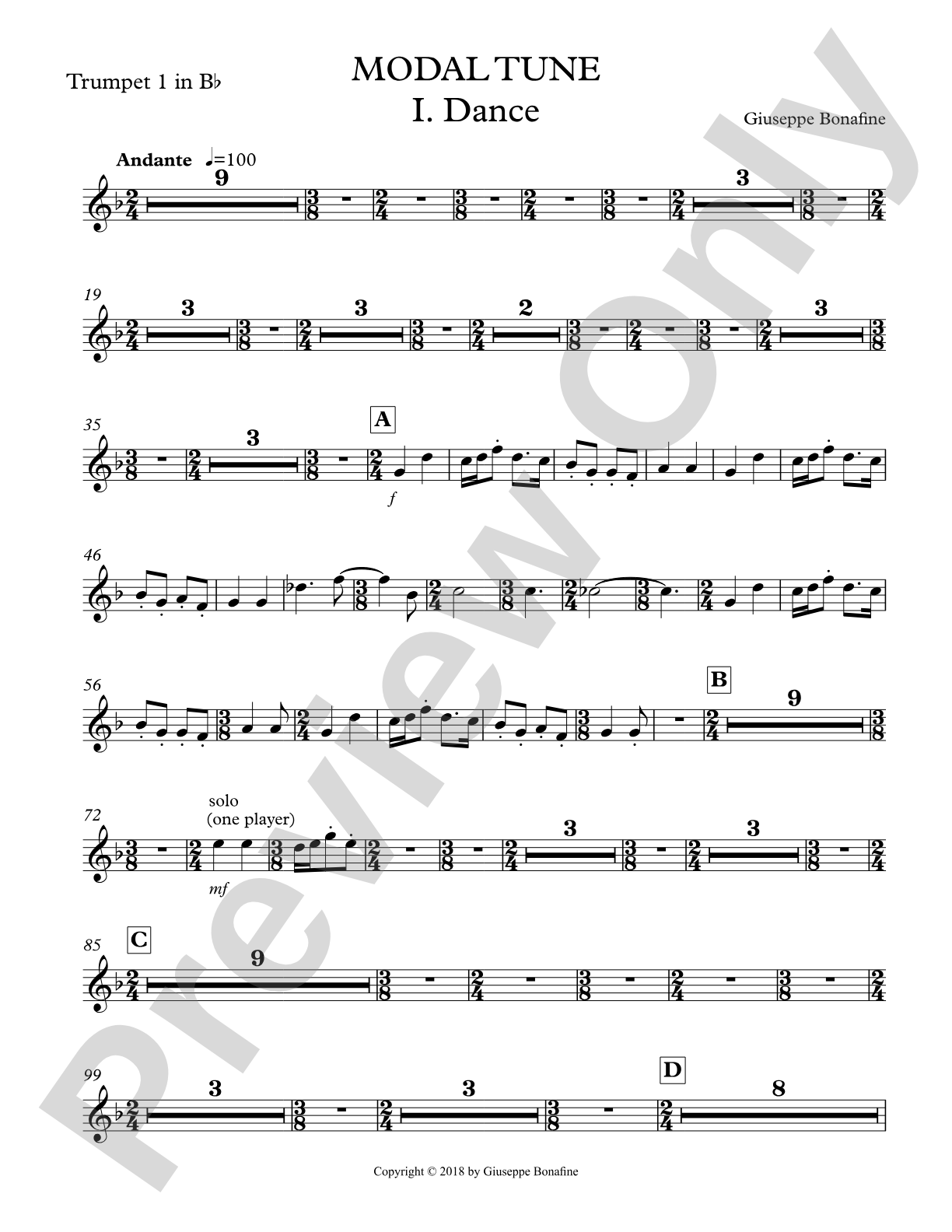
Modal Tune: 1st B-flat Trumpet Sheet Music Preview

Modal Tune: 1st B-flat Trumpet

By Giuseppe Bonafine

Grade: 6 (Difficult)

Item: 00-PC-0018382_T1

Digital Download
$4.00
Description
Echoes of ancient music are evident throughout Modal Tune. Renaissance modal scales and counterpoint, mixed with modern chords and personal sonorities, are at the core of the composition, creating a brilliant, but at the same time, serious style. The constant highlighting of the three main sections, (woodwinds, brass, and percussion), the use of irregular rhythms, and the moving 2nd movement make this a truly enjoyable piece for audiences, players, and conductors alike.

Don't just read it, hear it, play along with it, and watch your students grow with it. In MakeMusic Cloud, Modal Tune: 1st B-flat Trumpet comes alive with professional accompaniment, adjustable tempo, and built-in practice tools that turn solo practice into real progress.

Sample Audio
0:00
0:00
Sample Video
Additional Details
Series: Alfred Digital Concert Band
SKU: 00-PC-0018382_T1

More about this title

Why we love this

Bonafine writes for band with genuine sophistication, layering Renaissance modal thinking against contemporary harmonic language in a way that challenges without overwhelming. The piece genuinely interests players because each section gets genuine musical material, and it gives conductors real interpretive choices around color and balance rather than relying on volume or speed.

What to expect

Modal Tune inhabits a strange, productive space between ancient and present. It sounds both grounded and unsettled, as if Renaissance polyphony is being viewed through a modern prism. The serious tone contrasts deliberately with moments of brilliance, creating a composition that feels substantive rather than decorative.

Who it's for

Conductors leading Grade 6 bands with secure fundamentals in four-part writing and who want their students to hear serious compositional thinking. This works for bands comfortable with both modal harmony and contemporary extended techniques, and for ensembles ready to engage with irregular meters as expressive tools.

How to get the most out of it

  • Balance the dialogue between woodwinds, brass, and percussion intentionally. These three sections function as independent musical voices, so sectional rehearsals that isolate each choir's contrapuntal line will make ensemble clarity happen faster than playing through.
  • Prepare the irregular rhythms by conducting them in context first. Have the band tap the rhythmic patterns against a steady pulse before adding pitches; the modern rhythmic language sits better when players understand it as a deliberate contrast to the modal sections.
  • Shape the second movement's forward motion by thinking of it as a single phrase rather than a sequence of measures. The 'moving' quality Bonafine writes comes from continuity, not from rushing.

How to use it

Program this as a centerpiece for a concert exploring musical voice and form. It pairs naturally with twentieth-century works that also blend historical language with contemporary syntax, or stand it alone as an intermission statement that shifts the room's attention. The difficulty and conceptual weight make it suitable for a spring concert where rehearsal time has built real ensemble confidence.

Skills your students will build

  • Reading and performing modal scales and modal counterpoint
  • Balancing independent sectional voice-leading in ensemble context
  • Executing irregular rhythms and mixed meters with precision
  • Interpreting Renaissance compositional techniques within modern harmonic language
  • Listening across sectional lines to maintain transparency and blend

You May Also Like