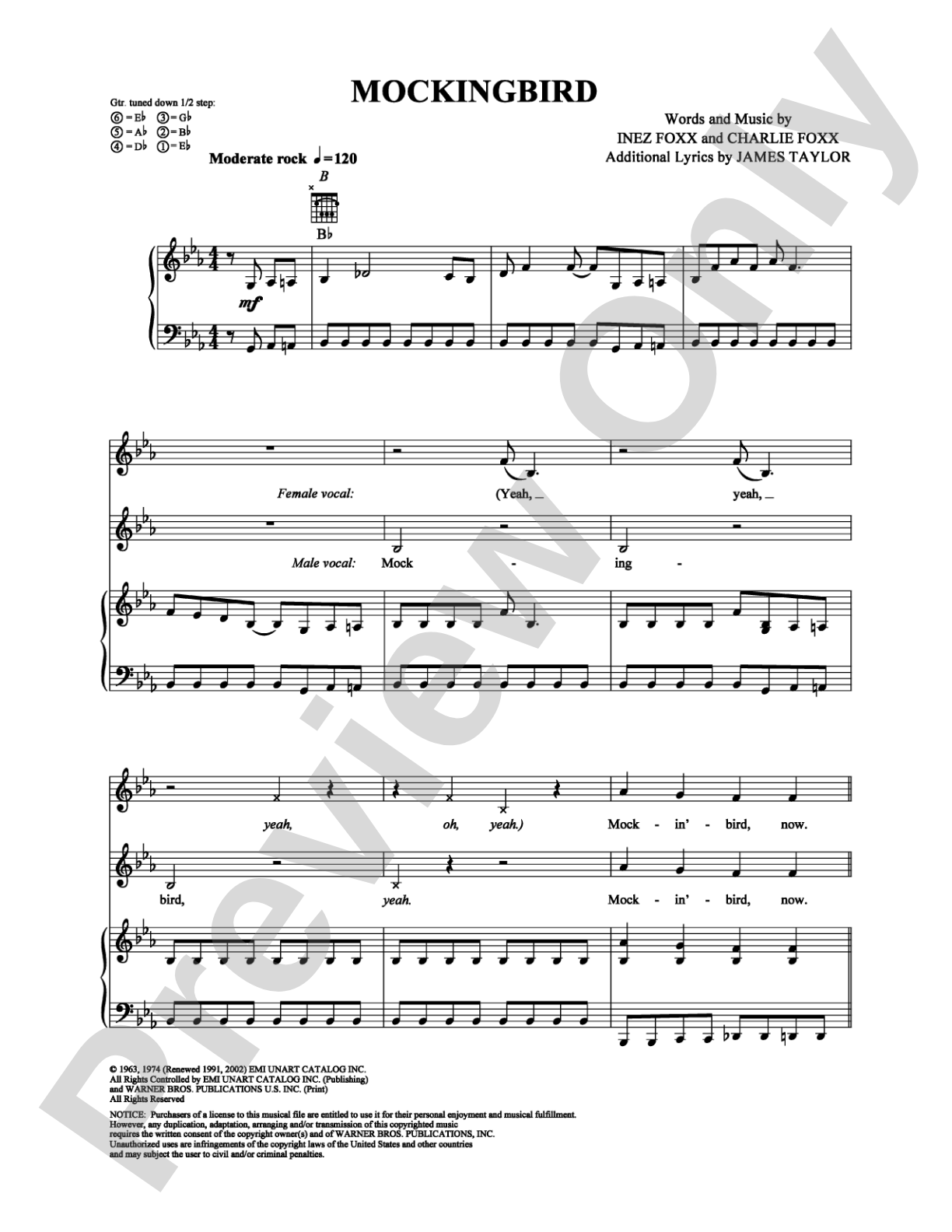
Mockingbird: Piano/Vocal/Chords Digital Sheet Music

Mockingbird: Piano/Vocal/Chords Digital Sheet Music

James Taylor, Carly Simon, Inez Foxx, Charlie Foxx

Item: 00-PS-0000644

Digital Download
$3.99
Description

Mockingbird: Piano/Vocal/Chords Digital Sheet Music isn't in MakeMusic Cloud just yet...but it could be. Let us know you'd like to see it, and you'll help shape what comes next. In the meantime, start a free trial and dive into thousands of interactive titles your students can play along with today.

Sample Audio
No sample audio found.
Sample Video
Additional Details
SKU: 00-PS-0000644

More about this title

About the Artist: James Taylor

James Taylor emerged as a defining voice of 1970s singer-songwriter pop rock, bringing introspective lyricism and fingerstyle guitar work to mainstream audiences. His catalog spans five decades of recording and performing, establishing him as a foundational figure in contemporary American popular music and a model for musicians who prioritize emotional authenticity in their craft.

Why we love this

This duet captures the interplay between two distinctive vocal personalities and showcases the piano-vocal genre at its most accessible. The song's conversational melody and straightforward harmonic movement make it ideal for students exploring popular song interpretation without technical barriers getting in the way of musicality.

What to expect

Warm, conversational, and intimate. The melody unfolds with the ease of two friends sharing a story, supported by piano voicings that feel both grounded and gently colorful. There's a reflective quality that invites genuine emotional connection rather than technical showmanship.

Who it's for

Singers working on contemporary repertoire and pianists preparing accompaniments for vocal students or recitals will find this duet accessible and musically rewarding. The straightforward piano writing makes it suitable for intermediate-level pianists accompanying vocalists at any age.

How to get the most out of it

  • Balance the vocal melody against the piano voicings; the accompaniment should support rather than overshadow the singers' dialogue.
  • Pay attention to the rhythmic phrasing between the two voices. The back-and-forth exchange is conversational, so communicate those hand-offs cleanly.
  • Use dynamics to shape the narrative arc. Lean into softer passages to create intimacy before opening up in moments that call for more presence.
  • Keep the tempo steady and natural; avoid rushing through the more reflective sections.

How to use it

Program this as a stand-alone duet on a vocal recital or mixed concert, or pair it with other contemporary pop or art song repertoire to balance classical selections. It works particularly well as a teaching tool for singers learning to accompany themselves at the piano or for demonstrating how popular song structure differs from formal art song.

Skills your students will build

  • Singing conversational melody lines with natural phrasing and emotional inflection
  • Reading and playing lead-sheet notation (chords and melody)
  • Accompanying vocalists with sensitive piano voicings
  • Interpreting popular song style and groove on acoustic piano
  • Collaborative listening and ensemble timing between vocalist and pianist

You May Also Like