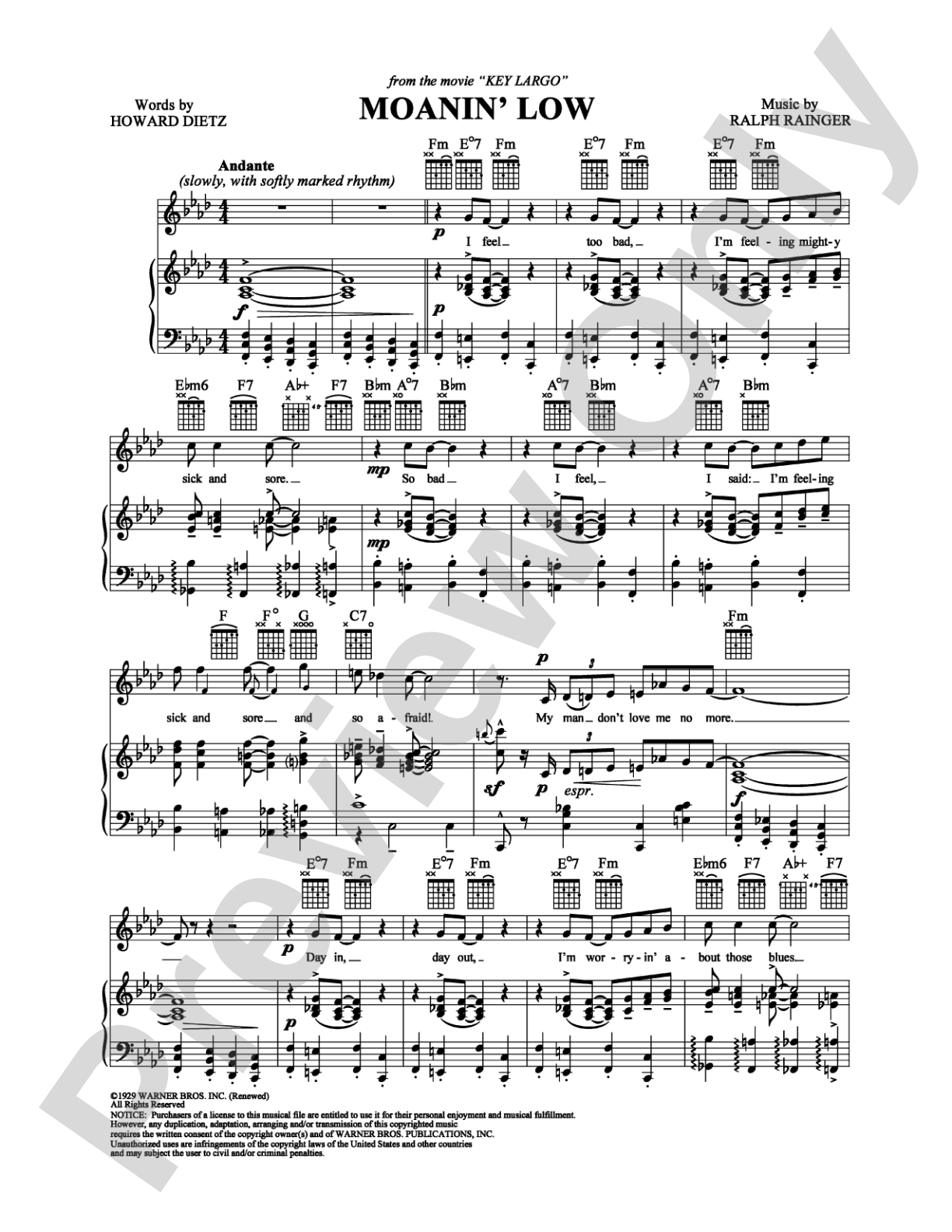
Moanin' Low: Piano/Vocal/Chords Digital Sheet Music

Moanin' Low: Piano/Vocal/Chords Digital Sheet Music

Harry James, Billie Holiday, Teddy Wilson, Libby Holman, Ralph Rainger

Item: 00-PS-0003944

Digital Download
$3.99
Description

Moanin' Low: Piano/Vocal/Chords Digital Sheet Music isn't in MakeMusic Cloud just yet...but it could be. Let us know you'd like to see it, and you'll help shape what comes next. In the meantime, start a free trial and dive into thousands of interactive titles your students can play along with today.

Sample Audio
No sample audio found.
Sample Video
Additional Details
SKU: 00-PS-0003944

More about this title

About the Artist: Billie Holiday

Billie Holiday (1915-1944) remains one of jazz's most influential vocalists, known for her ability to bend melody and reshape phrasing in ways that transformed how singers approached the American Songbook. Her interpretive depth and emotional directness influenced generations of jazz singers and continue to serve as a masterclass in vocal expression and storytelling through music.

For music educators, Holiday's recordings offer invaluable examples of how a vocalist can collaborate with instrumental players, trade phrases, and use space and silence as compositional elements. Her work demonstrates that technical perfection matters far less than authenticity and connection to the lyrical and emotional content of a song.

Why we love this

Moanin' Low sits in that perfect intersection of jazz standard and blues sensibility, giving vocalists a song that demands both technical control and emotional vulnerability. The harmonic movement and lyrical content reward singers who understand how to inhabit a character and use dynamics and phrasing to build tension and release, making it an excellent teaching tool for interpretation beyond note-reading.

What to expect

Moanin' Low carries a languid, blues-inflected elegance. The song unfolds with the patient pacing of late-night jazz, where restraint and understatement create more impact than volume or speed. It's the sound of someone turning a difficult emotion over in their hands, examining it from multiple angles without ever quite looking away.

Who it's for

Vocalists with some jazz experience and chord-reading ability who want to expand their jazz standard repertoire will find this arrangement accessible and musically rewarding. Pianists accompanying jazz singers benefit from the chord symbols and the opportunity to develop comping skills within a well-known harmonic framework.

How to get the most out of it

  • Study the recorded versions by Holiday, James, Wilson, and Holman to hear how different artists approach the same changes; notice how each prioritizes different melodic or rhythmic elements based on their voice type and sensibility.
  • Treat the chord symbols as a conversation starter, not a cage. Leave space for the piano to respond, and allow your phrasing to sit behind or push ahead of the beat in ways that feel organic to your reading of the lyric.
  • Pay close attention to vowel clarity in the lower register, where the melody sits. A muddy or swallowed tone will obscure the lyric and rob the song of its conversational intimacy.
  • Work the song in sections, focusing on one phrase at a time before stitching them together. This approach prevents the temptation to rush through the material and allows interpretive choices to emerge organically.

How to use it

This works beautifully on a jazz or standards concert, especially in a set that showcases different eras and styles of the Great American Songbook. Pair it with other blues-tinged ballads to create a cohesive first or closing set, or use it as a solo feature for a vocalist looking to build interpretation skills in a teaching or recital context.

Skills your students will build

  • Reading chord symbols and navigating jazz changes
  • Phrasing and rhythmic flexibility within a jazz context
  • Vocal control and vowel production in the lower register
  • Collaboration between vocalist and accompanist through active listening
  • Interpreting lyrics and building emotional narrative through selective emphasis

You May Also Like