Misty Mountain Hop: Guitar TAB Digital Sheet Music

Misty Mountain Hop: Guitar TAB Digital Sheet Music

Led Zeppelin, Jimmy Page, Robert Plant, John Paul Jones

Item: 00-PS-0000353

Digital Download
$2.99
Description

Misty Mountain Hop: Guitar TAB Digital Sheet Music isn't in MakeMusic Cloud just yet...but it could be. Let us know you'd like to see it, and you'll help shape what comes next. In the meantime, start a free trial and dive into thousands of interactive titles your students can play along with today.

Sample Audio
No sample audio found.
Sample Video
Additional Details
SKU: 00-PS-0000353

More about this title

About the Artist: Led Zeppelin

Led Zeppelin stands as one of rock music's most influential and commercially successful bands, fundamentally shaping heavy rock and metal from their formation in 1968 through their dissolution in 1980. Their innovative approach to arrangement, layering of acoustic and electric textures, and incorporation of blues, folk, and world music traditions created a blueprint that countless metal and rock musicians have studied and emulated for decades.

Their catalog remains essential listening in guitar education, particularly for students exploring the intersection of blues-based playing, alternate tuning techniques, and dynamic song construction. The band's technical demands and harmonic sophistication continue to challenge and inspire guitarists across all levels.

Why we love this

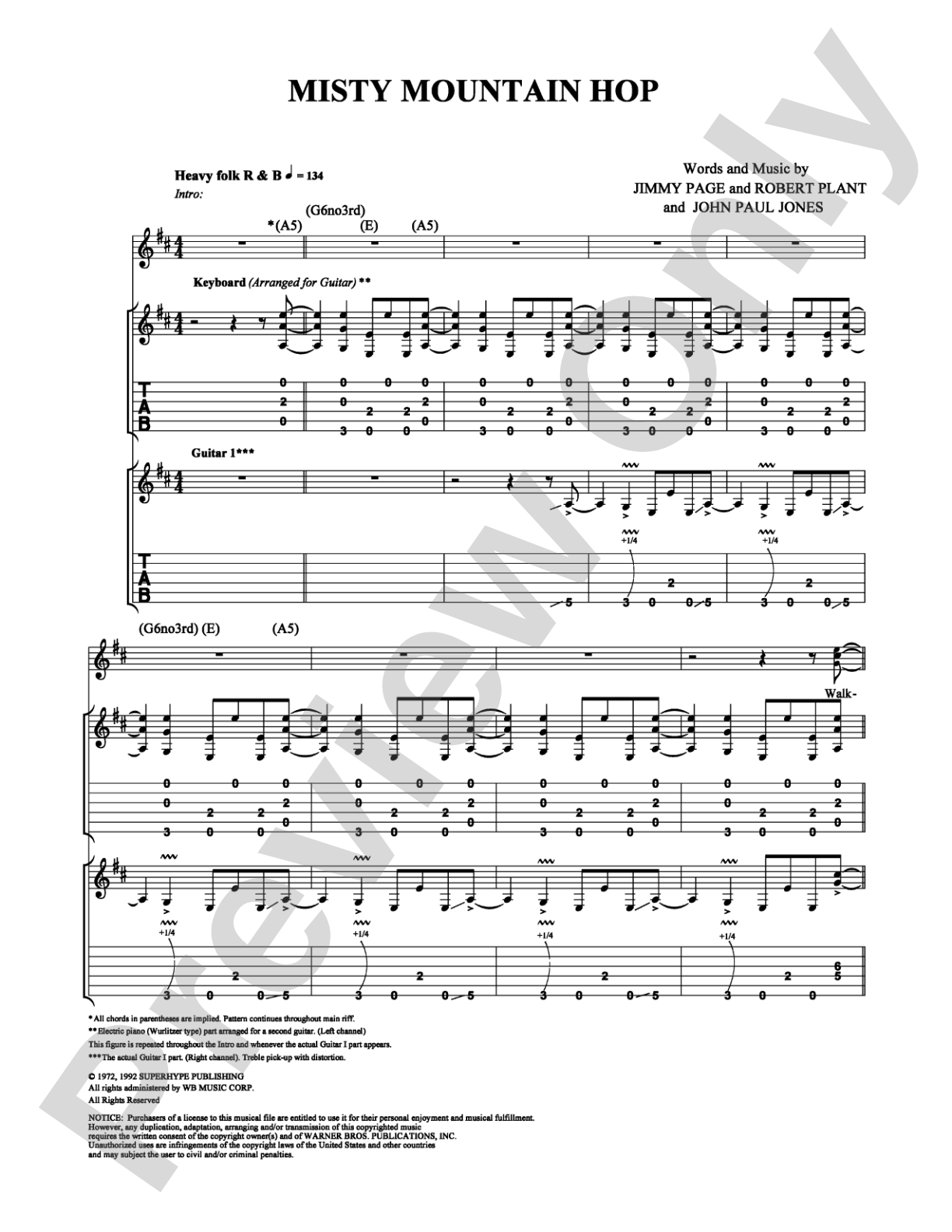
This song showcases the band's signature interplay between intricate fingerpicking patterns and driving rhythmic sections, giving guitar students a chance to work through both delicate and powerful textures in a single piece. The TAB format makes the specific fingering and alternate tuning accessible without requiring deep music theory knowledge, and the iconic riff has remained a benchmark for understanding how to craft memorable, technically engaging rock guitar lines.

What to expect

The piece balances hypnotic, intricate fingerpicking with moments of visceral power, shifting between thoughtful and driving energy. When executed well, the main riff feels both delicate and commanding, drawing listeners in through its precision while building toward the explosive sections that follow.

Who it's for

This TAB is ideal for intermediate to advanced guitarists who already read standard notation comfortably and want to expand their repertoire with classic rock material. It also serves students exploring the roots of metal guitar technique and those interested in understanding how blues-based phrasing functions within a rock song structure.

How to get the most out of it

  • Work through the main riff slowly using the TAB as a guide for finger placement, then gradually increase tempo once the muscle memory solidifies. The accuracy of the timing matters more than rushing to full speed.
  • Pay close attention to any alternate tuning notation in the TAB; verify your tuning before beginning, as a single string out of pitch will throw off the entire harmonic character of the piece.
  • Separate your practice into discrete sections (verse riff, chorus progression, bridge) rather than running through the full song repeatedly. This focused approach accelerates learning and prevents fatigue-related errors.
  • Listen to the original recording alongside your practice sessions to internalize the dynamics, phrasing, and rhythmic nuances that sheet music alone cannot fully convey.

How to use it

Program this for a guitar ensemble or solo showcase focused on classic rock and metal repertoire, placing it alongside other influential rock-era compositions to trace the evolution of guitar technique. It works particularly well in a unit exploring iconic riffs and how skilled arrangement elevates a song from popular hit to educational benchmark.

Skills your students will build

  • Executing complex fingerpicking patterns at tempo
  • Reading and applying alternate tuning information from TAB
  • Transitioning smoothly between fingerpicking and strummed sections
  • Understanding rhythmic syncopation in rock contexts
  • Building dynamic range and articulation control

You May Also Like