
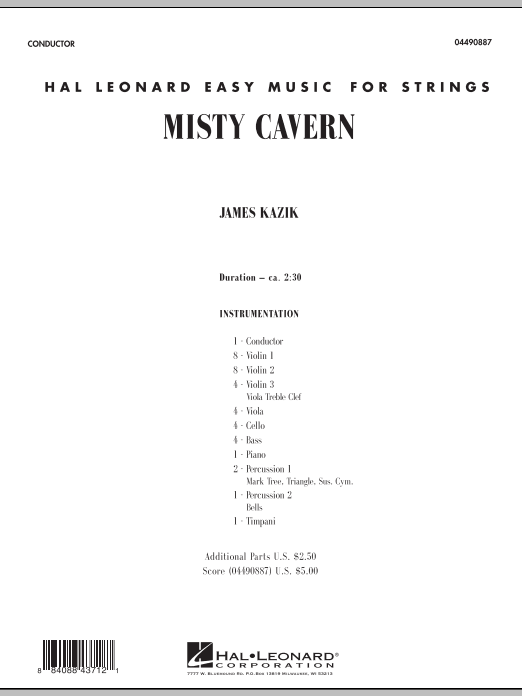

Misty Cavern: String Orchestra Conductor Score & Parts
By Jim Kazik
Grade: 2
Item: 35-PK00134875
$40.00
Pickup currently not available
Buy Extra Parts (Digital PDF Download)
| Product | Price | Quantity |
|---|---|---|
| Misty Cavern - Full Score | $6.00 | |
| Misty Cavern - Violin 1 | $7.00 | |
| Misty Cavern - Violin 2 | $7.00 | |
| Misty Cavern - Violin 3 (Viola Treble Clef) | $7.00 | |
| Misty Cavern - Viola | $7.00 | |
| Misty Cavern - Cello | $7.00 | |
| Misty Cavern - Bass | $7.00 | |
| Misty Cavern - Piano | $7.00 | |
| Misty Cavern - Percussion 1 | $7.00 | |
| Misty Cavern - Percussion 2 | $7.00 | |
| Misty Cavern - Timpani | $7.00 |
Parts Added to Cart!
Description
Composer Jim Kazik brings us this solid Grade 2 overture and programmatic piece that gives interesting melodic parts to all sections, including bass. Set in the comfortable key of E minor with carefully placed eighth-note figures, the musical sound is full with approachable contemporary harmonies. An ideal full ensemble teaching piece. Dur: 2:30


Misty Cavern: String Orchestra Conductor Score & Parts isn't in MakeMusic Cloud just yet...but it could be. Let us know you'd like to see it, and you'll help shape what comes next. In the meantime, start a free trial and dive into thousands of interactive titles your students can play along with today.
Request This Title
Tell us you want it.
Start Your Free Trial
Explore everything that's ready to play right now.
Sample Audio
No sample audio found.
Sample Video
No sample videos found.
Additional Details
Publisher:
Hal Leonard
SKU:
35-PK00134875
More about this title
Why we love this
Kazik writes with genuine respect for developing orchestras, refusing the temptation to dump melody onto first violins while everyone else marks time. Every section gets material that matters, which means your bass players won't tune out and your second violins will actually care about their part. The programmatic framing gives rehearsals narrative shape without veering into sentimentality.
What to expect
There's an atmospheric quality here that suggests exploration and discovery without becoming overly dramatic. The cavern imagery creates space for genuine musical storytelling as harmonic colors shift and each section takes turns with the narrative, building a landscape that feels both contemplative and engaging.
Who it's for
String orchestras working solidly at Grade 2 who need repertoire that distributes musical responsibility fairly and doesn't exhaust musicians with sitting idle. Works equally well for a full high school orchestra needing an ensemble piece or an intermediate youth orchestra building confidence with contemporary writing.
How to get the most out of it
- Balance the eighth-note figures across your string sections so they create texture rather than clutter. Light bow contact preserves clarity even when multiple parts are moving.
- Let the bass line breathe as a melodic voice, not just harmonic support. Bass players who hear themselves as storytellers will elevate the whole sound.
- The E minor tonality invites a slightly cooler, more introspective tone from all sections. Avoid the urge to brighten it up with excessive vibrato on sustained notes.
- Anchor your tempo around the natural breath length of the main melodic phrases rather than racing through the eighth-note passages.
How to use it
This functions beautifully as an overture or concert opener, setting a distinctive mood before moving into lighter fare. Its two-and-a-half-minute length makes it an ideal partner piece when you're building a concert around longer works, and the programmatic anchor gives audiences immediate entry into your concert's theme.
Skills your students will build
- Reading and executing consistent rhythmic figures across multiple string parts simultaneously
- Balancing transparency and blend when doubling melodic content in adjacent registers
- Understanding harmonic function within contemporary (non-traditional) key contexts
- Sustaining tone quality during longer passages with minimal harmonic movement
- Listening for melodic continuity when the lead passes between sections