
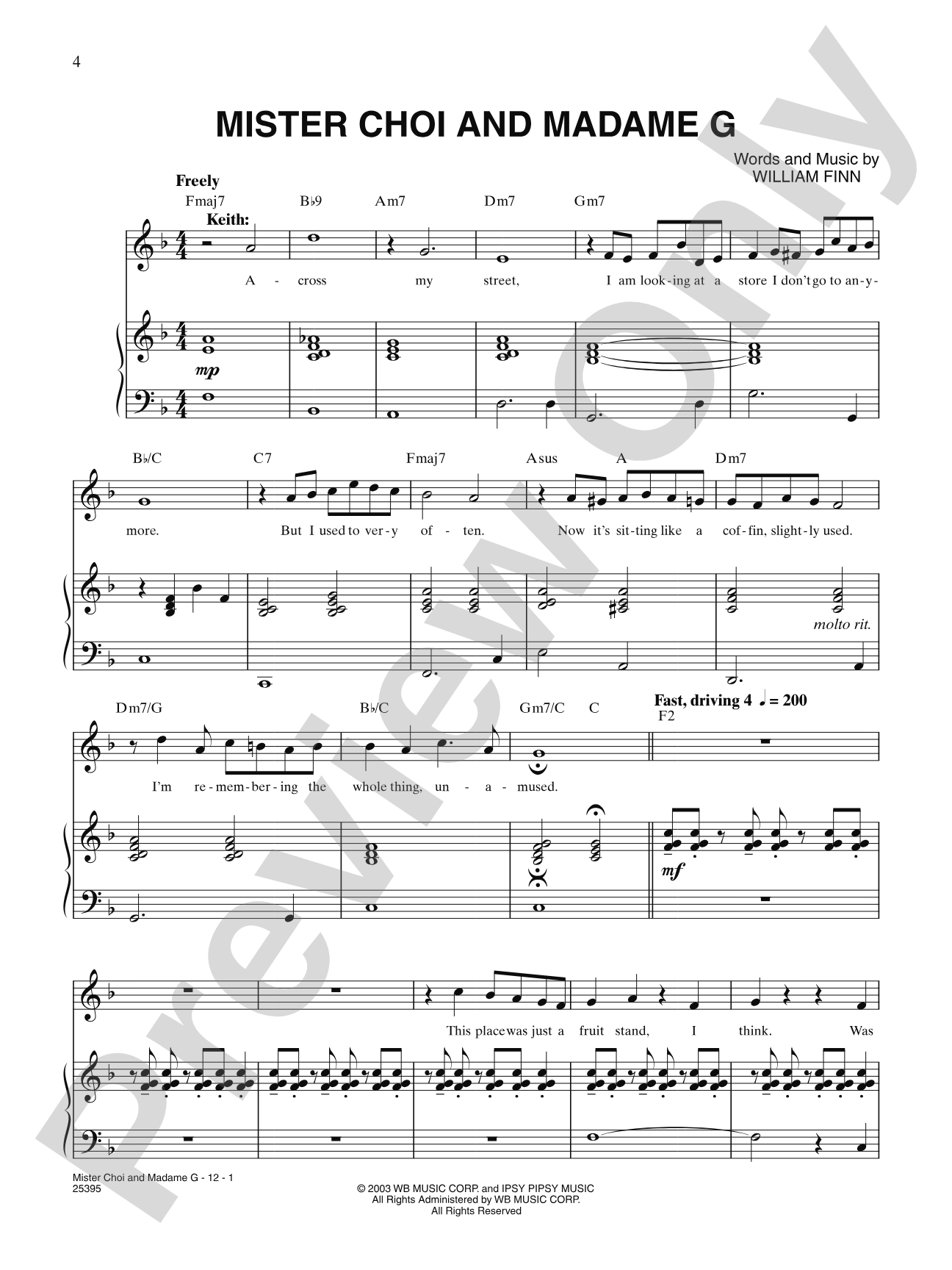
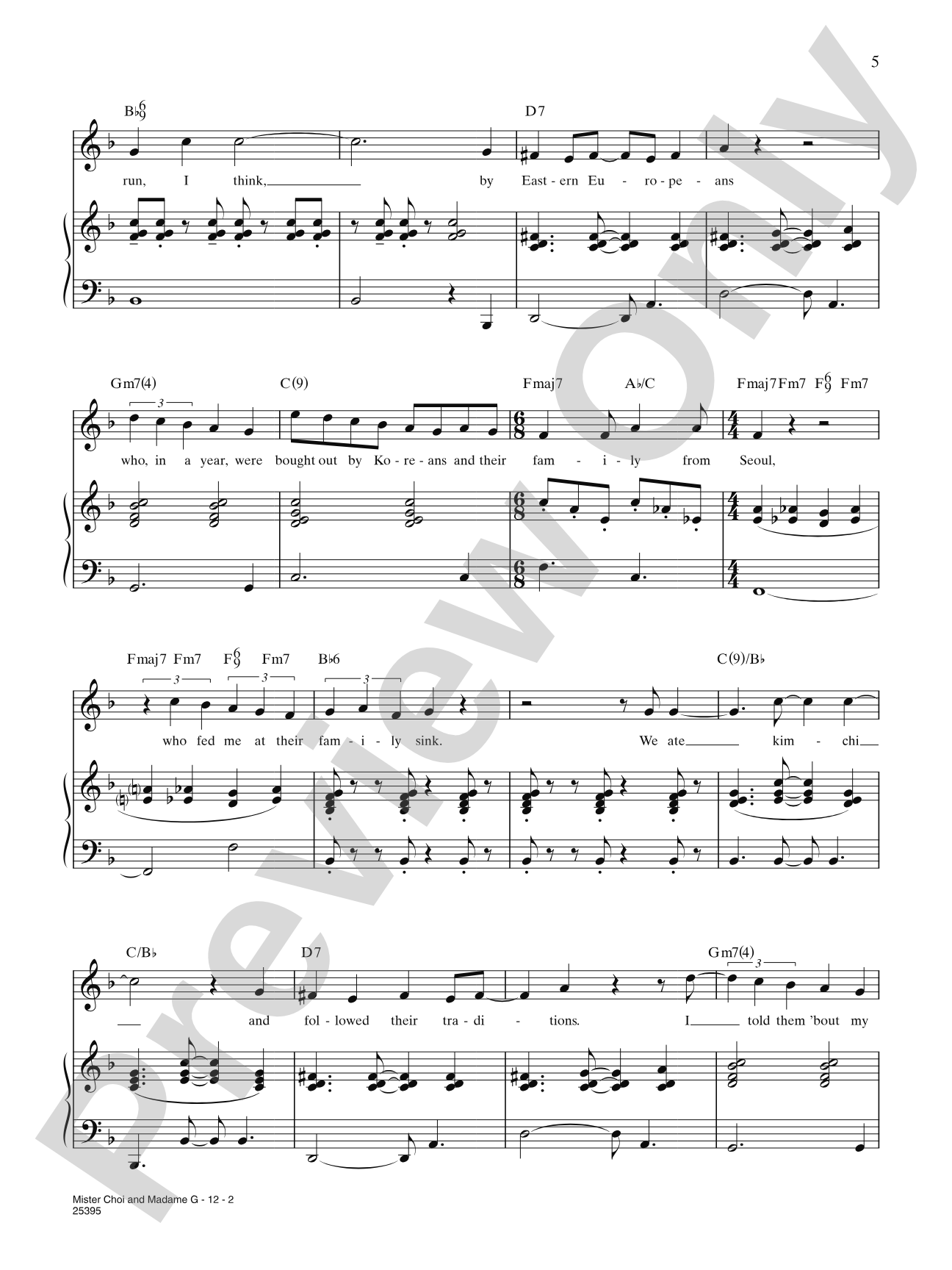
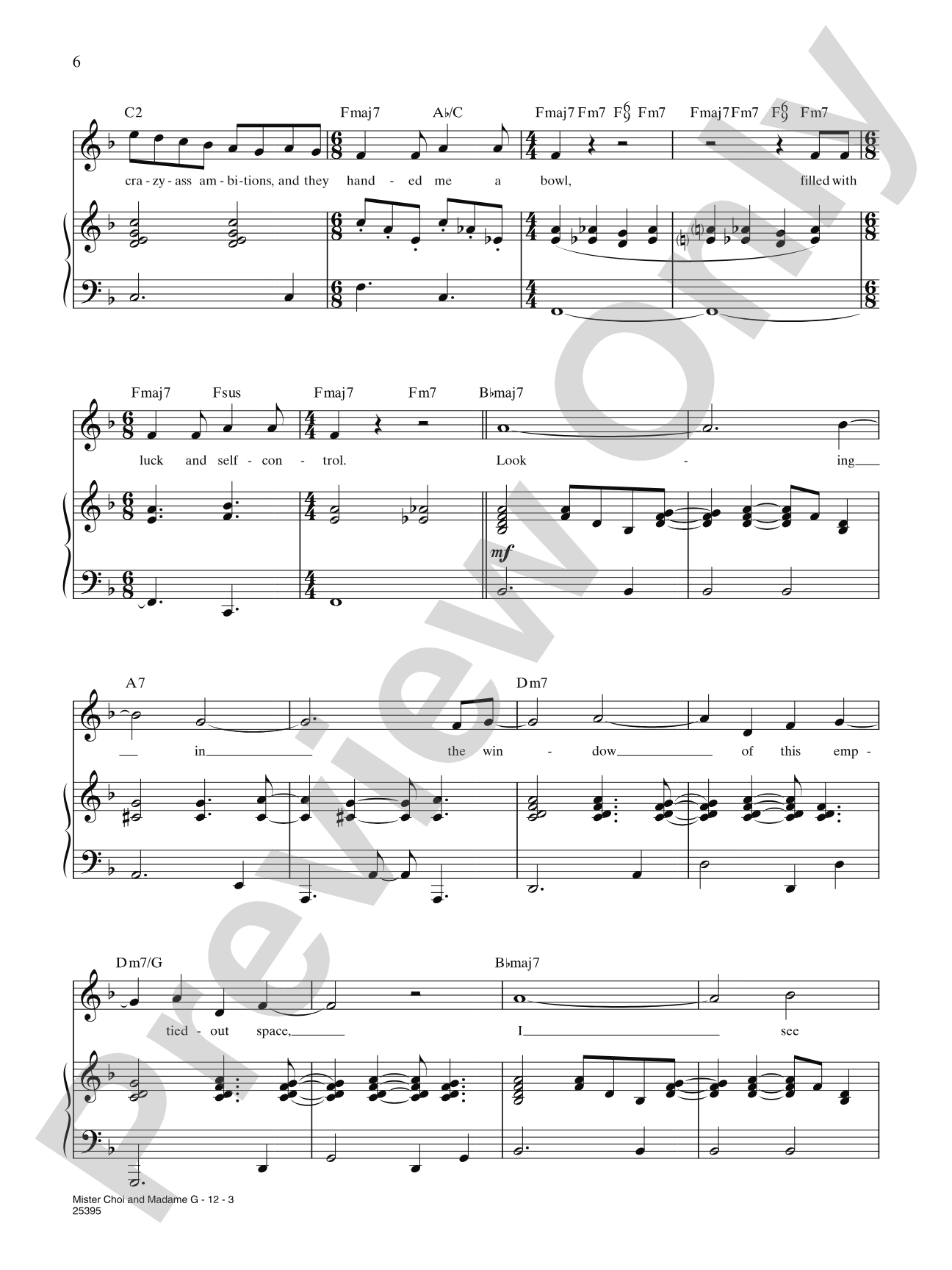

Mister Choi and Madame G (from "Elegies: A Song Cycle"): Piano/Vocal/Chords
Music and lyrics by William Finn
Item: 00-PSP-000047
$9.99
One moment…
Related Items
14 Dwight Ave., Natick, Massachusetts (from "Elegies: A Song Cycle"): Piano/Vocal/Chords |
$9.99
|
View | |
Anytime (I Am There) (from "Elegies: A Song Cycle"): Piano/Vocal/Chords |
$5.99
|
View | |
Saying My Goodbyes (from "Elegies: A Song Cycle"): Piano/Vocal/Chords |
$5.99
|
View | |
Infinite Joy (from "Elegies: A Song Cycle"): Piano/Vocal/Chords |
$5.99
|
View | |
Mark's All-Male Thanksgiving (from "Elegies: A Song Cycle"): Piano/Vocal/Chords |
$5.99
|
View | |
My Dogs (from "Elegies: A Song Cycle"): Piano/Vocal/Chords |
$5.99
|
View | |
Only One (from "Elegies: A Song Cycle"): Piano/Vocal/Chords |
$5.99
|
View | |
Passover (from "Elegies: A Song Cycle"): Piano/Vocal/Chords |
$9.99
|
View | |
When the Earth Stopped Turning (from "Elegies: A Song Cycle"): Piano/Vocal/Chords |
$5.99
|
View |
Description
Titles are: Mister Choi and Madame G * Mark's All-Male Thanksgiving * Only One * Passover * Infinite Joy * Anytime * My Dogs * 14 Dwight Ave, Natick, Massachusetts * When the Earth Stopped Turning * Saying My Goodbyes.


Mister Choi and Madame G (from "Elegies: A Song Cycle"): Piano/Vocal/Chords isn't in MakeMusic Cloud just yet...but it could be. Let us know you'd like to see it, and you'll help shape what comes next. In the meantime, start a free trial and dive into thousands of interactive titles your students can play along with today.
Request This Title
Tell us you want it.
Start Your Free Trial
Explore everything that's ready to play right now.
Sample Audio
No sample audio found.
Sample Video
No sample videos found.
Additional Details
Publisher:
Alfred Music
Page Count:
100
SKU:
00-PSP-000047
More about this title
About the Artist: William Finn
William Finn is a Tony Award-winning composer and lyricist whose work spans musical theater, choral music, and song cycles. His compositions are known for their emotional directness, sophisticated harmonic language, and ability to find profound humanity in intimate storytelling. Finn has spent decades creating music that moves audiences through a combination of accessibility and genuine artistic depth.
Why we love this
Elegies captures ten distinct emotional moments with music that feels both conversational and theatrically assured. Each song stands alone while belonging to a unified emotional arc, making this cycle ideal for recitalists who want to build a program around genuine character studies and deeply personal material.
What to expect
Finn's writing creates an intimate room where quiet observations become profound. The songs move between moments of gentle humor and unexpected tenderness, with harmony that feels both modern and deeply felt. There is no grandstanding here; instead, each moment invites quiet attention.
Who it's for
Singers preparing recital repertoire, music theater performers expanding into contemporary song cycles, and pianists looking for substantial accompanying material that demands real musicianship. This cycle suits mature student singers and professional performers comfortable with emotional vulnerability and contemporary theatrical idiom.
How to get the most out of it
- Approach each song as a discrete scene rather than a collection of numbers; let the narrative context (Thanksgiving, Passover, saying goodbye) shape your interpretation of the musical material.
- Attend closely to Finn's harmonic language, which often finds emotional weight in suspended chords and gentle chromatic movement; resist over-romanticizing what is already intricate.
- Balance the piano part as a equal partner to the voice, particularly in passages where accompaniment figures carry the emotional weight rather than the melody.
How to use it
Program individual songs or the full cycle in an art song recital alongside Schubert, Sondheim, or other contemporary composers working in character-driven cycles. The ten-song structure allows flexible programming: perform a full cycle as an act, select three to five songs as a suite, or use individual numbers to build a thematic recital around memory, family, and loss.
Skills your students will build
- Interpreting contemporary theater music notation and harmonic language
- Sustaining emotional authenticity across a song cycle format
- Balancing lyrical clarity with sophisticated piano accompaniment
- Managing dynamic range and breath in character-driven vocal lines
- Reading and executing contemporary performance practice in popular song style