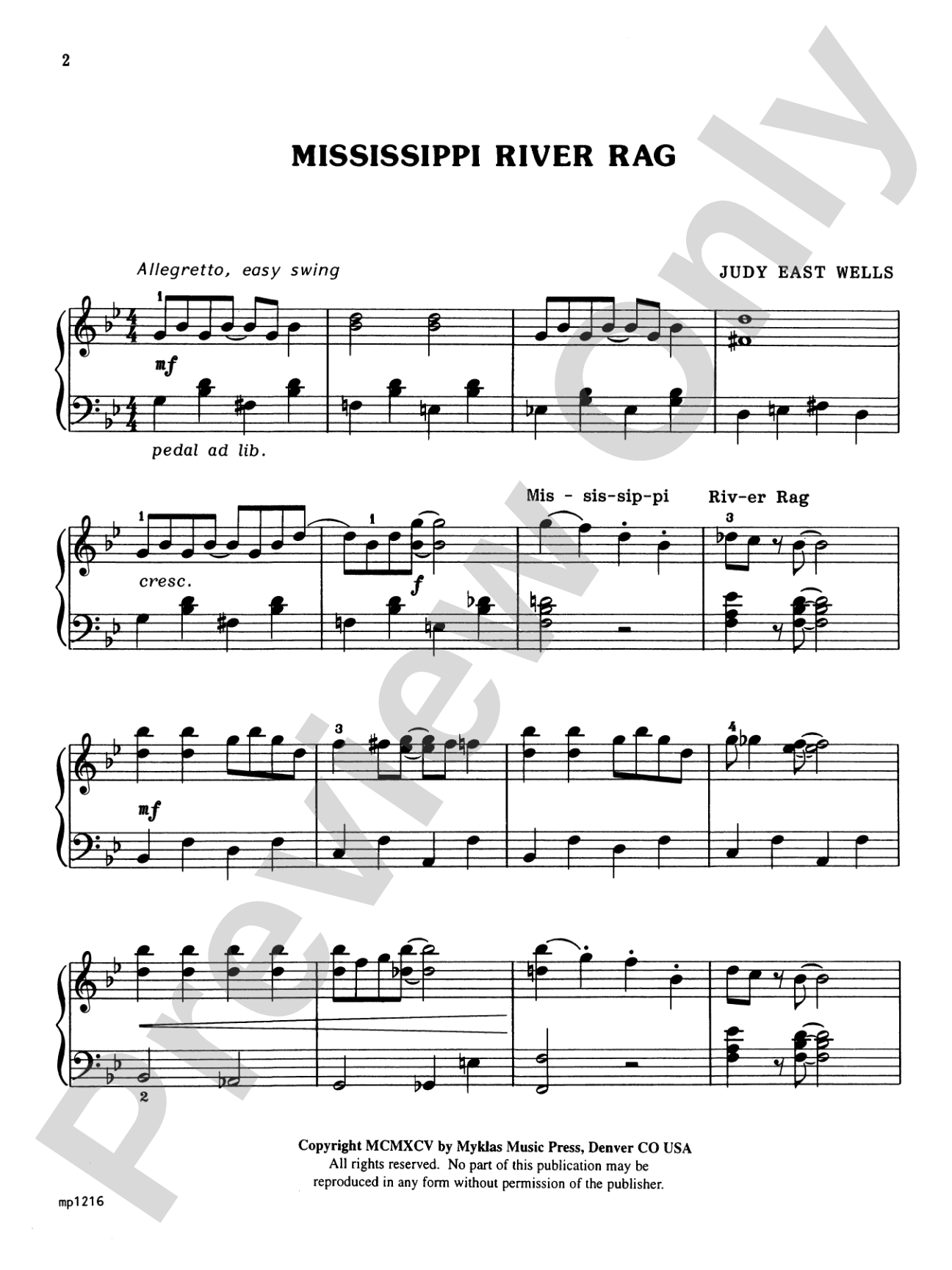
Mississippi River Rag - Piano Solo Sheet Music Preview

Mississippi River Rag - Piano Solo: Piano

By Judy East Wells

Level: Early Intermediate

Item: 00-PB-0000783

Digital Download
$3.50
Description

Mississippi River Rag - Piano Solo: Piano isn't in MakeMusic Cloud just yet...but it could be. Let us know you'd like to see it, and you'll help shape what comes next. In the meantime, start a free trial and dive into thousands of interactive titles your students can play along with today.

Sample Audio
No sample audio found.
Sample Video
Additional Details
Publisher: Alfred Music
Page Count: 4
SKU: 00-PB-0000783

More about this title

About the Composer: Judy East Wells

Judy East Wells

Judy East Wells brings decades of teaching experience and deep roots in music education to her compositions. A graduate of the University of Southern Mississippi with a degree in Music Education, she has spent her career teaching music in public schools and directing church music programs across Mississippi and Georgia. Her versatility across piano, organ, clarinet, and voice gives her a comprehensive understanding of how music works across different instruments and voices.

As an active member of the National Guild of Piano Teachers, Music Teachers National Association, and state and local music teacher associations, Wells remains engaged with the broader music education community. She has led workshops for teacher organizations and judged piano and composition competitions, bringing her pedagogical insights to bear on how young musicians develop their craft.

Why we love this

Wells writes this rag with a real sense of the genre's character—you'll find genuine ragtime vocabulary and phrasing, not a simplified approximation. Early intermediate pianists get to experience authentic syncopation and left-hand accompaniment patterns that build independence between the hands without overwhelming them.

What to expect

Mississippi River Rag captures the playful, syncopated character that makes ragtime irresistible. The piece has forward momentum and warmth, conjuring the improvisatory spirit of early 20th-century piano music while remaining firmly within reach of developing hands.

Who it's for

This piece speaks directly to early intermediate pianists hungry for authentic period style without the technical demands of advanced ragtime literature. It works equally well for students in private lessons, group classes, or preparing for recitals where a spirited, genre-based selection adds variety to a program.

How to get the most out of it

  • Establish a steady, even tempo before you begin; ragtime's syncopation can tempt you to rush, so a metronome is your friend through the learning process.
  • Shape the left-hand rhythm with clarity and purpose. The accompaniment pattern is the backbone of the rag's groove, so articulate those broken chords and stride figures distinctly.
  • Let the right-hand melody breathe within the steady tempo. Ragtime thrives on the tension between the strict beat and the syncopated melody dancing over it.
  • Balance dynamics so the melody sings above the accompaniment. Ragtimes can become muddled when both hands are equally prominent.

How to use it

Pair this with other early intermediate selections for a recital that celebrates American piano traditions. Its four pages make it a substantial but not overwhelming choice for a student solo spot, and its genre appeal often draws appreciative audience response from listeners who love the energy of ragtime.

Skills your students will build

  • Syncopation and ragtime rhythm patterns
  • Independence between hands in syncopated accompaniment
  • Left-hand stride and broken chord patterns
  • Tempo control and subdivision in syncopated contexts
  • Articulation and phrasing within a steady pulse

You May Also Like