
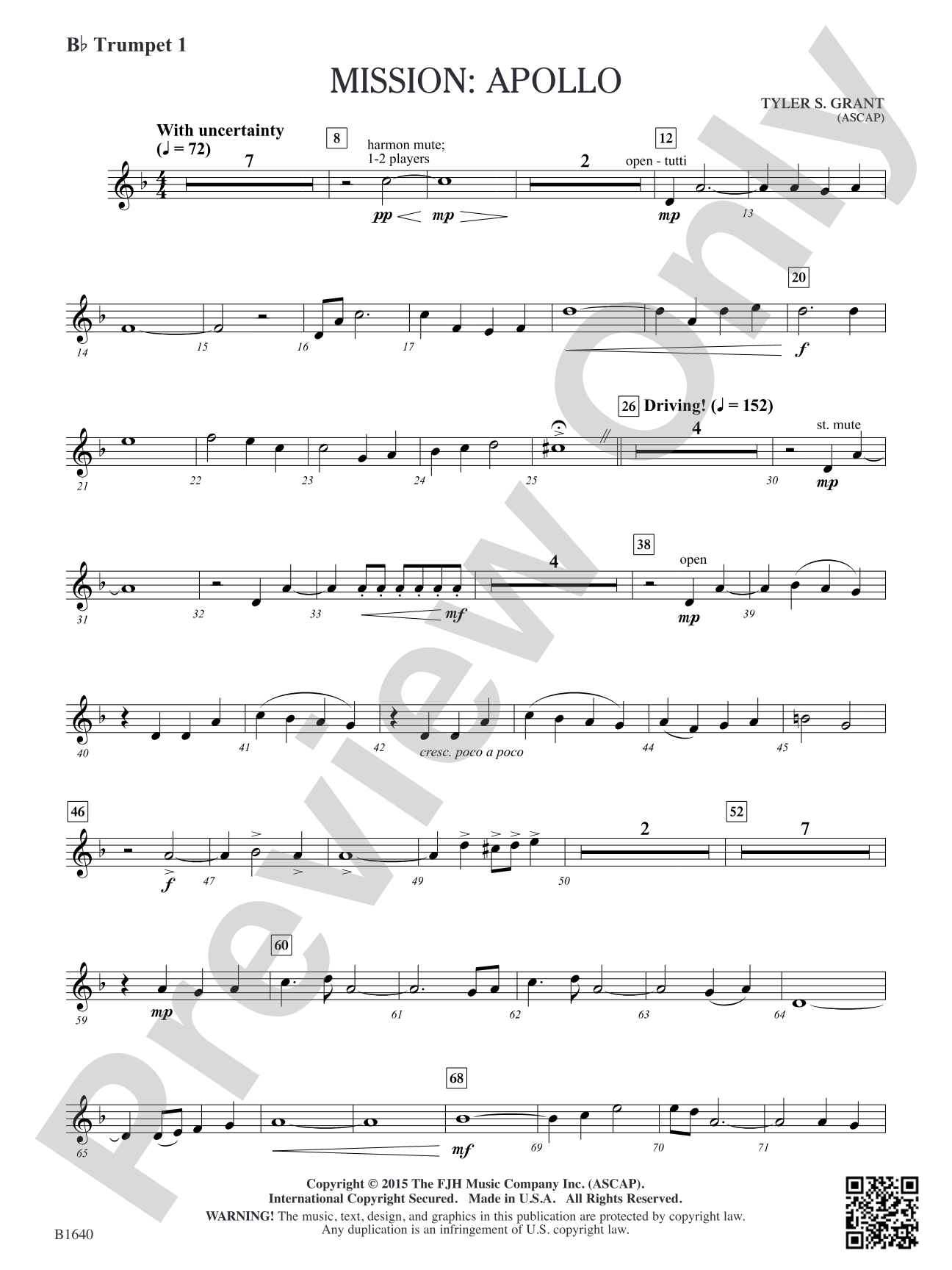

Mission: Apollo: B-flat Trumpet 1
By Tyler S. Grant
Grade: 2.5
Item: 98-PC-DB1640_T1
$7.00
Pickup currently not available
Description
Relive the adventure and excitement of the historic Apollo 11 mission in this evocative work inspired by the legendary “space-race” between the United States and the Soviet Union in the 1960s. After an ethereal opening, music builds as the rockets ignite and the astronauts start their rapid ascent into space. A brief slower section signifies the careful process of landing on the moon before the music picks up speed once again to depict the spacecraft hurling back to earth. Fantastic!


Mission: Apollo: B-flat Trumpet 1 isn't in MakeMusic Cloud just yet...but it could be. Let us know you'd like to see it, and you'll help shape what comes next. In the meantime, start a free trial and dive into thousands of interactive titles your students can play along with today.
Request This Title
Tell us you want it.
Start Your Free Trial
Explore everything that's ready to play right now.
Sample Audio
1
Audio File
--:--
0:00
0:00
Sample Video
No sample videos found.
Additional Details
Series:
FJH Young Band
Publisher:
The FJH Music Company, Inc.
SKU:
98-PC-DB1640_T1
More about this title
About the Composer: Tyler S. Grant

Tyler S. Grant has built a reputation as a composer and arranger whose music appears regularly on honor band and all-state repertoire lists across North America. His work Panoramic Fanfare won the Dallas Wind Symphony's 2014 "Call for Fanfares" Competition and has since been performed by collegiate and professional ensembles throughout the region. Since 2010, he has consistently accepted commissions and released new concert band and orchestral works each year.
Beyond the page, Grant serves as an active clinician, having worked with over 100 school instrumental programs across more than 15 states. His compositions have been heard at major venues including The Midwest Clinic, Carnegie Hall, the Macy's Thanksgiving Day Parade, and the Bands of America Grand Nationals. A University of Alabama graduate in instrumental music education, he studied conducting with Professor Randall Coleman and credits composer Brian Balmages as a formative influence on his development as a writer for winds.
Why we love this
Grant crafts a narrative arc that keeps young musicians engaged from opening gesture to final descent, making the astronomical scope of the Apollo mission feel immediate and achievable for a Grade 2.5 ensemble. The programmatic structure guides players through distinct musical landscapes without demanding virtuosic technique, freeing them to focus on ensemble cohesion and storytelling. Patriotic concert programming gains dimension when you pair it with music that celebrates human achievement rather than relying on marches alone.
What to expect
The music opens with quiet wonder, as if gazing up at the night sky before launch. As the band swells, you feel the power and thrust of ignition; the tempo quickens, the harmonies build, and the sense of ascent becomes undeniable. A hushed, reverent passage follows as you touch down on another world, then the return journey quickens again, carrying the listener safely home.
Who it's for
Concert bands at the intermediate level will find this work accessible in technical demands yet rich enough in musical storytelling to hold an audience. Young musicians respond well to programmatic writing that connects abstract notation to vivid imagery, making this ideal for bands building confidence in ensemble musicianship. Directors seeking repertoire that combines patriotic themes with contemporary compositional craft will appreciate Grant's approach.
How to get the most out of it
- Establish the ethereal opening by balancing soft dynamics across the full band; this transparent texture sets the expressive foundation for everything that follows.
- Mark the transition to the rocket ignition clearly in rehearsal. Build intensity steadily through the rising passage so the acceleration feels organic, not abrupt.
- Shape the slower moon-landing section with careful phrasing and attention to longer note values; this moment of reverence creates contrast and deepens the narrative arc.
- Balance the return journey section by keeping articulation clean and ensemble alignment tight. The faster pace should convey urgency without sacrificing precision.
How to use it
Position this work as the centerpiece of a concert celebrating American achievement or space exploration themes; it pairs well with patriotic repertoire and educational programs tied to history or STEM initiatives. The manageable length and Grade 2.5 difficulty make it an excellent anchor for a concert focused on accessible yet engaging concert band literature. Consider programming it in the middle of your set to take advantage of its narrative momentum and emotional payoff.
Skills your students will build
- Controlling dynamics across sustained passages, especially at soft, exposed moments
- Executing clear articulation during rapid passages and tempo changes
- Listening for ensemble balance when blending different instrumental families in dialogue
- Responding to programmatic cues and shaping phrases to reflect musical storytelling
- Coordinating rhythmic precision during tempo transitions