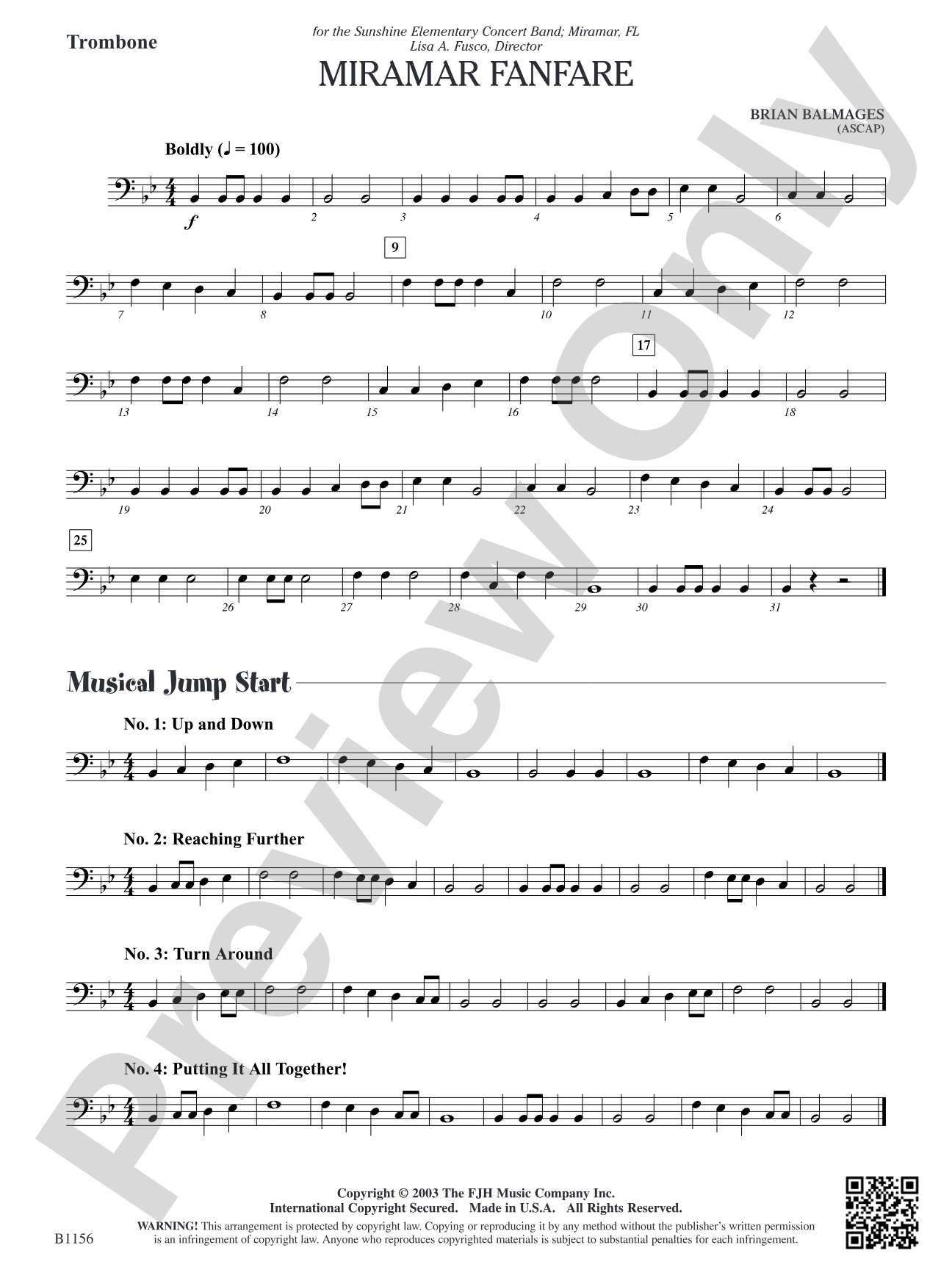
Miramar Fanfare: Trombone Sheet Music Preview

Miramar Fanfare: Trombone

By Brian Balmages

Level:.5

Item: 98-PC-DB1156_TN1

Digital Download
$7.00
Description
Uses only 5 notes! This easy fanfare is the perfect way to open your concert or assembly. Written specifically for an after-school program, this very accessible work uses a lot of rhythmic unison and simple harmonies. Ideal to teach students fundamental concepts of form, countermelody, and harmony - and with only five notes. Easy music that sounds more complex!

Miramar Fanfare: Trombone isn't in MakeMusic Cloud just yet...but it could be. Let us know you'd like to see it, and you'll help shape what comes next. In the meantime, start a free trial and dive into thousands of interactive titles your students can play along with today.

Sample Audio
0:00
0:00
Sample Video
Additional Details
Series: FJH Starter Series
Publisher: The FJH Music Company, Inc.
SKU: 98-PC-DB1156_TN1

More about this title

About the Composer: Brian Balmages

Brian Balmages

Brian Balmages composes across orchestral, band, and chamber idioms with equal fluency, and his works have been commissioned and performed by everyone from elementary school ensembles to professional orchestras at venues including Carnegie Hall, the Kennedy Center, and the Sydney Opera House. He holds the A. Austin Harding Award from the American School Band Directors Association, won the 2020 NBA William D. Revelli Composition Contest, and serves as an elected member of the American Bandmasters Association.

As both composer and conductor, Balmages maintains an active schedule guest conducting all-state ensembles, university groups, and professional orchestras worldwide. He currently directs MakeMusic Publications and Digital Education for Alfred and MakeMusic, bringing his deep pedagogical expertise to music education at every level.

Why we love this

Balmages delivers genuine musicality within radical constraints. Rather than writing down to beginners, he uses five notes as a compositional discipline, creating a piece that sounds substantially more sophisticated than its technical demands. The rhythmic unison passages build ensemble confidence while the strategic countermelody and harmony layers teach form organically, making it ideal for students who need early success without sacrificing musical integrity.

What to expect

Bright, ceremonial, and purposeful. Despite its simplicity, the piece conveys genuine fanfare grandeur through rhythmic drive and layered sonority. It feels like a real opening number, not a training exercise.

Who it's for

Beginning concert bands, after-school music programs, and ensembles preparing for contests or festivals where accessibility and quick learning matter. Students new to reading pitch and rhythm benefit most from the tonal limitations, while more experienced groups find pedagogical value in the form and harmony principles embedded in the writing.

How to get the most out of it

  • Shape the rhythmic unison sections with light dynamic swells rather than playing them flat; this adds musical interest while keeping technical difficulty low.
  • Balance the countermelody against the main harmonic layer so both lines remain audible without overshadowing each other.
  • Keep the tempo steady and energetic to maintain the fanfare character; this is ceremonial music that should feel confident and bright.
  • Use the opening moments to establish ensemble precision; nailing the unison rhythms early builds momentum for the harmonic sections that follow.

How to use it

Open your next concert or assembly with this; it sets an energetic tone while requiring minimal rehearsal time. Pair it with slightly more complex repertoire on the same program to highlight what students can accomplish across a range of difficulty levels, or program it early in the season when your ensemble is building foundational skills.

Skills your students will build

  • Reading and performing rhythmic unison passages with precision
  • Identifying and executing countermelody lines independently
  • Understanding basic harmonic function through listening and performing
  • Recognizing fanfare form and ceremonial style conventions
  • Balancing multiple musical lines within a single texture
  • Building confidence through musically rewarding early repertoire

You May Also Like