Miracle Of Miracles (from Fiddler On The Roof) Sheet Music Preview

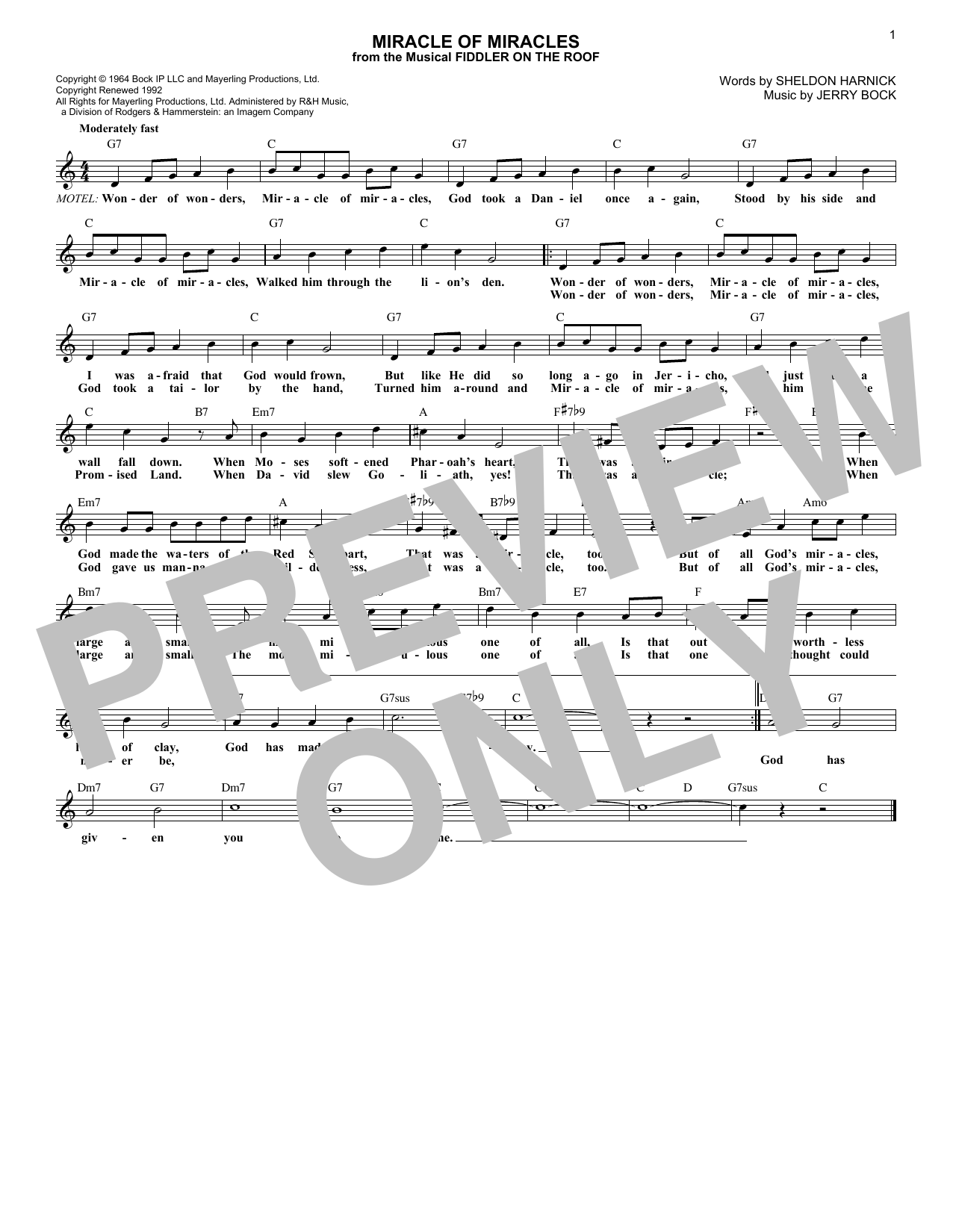
Miracle Of Miracles (from Fiddler On The Roof): Lead Sheet / Fake Book

As performed by Bock & Harnick

Item: 35-DS00439388

Digital Download
$3.99

One moment…

Description

Miracle Of Miracles (from Fiddler On The Roof): Lead Sheet / Fake Book isn't in MakeMusic Cloud just yet...but it could be. Let us know you'd like to see it, and you'll help shape what comes next. In the meantime, start a free trial and dive into thousands of interactive titles your students can play along with today.

Sample Audio
No sample audio found.
Sample Video
Additional Details
Publisher: Hal Leonard
Page Count: 1
SKU: 35-DS00439388

More about this title

About the Artist: Bock & Harnick

Sheldon Harnick and Jerry Bock created some of Broadway's most enduring scores, with Fiddler on the Roof (1964) standing as their masterwork. Harnick's lyrics capture the texture of Yiddish speech patterns and the emotional weight of tradition meeting change, while Bock's melodies root themselves in Eastern European folk idioms without ever feeling imitative. Together, they wrote for singers who needed to act first and show off second, a discipline that shaped how musical theater could tell stories with real human stakes.

Their work appears regularly in school programs, community theaters, and concert halls because the songs function equally well as standalone pieces or within the show's narrative. For music educators, Bock and Harnick represent a standard of craft that values clarity, singability, and emotional authenticity over spectacle.

Why we love this

This lead sheet captures one of theater's most joyful moments of affirmation, written in a way that reveals the character's wonder without requiring full orchestral support. The melody sits comfortably for singers while offering enough harmonic interest to keep accompanists engaged, making it ideal for recitals, auditions, or classroom performance. Harnick's lyrics land with precision, and the emotional arc from uncertainty to conviction comes through clearly in even a solo piano arrangement.

What to expect

A quiet miracle unfolding in real time. The melody has a folk quality that feels humble and grounded, yet the emotional journey builds from tentative hope to unshakeable joy. There's lightness here, even in moments of vulnerability, reflecting a character who finds grace in the ordinary.

Who it's for

Singers preparing auditions for musical theater programs, music students exploring Broadway repertoire in voice lessons, and anyone building a mixed recital program that includes songs beyond classical art song. Piano students can use this as an accompaniment study while learning to support a vocalist's narrative.

How to get the most out of it

  • Find the conversational rhythm in Tevye's phrasing. These aren't operatic lines; they're a man thinking out loud, so breathe where speech naturally pauses rather than at bar lines.
  • Let the piano part breathe in the first section, resisting the urge to fill every space. The accompaniment should sound like accompaniment, not competition.
  • Build the intensity gradually as the character moves from "Is it possible?" to absolute conviction. The melody repeats, so use dynamics and articulation shifts to show his growing certainty.
  • Balance sincerity with the inherent lightness in the melody. This is a moment of grace, not a power ballad.

How to use it

Pair this with other songs of faith or transformation, or program it alongside contemporary musical theater selections to show the range of the genre. It works beautifully in a concert exploring storytelling in song, or as a contrast piece in a recital that otherwise features classical repertoire. High school and college singers often gravitate toward this for auditions, making it a repertoire staple in voice studios.

Skills your students will build

  • Singing text-driven melody that prioritizes clarity and phrasing over pure vocal display
  • Navigating the bridge between folk idioms and Broadway musical theater conventions
  • Building emotional intensity through repeated melodic phrases with varied interpretations
  • Coordinating with piano accompaniment in lead sheet format, requiring awareness of harmonic support

You May Also Like