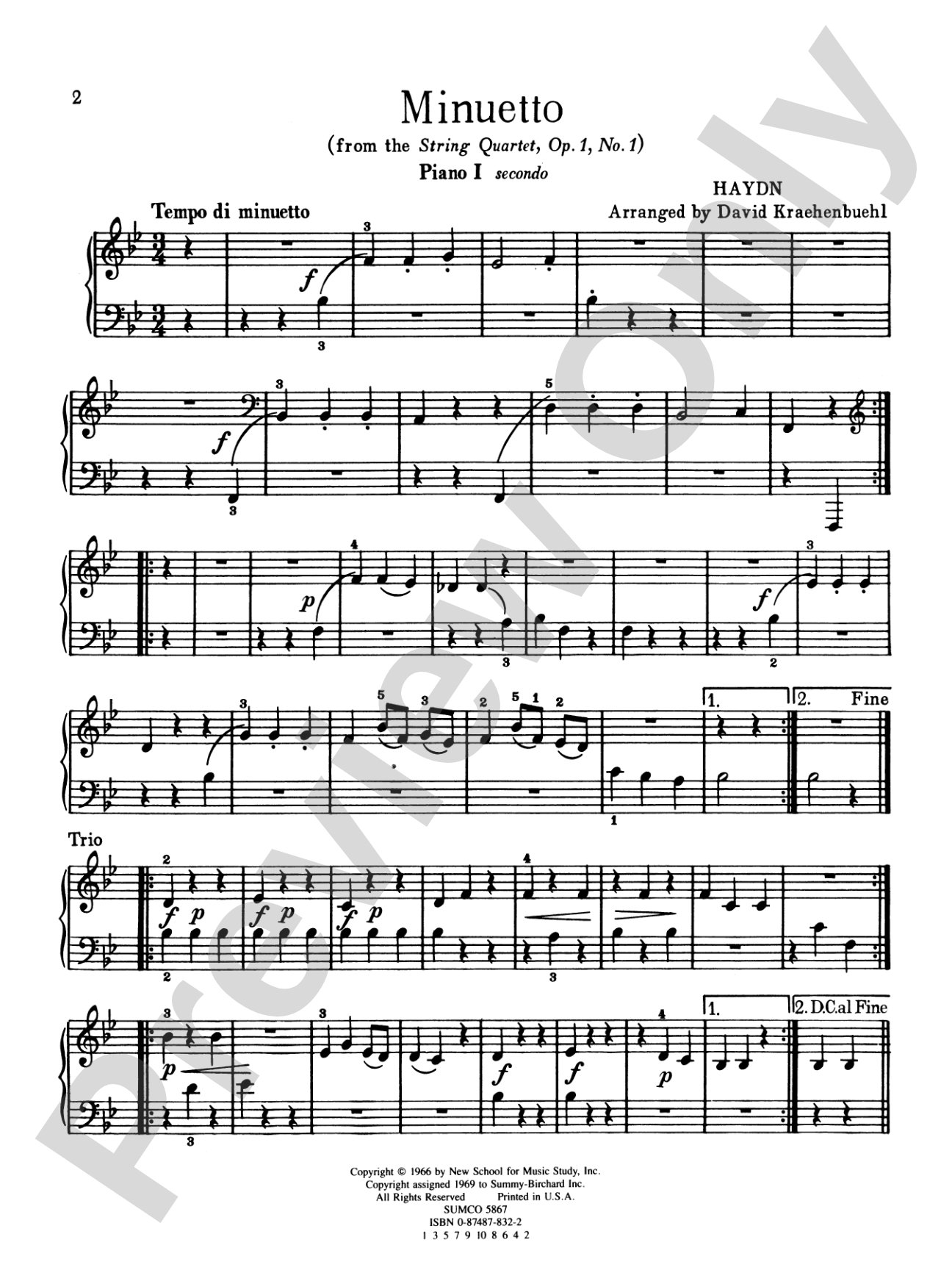
Minuetto from String Quartet, Opus 1, No. 1 - Piano Quartet (2 Pianos, 8 Hands) Sheet Music Preview

Minuetto from String Quartet, Opus 1, No. 1 - Piano Quartet (2 Pianos, 8 Hands): Piano

By Franz Joseph Haydn / arr. David Kraehenbuehl

Level: Early Intermediate

Item: 00-PB-0000788

Digital Download
$4.99
Description
The Minuetto from String Quartet, Op. 1, No. 1 is arranged for an intermediate piano ensemble of two pianos, eight hands. This delightful classical dance movement is in the key of B-flat major and 3/4 meter. The Trio section explores changes in dynamics. Two copies are included. A Federation Festivals 2024-2028 selection.

Minuetto from String Quartet, Opus 1, No. 1 - Piano Quartet (2 Pianos, 8 Hands): Piano isn't in MakeMusic Cloud just yet...but it could be. Let us know you'd like to see it, and you'll help shape what comes next. In the meantime, start a free trial and dive into thousands of interactive titles your students can play along with today.

Sample Audio
No sample audio found.
Sample Video
Additional Details
Publisher: Alfred Music
Page Count: 8
SKU: 00-PB-0000788

More about this title

About the Composer: Franz Joseph Haydn

Franz Joseph Haydn (1732-1809) shaped the Classical era more than any composer of his generation. His prolific output across every genre established conventions that Mozart and Beethoven would later refine, from sonata form to the symphony itself. His string quartets represent a pinnacle of chamber music writing, balancing intellectual rigor with genuine warmth and wit.

Haydn's long tenure at the Esterházy court gave him the freedom to experiment constantly. He treated each new work as an opportunity to solve compositional problems in fresh ways, which is why his music remains endlessly instructive for musicians at every level. His minuets and dance movements have an elegance that never feels stiff or antiquated.

Why we love this

This arrangement captures the grace of Haydn's original chamber writing while creating a genuine ensemble experience for eight hands. The Trio's dynamic exploration gives pianists real interpretive choices without overwhelming an early intermediate ensemble. It's a genuine Classical masterwork, not a simplified approximation, and students will feel the difference.

What to expect

Courtly and graceful, with the restrained joy of a Baroque dance reimagined through Classical clarity. The Minuetto's measured elegance contrasts beautifully with the Trio's more playful dynamic shifts, creating a piece that's both intellectually satisfying and genuinely entertaining to perform.

Who it's for

Intermediate pianists ready for the responsiveness and communication required of ensemble playing. This works well for studio pianists preparing for chamber recitals, competitive festivals (it's a 2024-2028 Federation Festivals selection), or ensemble concerts at the secondary or early college level.

How to get the most out of it

  • Shape the opening theme with a gentle lean toward the downbeat, allowing the lilting 3/4 meter to breathe naturally rather than feeling metronomic
  • Balance the two pianos so neither one dominates; Haydn's orchestration relies on clear dialogue, and the arrangement preserves this. Rehearse with attention to who leads each phrase
  • Use the dynamic shifts in the Trio section as opportunities for expressive playing. The contrast between passages calls for genuine tonal variety, not mechanical execution
  • Synchronize rhythmic figures across both instruments without rushing. Precision here serves the music's elegance

How to use it

Pair this with other chamber works on a recital to showcase different textures and ensemble configurations. It also works as a bridge between a heavier Romantic-era piece and lighter contemporary music, offering audiences a moment of Classical refinement. The eight-hand format makes it ideal for showcasing multiple students in a single performance slot.

Skills your students will build

  • Ensemble balance and listening to other pianists while managing your own part
  • Maintaining steady 3/4 meter while shaping phrasing across both pianos
  • Dynamic control and tonal variety in the Trio section
  • Reading and executing Classical-era harmonic progressions in B-flat major
  • Coordination and synchronization across multiple keyboard instruments

You May Also Like