Minuet, Z. 649 (Encore Plus, Book 1) Sheet Music Preview

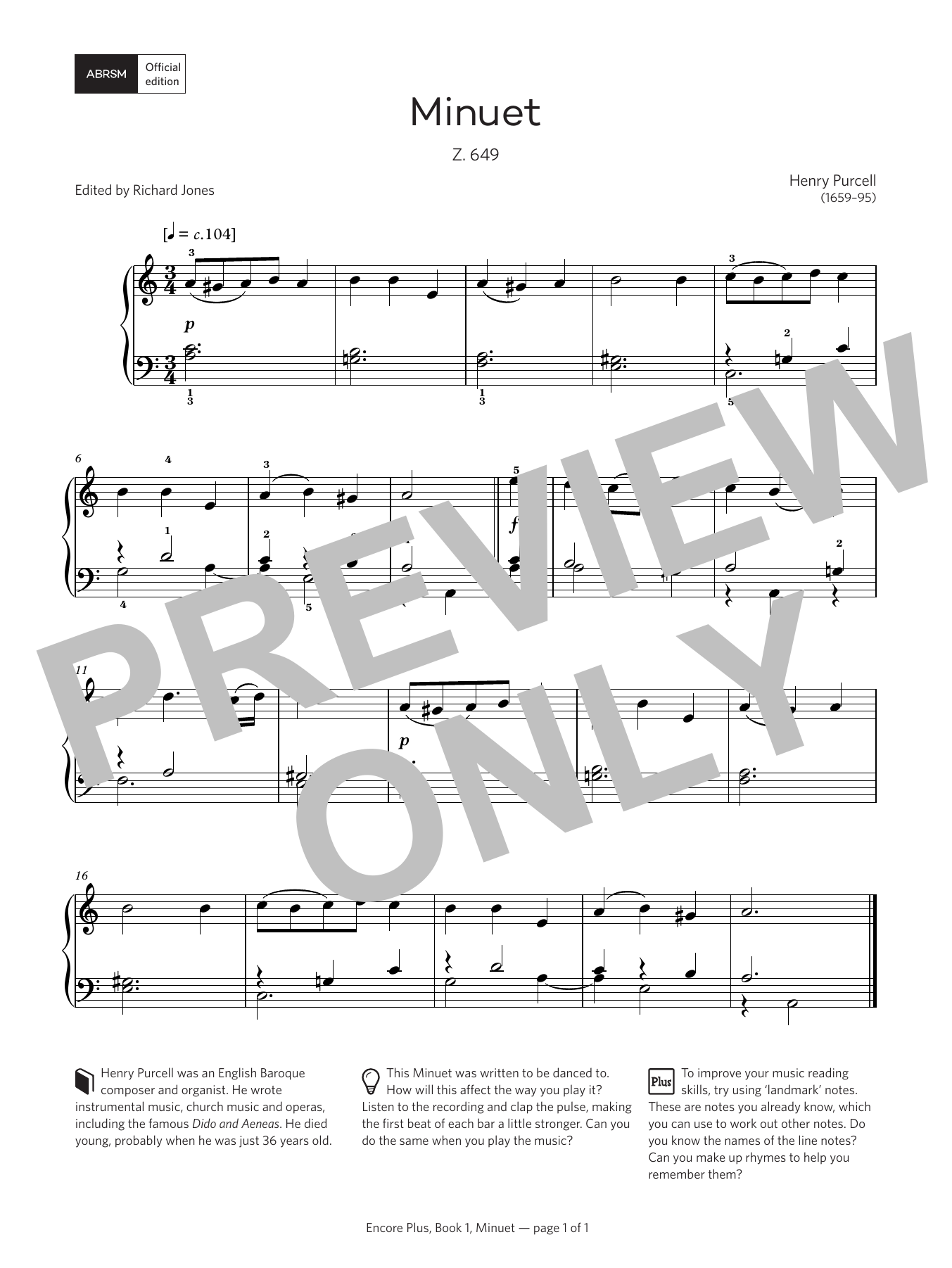
Minuet, Z. 649 (Encore Plus, Book 1): Piano Solo

By Henry Purcell

Grade: 1

Item: 35-DS01989309

Digital Download
$1.99
Description

Discover MakeMusic Cloud: thousands of interactive titles your students can play along with today.

Sample Audio
No sample audio found.
Sample Video
Additional Details
Publisher: Hal Leonard
Page Count: 1
SKU: 35-DS01989309

More about this title

About the Composer: Henry Purcell

Henry Purcell (1659–1695) stands as England's most significant Baroque composer, creating a vast catalog that shaped musical life during the Restoration era. His facility with melody, harmonic innovation, and gift for dramatic expression made him equally comfortable writing grand theatrical works, intimate chamber pieces, and keyboard music that students encounter today.

Why we love this

Purcell's minuets offer young pianists their first taste of genuine Baroque style without the technical barriers that come with more complex keyboard works. The melodic clarity and balanced phrasing make this piece immediately rewarding to perform, while the period conventions embedded in the score teach elegant voice leading and proper ornamentation naturally.

What to expect

Graceful and refined, with the gentle courtesy of a courtly dance. The piece speaks in clear, balanced phrases that feel almost conversational, inviting the listener into an intimate rather than grand musical moment.

Who it's for

Beginning pianists ready to move beyond simplified arrangements into actual repertoire from the Baroque period. Teachers will find this useful as both a standalone teaching piece and as preparation for larger Purcell works or other keyboard music by his contemporaries.

How to get the most out of it

  • Observe the two-voice texture carefully; the left hand supports rather than doubles, so clarity between hands requires light touch and careful voicing rather than heavy pedal
  • Shape phrases with gentle direction toward cadence points rather than playing measure to measure, which helps the minuet maintain its courtly elegance
  • Keep the tempo moderate and dance-like; rush and you lose the dignity of the minuet form, drag and it becomes heavy

How to use it

Perfect for a young student recital segment on composers or keyboard styles, or as a pairing with other single-movement Baroque pieces for a thematic program exploring the minuet form across different eras and regions.

Skills your students will build

  • Baroque ornament interpretation and execution
  • Two-voice independence and texture differentiation
  • Phrase shaping and cadential clarity
  • Period-appropriate articulation and rubato
  • Score reading from Baroque keyboard notation conventions

You May Also Like