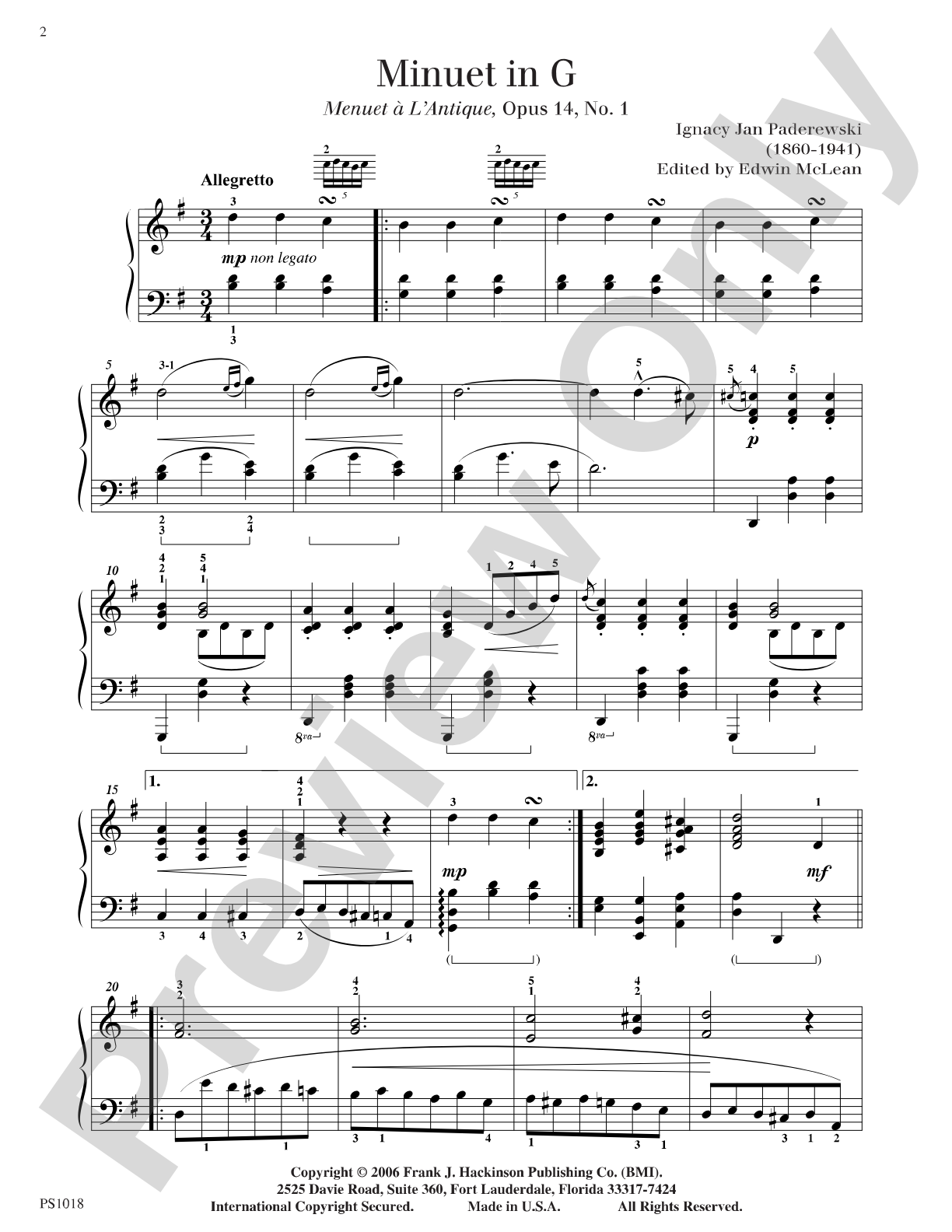
Minuet in G (Menuet a L'Antique, Op. 14, No. 1) Sheet Music Preview

Minuet in G (Menuet a L'Antique, Op. 14, No. 1): Piano

By Ignacy Jan Paderewski / ed. Edwin McLean

Item: 98-DPS1018

Digital Download
$4.95
Description
(Menuet a L'Antique, Op. 14, No. 1) Newly edited and fingered, this latest addition to The FJH Piano Solo Series is based on the original authoritative edition by Paderewski. The Minuet in G has long been a significant and established part of the piano repertoire and is an essential addition to your piano library.

Minuet in G (Menuet a L'Antique, Op. 14, No. 1): Piano isn't in MakeMusic Cloud just yet...but it could be. Let us know you'd like to see it, and you'll help shape what comes next. In the meantime, start a free trial and dive into thousands of interactive titles your students can play along with today.

Sample Audio
No sample audio found.
Sample Video
Additional Details
Series: The FJH Piano Solo Series
Publisher: The FJH Music Company, Inc.
SKU: 98-DPS1018

More about this title

About the Composer: Ignacy Jan Paderewski

Ignacy Jan Paderewski (1860-1941) was a Polish composer, pianist, and statesman whose virtuosic performances and nationalist compositions made him one of the most celebrated musicians of the late nineteenth and early twentieth centuries. Beyond his renown as a concert pianist, Paderewski championed Polish musical identity through his compositions and later served as Poland's prime minister and delegate to the Paris Peace Conference following World War I.

His piano works, including the Minuet in G, blend Romantic sensibility with classical form, creating pieces that reward both the developing pianist and the seasoned performer. Paderewski's own editorial supervision of his music ensured that his compositions reflect his artistic vision, making his works essential touchstones for pianists seeking authenticity and depth.

Why we love this

This newly edited and fingered edition draws directly from Paderewski's own authoritative treatment of the work, providing students with fingerings informed by the composer's pianistic knowledge. The piece sits comfortably in the intermediate repertoire, offering a bridge between classical sonatinas and more substantial works while maintaining the elegant proportions and harmonic clarity that have sustained it as a cornerstone of piano literature.

What to expect

Graceful and intimate, the Minuet in G evokes the elegant dance forms of the eighteenth century while retaining the harmonic sophistication of the Romantic era. The writing is transparent and well-scaled to the piano, with moments of genuine lyricism that invite expressive playing without bombast.

Who it's for

Intermediate pianists seeking a refined classical minuet that develops musical maturity and touch control. Teachers value this work for students ready to move beyond easier sonatinas but still developing comfort with longer phrases and subtle dynamic shaping.

How to get the most out of it

  • Shape the opening phrase with gentle weight on the first beat of each measure, allowing the melody to sing naturally without rushing into the second and third beats.
  • Attend to the articulation carefully; legato passages should feel connected while lighter sections remain transparent and uncluttered.
  • Use the fingerings provided as a guide for achieving smooth position shifts; Paderewski's own suggestions support hand comfort and musical flow.
  • Balance the accompaniment figures so they support rather than overshadow the melodic line, even when the harmony thickens.

How to use it

Program this as a refined contrast piece in a recital of mixed styles, or pair it with other classical minuets and dance forms to explore how form and character evolve across composers. Its moderate length and clear structure make it excellent for young pianists making their first concerto appearances or for studio recitals emphasizing classical repertoire.

Skills your students will build

  • Phrasing and voice leading in classical forms
  • Legato and non-legato articulation control
  • Hand independence in accompaniment patterns
  • Ornamentation interpretation (if present in the score)
  • Musical interpretation of minuet conventions while maintaining Romantic expression

You May Also Like