Carol Klose has built a career arranging classical repertoire for young pianists, with a particular gift for maintaining the integrity of beloved pieces while making them genuinely accessible to developing musicians. Her arrangements respect the original compositions' character and pedagogical value, which is why they appear regularly in studio settings and group piano classes.
Why we love this
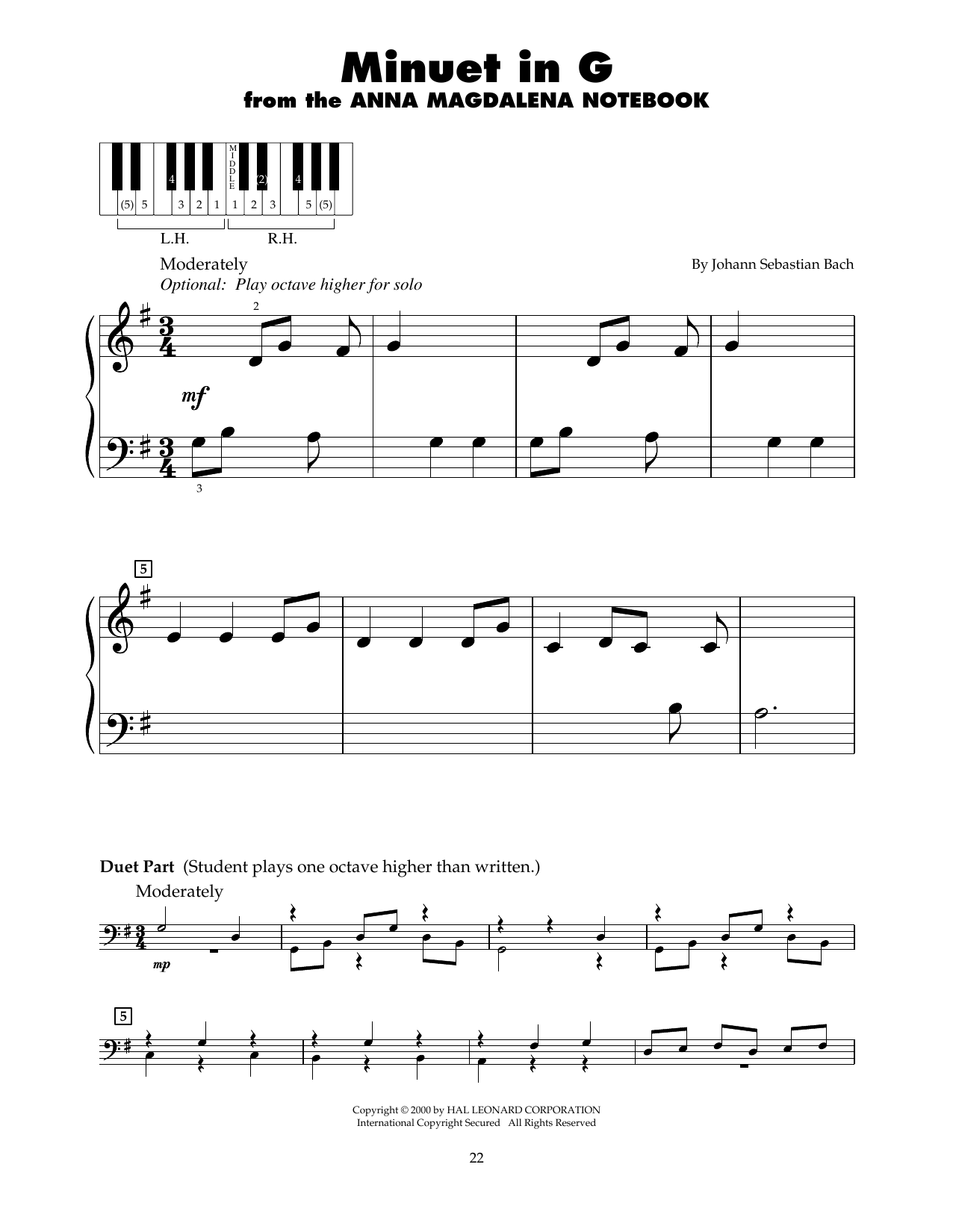
Klose's five-finger arrangement of this Bach-attributed minuet preserves the melody's elegance while removing the harmonic and technical barriers that typically keep it out of reach for early elementary students. It's the rare arrangement that teachers actually want to assign because students hear the real music, not a gutted version.
What to expect
A courtly dance captured in miniature, with a straightforward melody that invites careful listening and clean execution. The three-page length feels substantial without being daunting, giving young pianists genuine accomplishment upon completion.
Who it's for
Early elementary piano students (typically late first year through second year) who have mastered the five-finger position and basic hand independence. This works equally well for classroom group piano and private studio settings.
How to get the most out of it
Shape the phrase endings by allowing a slight breath after the cadential figures rather than playing through them mechanically.
Maintain evenness in the five-finger pattern across both hands; uneven technique here becomes immediately audible in a melody this straightforward.
Add gentle articulation to distinguish the two-note motifs without rushing the tempo.
Consider the piece's original character as a dance form: think of a graceful, unhurried walking pace rather than a stiff march.
How to use it
Include it on a student recital as an early solo slot that builds confidence before more substantial repertoire takes the stage. It also pairs beautifully in a "Classical Masters" program section alongside similar-level arrangements of Baroque or early Classical works.
Skills your students will build
Five-finger position security and hand stability
Phrasing awareness in a melody without explicit markings
Hand independence between treble and bass lines
Sustaining focus on rhythmic accuracy without expressive crutches
Recognition of binary form (A and B sections)
You May Also Like
Scan to Complete Your Purchase
Use your phone's camera to scan the code below
You'll log in on your phone and the order will be added to your account