Minuet In G Sheet Music Preview

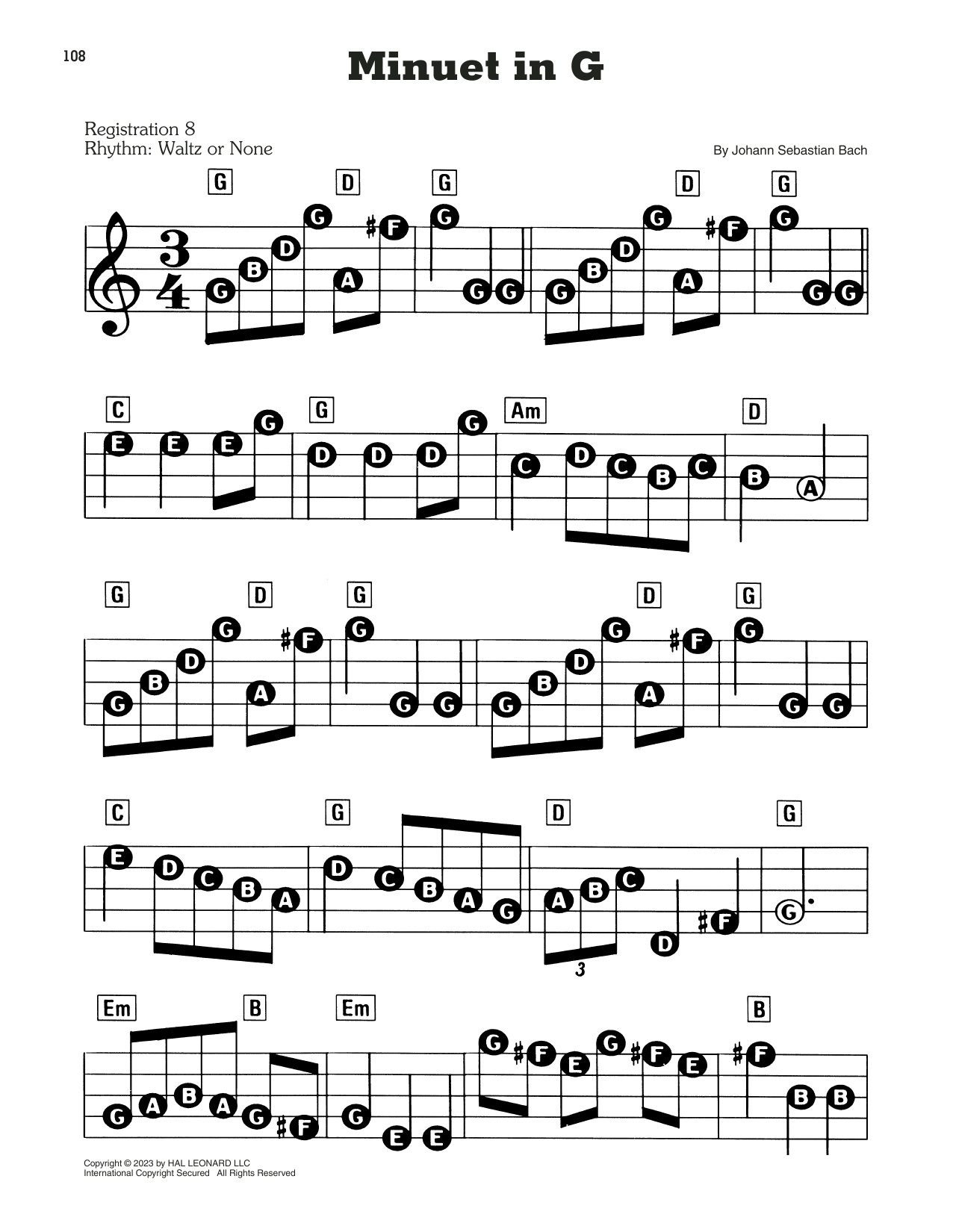
Minuet In G: E-Z Play Today

By Johann Sebastian Bach

Item: 35-DS00733688

Digital Download
$4.99
Description

Minuet In G: E-Z Play Today isn't in MakeMusic Cloud just yet...but it could be. Let us know you'd like to see it, and you'll help shape what comes next. In the meantime, start a free trial and dive into thousands of interactive titles your students can play along with today.

Sample Audio
No sample audio found.
Sample Video
Additional Details
Publisher: Hal Leonard
Page Count: 2
SKU: 35-DS00733688

More about this title

About the Composer: Johann Sebastian Bach

Johann Sebastian Bach (1685-1750) stands as one of the most intellectually rigorous composers in Western music history. His mastery of counterpoint, harmonic language, and formal structure set the foundation for everything that followed, making his works essential study for any serious musician.

Bach's output spans sacred and secular genres across keyboard, string, wind, and vocal media. His systematic approach to composition and his ability to craft profound musical statements within strict structural frameworks have secured his position as a cornerstone of music education.

Why we love this

This arrangement captures one of Bach's most immediately accessible keyboard works without sacrificing its harmonic integrity. E-Z Play Today's reduction makes the piece genuinely playable for early intermediate students while preserving the character that makes this minuet a legitimate introduction to Baroque style and Bach's musical language.

What to expect

Elegant and unhurried, like a courtly dance observed from a distance. The piece unfolds with quiet confidence, its simple melody and basic harmonic motion creating a sense of refinement that feels both understated and complete.

Who it's for

Early intermediate pianists building foundational technique and an ear for Baroque style. Teachers introducing students to Bach's melodic gift and harmonic clarity without overwhelming them with complexity.

How to get the most out of it

  • Maintain the underlying pulse with steady quarter notes in the left hand; this foundation allows the right hand melody to sing naturally without rushing.
  • Shape the two-measure phrases as complete musical thoughts; each pair should breathe slightly before the next idea begins.
  • Keep the articulation clean but not detached; these eighteenth century dances benefit from a gentle, connected legato rather than a percussive touch.

How to use it

Use this as an encore or a short interlude between longer contemporary works; its brevity and accessibility make it perfect for filling concert slots where you need musical substance without technical demands. It also works beautifully as a memorization project early in the school year, building student confidence with a composer they'll encounter repeatedly.

Skills your students will build

  • Playing steady accompaniment patterns while maintaining independence from the melodic line
  • Recognizing and executing periodic phrase structure (two and four measure units)
  • Applying Baroque articulation and ornamentation conventions
  • Understanding basic harmonic movement in Baroque-era tonality

You May Also Like