Minuet from Petite Suite: Double Bass Sheet Music Preview

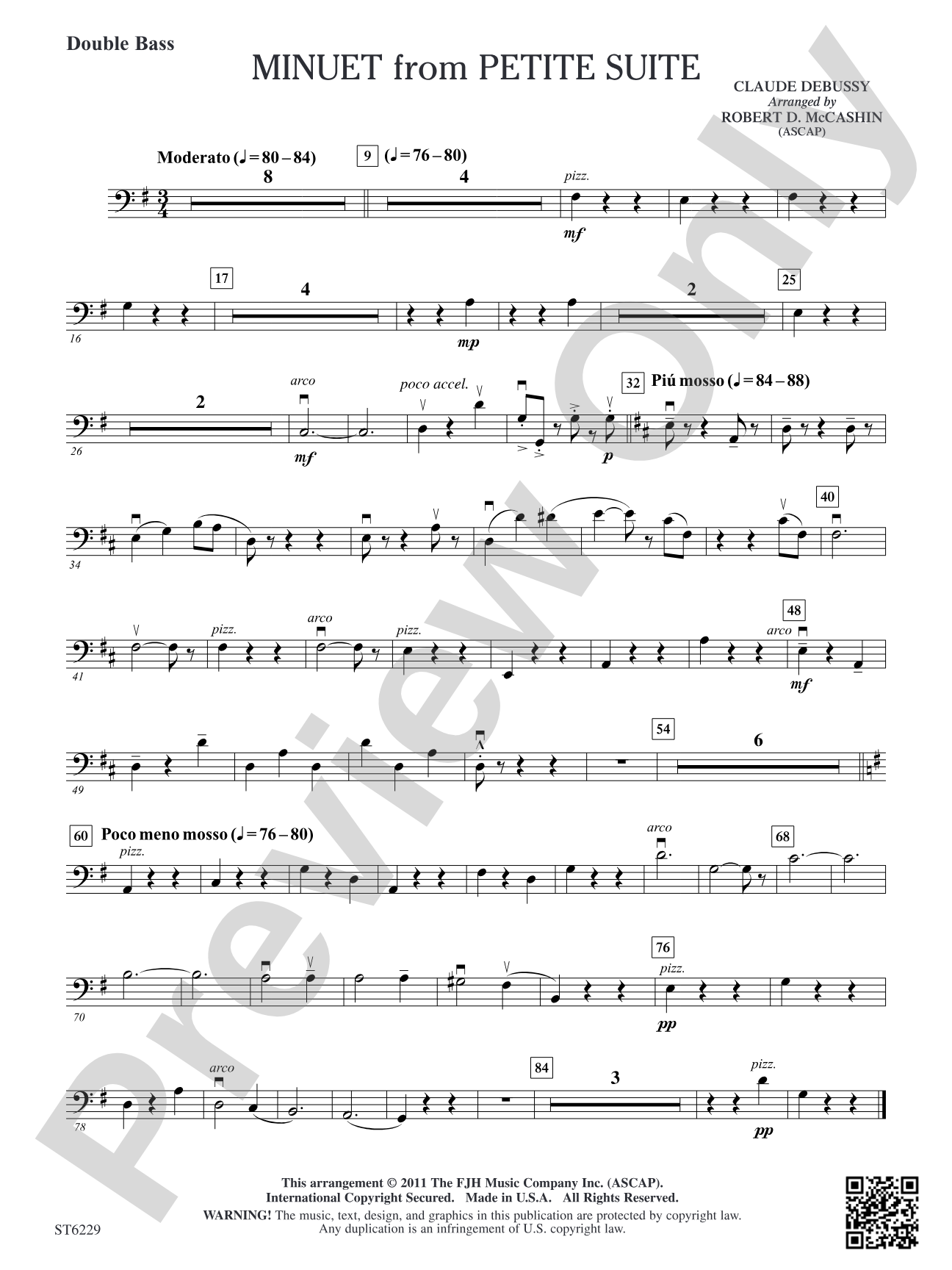
Minuet from Petite Suite: Double Bass

Arranged by Robert D. McCashin

Grade: 5

Item: 98-PC-DST6229_SB

Digital Download
$7.00
Description
This arrangement of the beautiful Minuet (3rd movement) of Debussy's Petite Suite is an excellent example of Debussy's Impressionist style. Often described by Debussy's colleagues and later critics as "pure musical magic," this version retains the complete melodic content as well as Debussy's musical intent. Sure to delight!

Minuet from Petite Suite: Double Bass isn't in MakeMusic Cloud just yet...but it could be. Let us know you'd like to see it, and you'll help shape what comes next. In the meantime, start a free trial and dive into thousands of interactive titles your students can play along with today.

Sample Audio
0:00
0:00
Sample Video
Additional Details
Series: FJH String Orchestra
Publisher: The FJH Music Company, Inc.
SKU: 98-PC-DST6229_SB

More about this title

About the Arranger: Robert D. McCashin

Robert D. McCashin

Robert D. McCashin holds a Doctor of Musical Arts in conducting from the University of Arizona and earned both bachelor and master degrees in violin performance from Louisiana State University. He spent 43 years in higher education, serving as Professor Emeritus and former Director of Orchestras at James Madison University, where he led the Symphony, Chamber Orchestra, and Opera Orchestras from 1992 through 2016. In 2015, he received JMU's Distinguished Teacher Award for the College of Visual and Performing Arts.

McCashin has become a prolific educational arranger, publishing nearly 80 works across Grade 1 through 5 performance levels, many of which have won Editors' Choice recognition in music education circles. Before joining James Madison University, he taught at the University of Texas at Arlington and Texas Wesleyan University, where he also conducted the Arlington Youth Symphony and performed as a freelance violinist throughout North Texas. He is co-author of the widely adopted string class methods New Directions for Strings and A Scale in Time.

Why we love this

McCashin's deep understanding of string writing and 43-year career in orchestral conducting shows in every voice of this arrangement. He preserves the impressionistic delicacy that made Debussy's original so treasured while crafting textures that sit perfectly under student fingers and bows. The Grade 5 level hits the sweet spot where your orchestra can sound genuinely musical without fighting the arrangement.

What to expect

Delicate and luminous. Debussy's Impressionist palette comes alive through shimmering harmonic shifts and gentle melodic contours that float above rippling accompaniment figures. There's an almost dreamlike quality that rewards patient, careful listening and rewards the orchestra that can play with restraint and elegance.

Who it's for

String orchestras at the Grade 5 level seeking a masterwork that challenges them musically without overwhelming technical demands. This arrangement works equally well for advanced middle school programs and community youth orchestras aiming to add serious repertoire to their concert.

How to get the most out of it

  • Shape the phrasing in legit gestures, not mechanically; Impressionist style rewards conductors who think in longer musical lines even when the surface appears fragmentary.
  • Balance the melody generously so it sings above the accompanying voices, but resist the urge to make the accompaniment timid. Debussy's magic lives in the interaction between layers.
  • Emphasize transparent tone production across all sections, especially in the sustained harmonies. This arrangement needs clarity, not weight.

How to use it

Program this as a bridge between lighter pedagogical pieces and the heavier classical repertoire in your season. It pairs beautifully with Baroque string works and creates a sophisticated programming moment that reminds audiences why orchestral color matters. Late fall or spring concerts benefit from its intimate character and visual simplicity.

Skills your students will build

  • Playing sustained tones with consistent tone quality and intonation
  • Responding to subtle dynamic shaping and phrase direction
  • Executing transparent accompaniment figures that support rather than obscure melody
  • Reading and interpreting Impressionist compositional technique and style

You May Also Like