Minuet and Bourrée: 1st Violin Sheet Music Preview

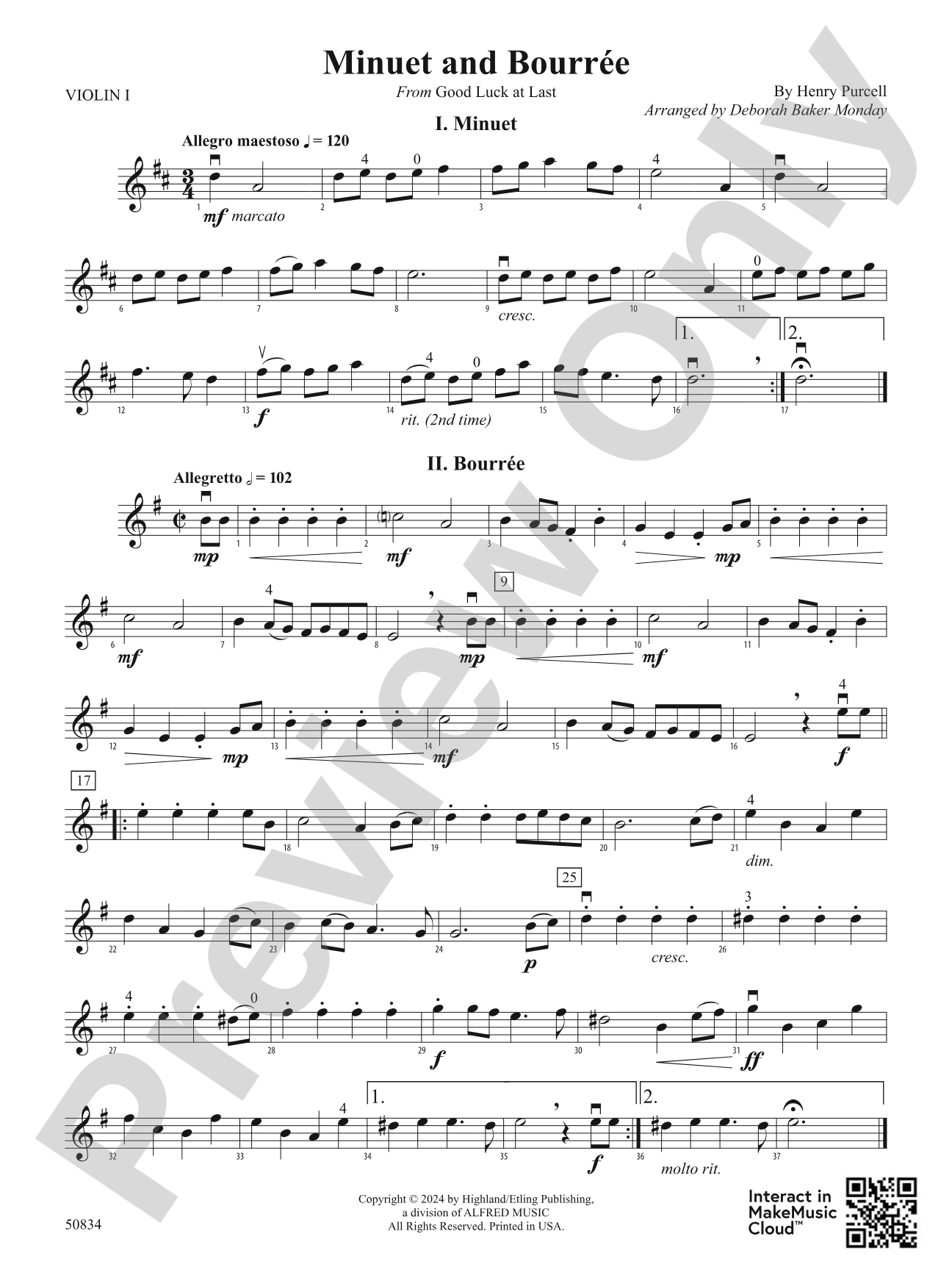
Minuet and Bourrée: 1st Violin

From Good Luck at Last

By Henry Purcell / arr. Deborah Baker Monday

Grade: 2

Item: 00-PC-0019281_VN1

Digital Download
$3.00
Description
Minuet and Bourrée are two of nine dances, written for the stage, from Purcell's 1679 stage work, "Good Luck at Last," and have been delightfully arranged for your string orchestra by Deborah Baker Monday. Both movements are tuneful and offer each student exciting and engaging parts. A terrific selection for reinforcing 3/4 time and cut time. Minuet is in D major, and Bourrée is in E minor. Combined, they make a resonant and exciting selection for concerts or festivals. (2:00)

Don't just read it, hear it, play along with it, and watch your students grow with it. In MakeMusic Cloud, Minuet and Bourrée: 1st Violin comes alive with professional accompaniment, adjustable tempo, and built-in practice tools that turn solo practice into real progress.

Sample Audio
0:00
0:00
Sample Video
Additional Details
Series: Highland/Etling String Orchestra
Publisher: Alfred Music
SKU: 00-PC-0019281_VN1

More about this title

About the Composer: Henry Purcell

Henry Purcell (1659-1695) stands as England's greatest Baroque composer and a defining voice in seventeenth-century music. His output spanned sacred music, instrumental works, and theatrical compositions, all marked by inventive harmonies, expressive melody, and an instinctive understanding of the human voice and instruments. Purcell's stage music, written for plays and semi-operas, showcases his gift for creating memorable dances and functional pieces that nonetheless transcend their theatrical origins.

Why we love this

Purcell's dance movements arrive fully formed and singable, which means your students will sound engaged from the first rehearsal. Deborah Baker Monday's arrangement respects the melodic integrity of the originals while distributing parts so that every section carries musical weight, making this an excellent choice for orchestras where you want equitable writing rather than a top-heavy score.

What to expect

The minuet emerges with courtly poise and gentle forward momentum, inviting careful attention to phrase contour. The bourrée that follows maintains energy and spirited character while shifting into the minor, creating a refreshing textural and harmonic contrast that keeps the listener alert.

Who it's for

String orchestras in grades 2-3 looking for repertoire that teaches metric security without oversimplifying the musical language. Directors building concert programs with historically rooted literature will find these paired dances both accessible and musically substantive.

How to get the most out of it

  • Balance the harmonic foundation in the lower strings; the minuet's D major and bourrée's E minor sonorities depend on clean, sustained accompaniment beneath the melody line.
  • Shape each phrase with subtle dynamic conversation between sections rather than sudden changes; Baroque dance forms thrive on gentle lift and release.
  • Practice the transition between minuet and bourrée separately so the key change lands clearly without rushed tempo shifts.

How to use it

Program these dances as a Baroque pairing on a concert that balances pedagogical clarity with repertoire breadth. The two-minute combined runtime makes them ideal as a standalone feature or as a bridge between larger works, and their success at festivals means they work equally well in competition programming.

Skills your students will build

  • Reading and executing 3/4 and cut time signatures with consistent pulse
  • Balancing sustained harmonic accompaniment while supporting primary melodic lines
  • Responding to key signature changes (D major to E minor) with accurate intonation
  • Phrasing within dance-form structures using period-appropriate articulation and dynamics

You May Also Like