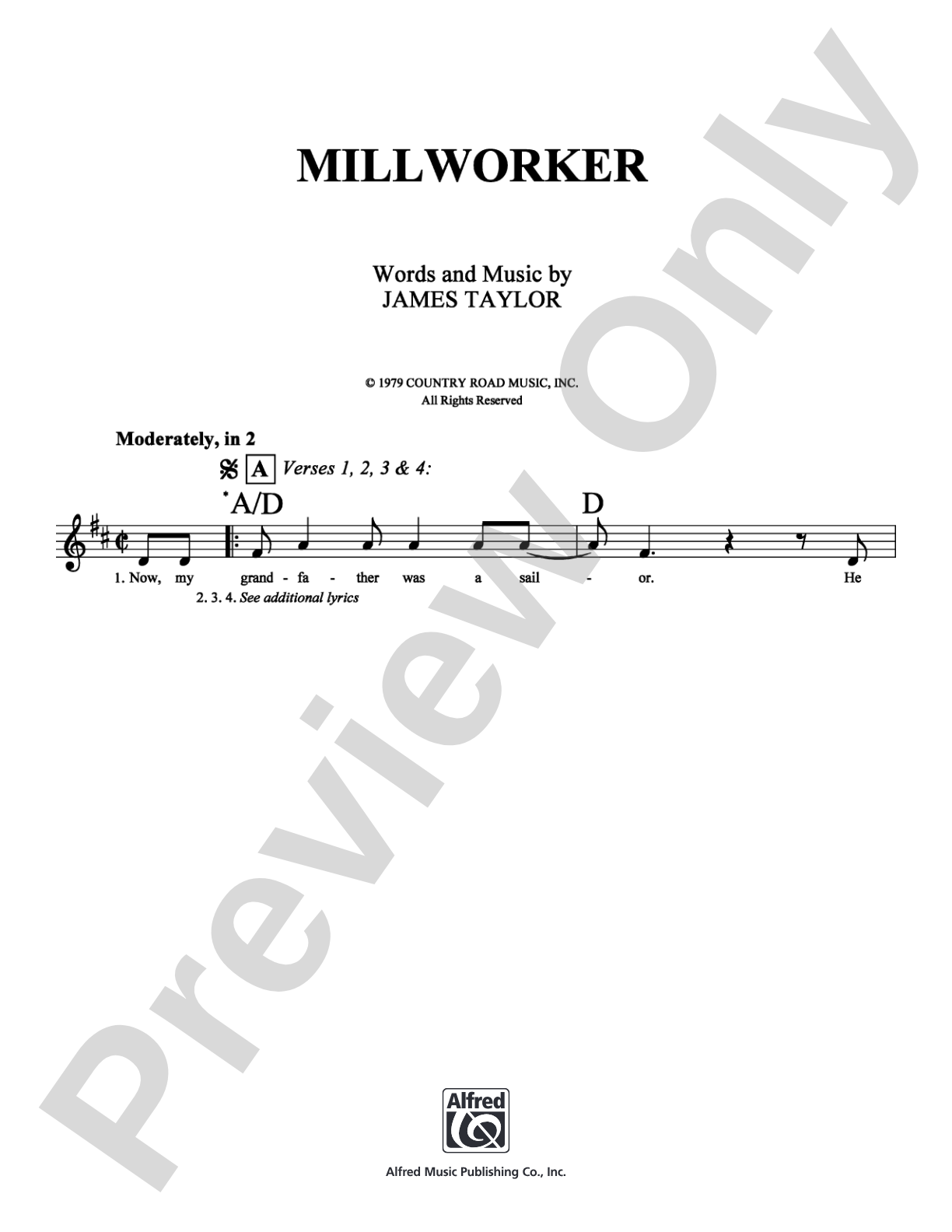
Millworker: Lead Sheet Digital Sheet Music

Millworker: Lead Sheet Digital Sheet Music

James Taylor

Item: 00-PS-0009888

Digital Download
$1.99
Description

Millworker: Lead Sheet Digital Sheet Music isn't in MakeMusic Cloud just yet...but it could be. Let us know you'd like to see it, and you'll help shape what comes next. In the meantime, start a free trial and dive into thousands of interactive titles your students can play along with today.

Sample Audio
No sample audio found.
Sample Video
Additional Details
SKU: 00-PS-0009888

More about this title

About the Artist: James Taylor

James Taylor emerged in the early 1970s as one of America's most influential singer-songwriters, bringing introspective lyrics and accessible melodies to the mainstream. His work spans decades of recording and touring, establishing him as a cornerstone of pop-rock and adult contemporary music with a catalog that speaks directly to classroom and rehearsal contexts where authenticity and emotional clarity matter.

Why we love this

This lead sheet captures a song that rewards careful harmonic analysis and melodic phrasing in a decidedly non-classical context. Students working from lead sheets learn to engage with real-world popular music notation while exploring how Taylor's restrained vocal approach and conversational lyrics demand precision in rhythm and attention to lyrical intent, making it a strong choice for interdisciplinary music study.

What to expect

The song carries an understated, reflective quality; the melody sits close to speech patterns, grounded in a harmonic language that feels both simple and sophisticated. There's an intimate quality here, as if you're listening to someone think out loud rather than perform for a crowd.

Who it's for

This lead sheet works well for high school and college music students exploring the intersection of pop songwriting and harmonic literacy. Piano students, guitarists, and singers tackling contemporary styles will find it a practical resource for understanding how accessible melodies are built on thoughtful harmonic progressions.

How to get the most out of it

  • Treat the melody line as a conversation rather than a showcase; Taylor's strength lies in understatement, so resist the urge to oversing.
  • Pay close attention to rhythmic phrasing around the lyrics, as the natural speech patterns often sit slightly ahead of or behind the beat.
  • Use the harmonic framework to inform dynamic shape; shifts in chord quality should guide subtle changes in vocal intensity without added vibrato.
  • Explore the lead sheet's chord symbols to understand voice-leading options for accompaniment, which opens discussion about how different voicings change the song's emotional weight.

How to use it

Consider this as a bridge between classical and contemporary contexts in a mixed-genre concert, or use it in a songwriting and arranging unit where students analyze how lead sheets translate Taylor's compositional choices. It's also well-suited to accompanying film, spoken word, or theatrical programming where emotional authenticity is central.

Skills your students will build

  • Reading and interpreting lead sheet notation with chord symbols
  • Understanding rhythmic phrasing in conversational, lyric-driven melodies
  • Analyzing harmonic progressions in contemporary pop-rock songwriting
  • Accompanying from a lead sheet with appropriate harmonic voicing choices
  • Identifying and performing with stylistic restraint in modern contexts

You May Also Like