
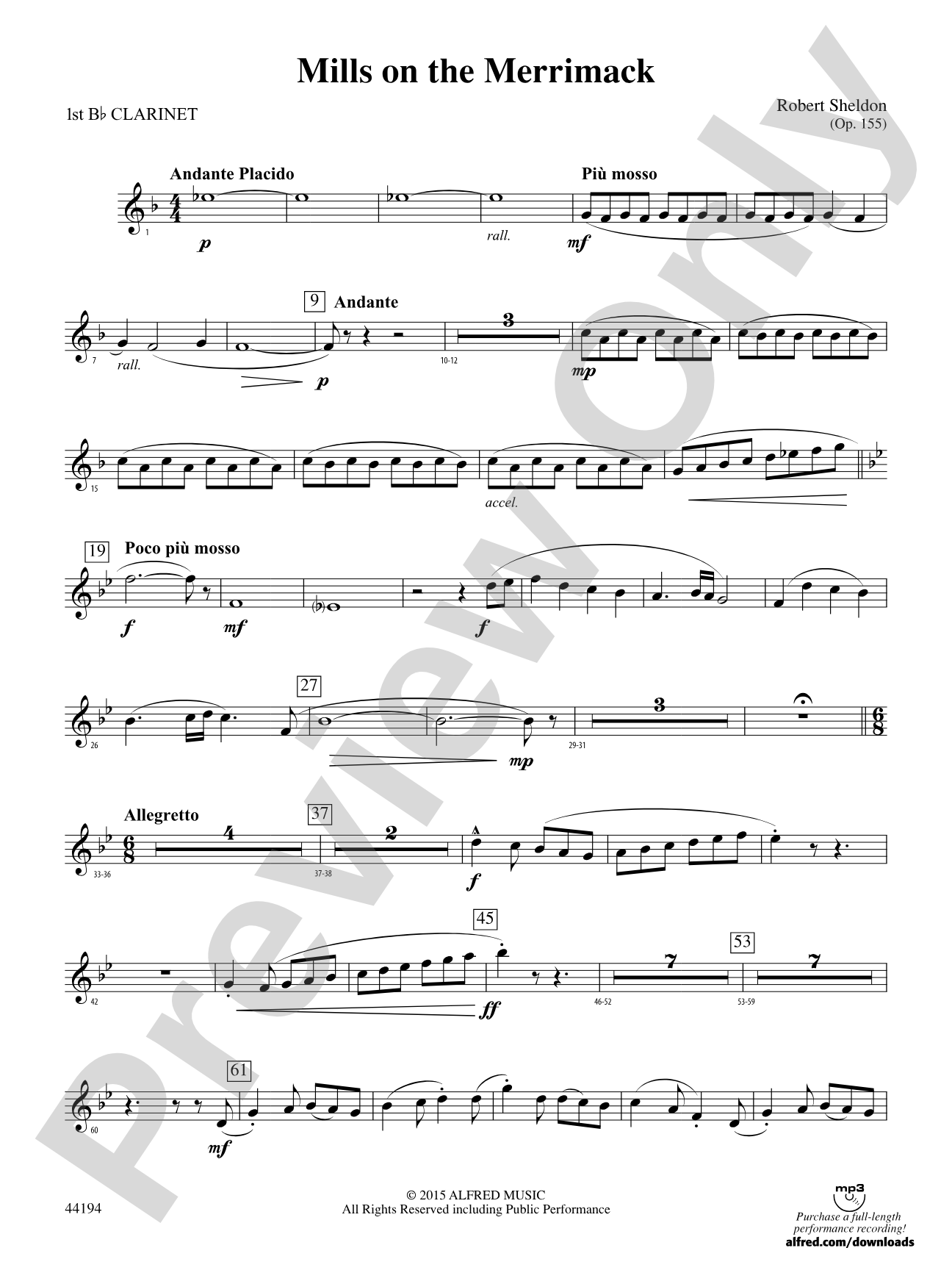

Mills on the Merrimack: 1st B-flat Clarinet
By Robert Sheldon
Grade: 3 (Medium)
Item: 00-PC-0017044_C1
$3.00
Pickup currently not available
Description
"Mills on the Merrimack" presents a musical portrait of Lowell, MA and its mill town traditions. Opening with a view of the river on a misty morning, the music flows with the river into the city of Lowell where industry and the Irish heritage of its settlers is represented. These two main musical themes are then brought together in a way that depicts the bond between the city and its founding citizens. (3:45) This title is available in MakeMusic Cloud.


Don't just read it, hear it, play along with it, and watch your students grow with it. In MakeMusic Cloud, Mills on the Merrimack: 1st B-flat Clarinet comes alive with professional accompaniment, adjustable tempo, and built-in practice tools that turn solo practice into real progress.
Open in the Player
Jump straight in and assign it today.
Start Your Free Trial
Open this title and explore the full library in minutes.
Sample Audio
1
Audio File
--:--
0:00
0:00
Sample Video
No sample videos found.
Additional Details
Series:
Alfred Concert Band
Publisher:
Alfred Music
Page Count:
268
SKU:
00-PC-0017044_C1
More about this title
About the Composer: Robert Sheldon

Robert Sheldon stands among the most frequently programmed composers in concert band literature. His output spans thousands of works performed in schools and concert halls worldwide, and he has received major recognitions from the American School Band Director's Association, Phi Beta Mu, and ASCAP for his contributions to the field.
Beyond composition, Sheldon shapes music education as lead author of Sound Innovations for Concert Band and maintains an active schedule as guest conductor for All-State and Regional Honor Bands. His conducting and clinician work have taken him across the United States and internationally to Japan, Canada, Italy, Germany, Australia, and China. His compositions have been performed at Carnegie Hall, Orchestra Hall in Chicago, Boston Symphony Hall, the Sydney Opera House, and the Kennedy Center for the Performing Arts. In 2020, VanderCook College of Music awarded him an honorary doctorate in recognition of his sustained impact on wind band music.
Why we love this
Sheldon crafts narrative concert pieces that engage both musicians and audiences without relying on excessive technical difficulty. Mills on the Merrimack succeeds because it balances programmatic storytelling with solid Grade 3 scoring that allows bands to achieve genuine musical expression. The structural clarity and memorable themes make this an effective choice for building ensemble cohesion while tackling a piece with real artistic substance.
What to expect
The piece opens with an impressionistic wash suggestive of early morning mist hovering over water, then shifts into the bustle and energy of an industrial mill town. Woven throughout is a sense of place and heritage, with distinct musical characters representing both the natural landscape and the human community that shaped Lowell. The culmination brings these elements together in a way that feels inevitable and earned.
Who it's for
Grade 3 concert bands ready to tackle repertoire with programmatic depth and cultural specificity. This work suits ensembles that respond to storytelling in music and benefit from pieces with clear narrative arc to guide their interpretation and rehearsal focus.
How to get the most out of it
- Shape the opening mist-on-the-river passage with gradual dynamic layering rather than sudden changes. Let the texture build organically as sections enter.
- Emphasize the contrast between the two main themes by adjusting articulation and phrasing distinctly for each. The river music will feel more fluid; the industrial and heritage sections benefit from crisper attack.
- Balance melodic lines between woodwinds and brass throughout the middle section. This piece relies on clear voice-leading to tell its story, so transparent scoring serves the narrative.
- In the final section where themes combine, resist the urge to push tempo. Clarity of how the themes interact matters more than forward momentum.
How to use it
Program this as a centerpiece for a concert celebrating regional or local history. It works equally well in a contest or festival setting where judges appreciate both accessibility and musical substance. The manageable length (3:45) makes it an ideal anchor piece that allows time for additional repertoire in a concert or festival schedule.
Skills your students will build
- Shaping long phrases through gradual dynamic control
- Balancing contrasting melodic lines across sections
- Interpreting programmatic intent through articulation and phrasing choices
- Maintaining clarity and cohesion in multi-section extended forms
- Responding to narrative structure as a guide for musical decision-making