
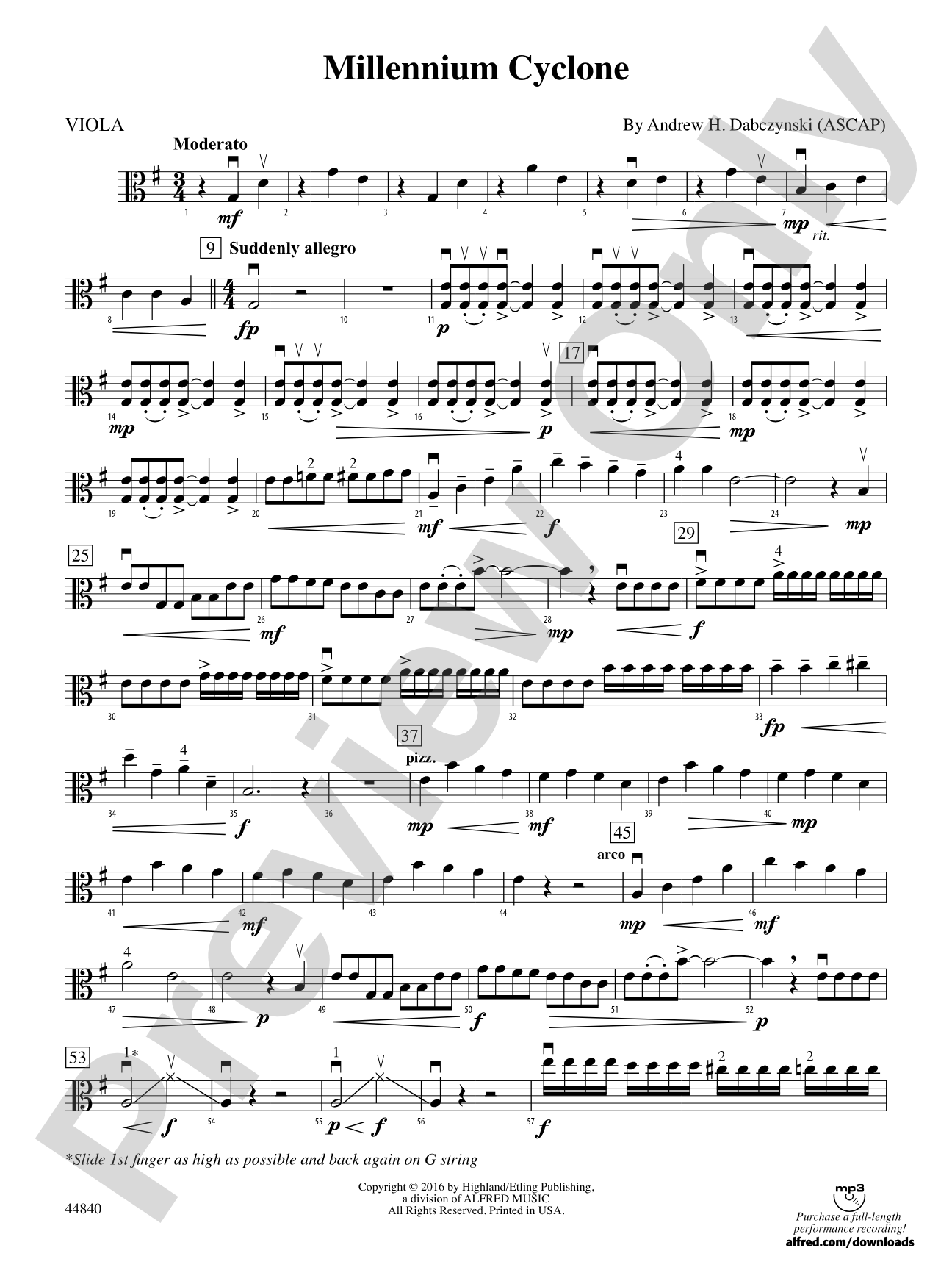

Millennium Cyclone: Viola
By Andrew H. Dabczynski
Grade: 2.5
Item: 00-PC-0017357_VA1
$5.99
Pickup currently not available
Description
Attention thrill-seekers! Invite your orchestra and audience to step aboard the "Millennium Cyclone" roller coaster, and take off on a wild ride! Filled with twists, turns, ups, and downs---and even a moment to catch your breath. Here's an original piece by Andrew H. Dabczynski that will delight and challenge intermediate string players. It's also a chance to introduce repeated 16th note figures and dramatically contrasting dynamics; this one is a sure "must ride!" (3:30)


Don't just read it, hear it, play along with it, and watch your students grow with it. In MakeMusic Cloud, Millennium Cyclone: Viola comes alive with professional accompaniment, adjustable tempo, and built-in practice tools that turn solo practice into real progress.
Open in the Player
Jump straight in and assign it today.
Start Your Free Trial
Open this title and explore the full library in minutes.
Sample Audio
1
Audio File
--:--
0:00
0:00
Sample Video
Additional Details
Series:
Highland/Etling String Orchestra
Publisher:
Alfred Music
Page Count:
128
SKU:
00-PC-0017357_VA1
More about this title
About the Composer: Andrew H. Dabczynski

Andrew H. Dabczynski shaped string education across multiple institutions and roles. He founded BYU's "New Horizons Orchestra" while serving as Emeritus Professor of Music Education at Brigham Young University, creating both a performance ensemble for adult learners and a training ground for future string teachers. His work earned him BYU's Joseph E. White Fellowship for Teaching and Learning. Earlier in his career, he held teaching and administrative positions at the Eastman School of Music and in public school districts across New York and Michigan, including a stint as Fine Arts Supervisor in Waterford, Michigan.
Dabczynski's credentials span performance, research, and curriculum development. He holds a B.M. in viola performance from Eastman, an M.A. from the University of Connecticut (where he performed in the graduate string quartet), and a Ph.D. in Music Education from the University of Michigan. He has performed viola with the Rochester Philharmonic, Hartford Symphony, Portland Symphony, Kalamazoo Symphony, and Greenwich Symphony, and spent six years as a member of the Colden String Quartet at Western Michigan University. His national leadership includes committee work with the American String Teachers Association and past-presidency of Utah ASTA, which honored him in 2005 as Higher Education Teacher of the Year and again in 2014 for Outstanding Contributions to Music Education. He co-authored the String Explorer method series published by Alfred, and his research interests in folk music and ethnomusicology inform his ongoing work in string pedagogy.
Why we love this
Dabczynski writes with intermediate orchestras in mind, and this one proves it. The programmatic hook of a roller coaster ride gives your ensemble a concrete narrative to follow, making rehearsals fun and giving students something memorable to animate during performance. The musical challenges are real—repeated 16th note figures and sharp dynamic contrasts—but scaled to reward players at this level without overwhelming them.
What to expect
Pure kinetic energy wrapped in orchestral color. The ride metaphor isn't mere window dressing; the music actually swings between moments of frenetic activity and sudden stillness, mirroring the physical sensations of acceleration and weightlessness. Those breathing moments give the ear (and the players) a chance to reset before the next surge of forward momentum.
Who it's for
Intermediate string orchestras ready to tackle rhythmic precision and dynamic range within a Grade 2.5 framework. This piece works well for orchestras that have solid fundamentals but need engaging repertoire that stretches them musically without requiring advanced techniques. It's equally suited to concert settings and festival competition.
How to get the most out of it
- Establish the 16th note patterns early in rehearsal. Have the section work through them slowly, then gradually increase tempo to performance speed. Lock the rhythmic precision before layering in the dynamic contrasts.
- Shape the breath moments intentionally. These aren't accidental pauses but opportunities for the audience to register the 'twists and turns' of the ride. Conduct them with clear, generous gestures so the orchestra understands their dramatic function.
- Balance the dynamics across the ensemble. At Grade 2.5, younger sections may naturally pull back during softer passages. Reinforce that subtle volume changes require just as much control as the dramatic drops.
- Use the program concept to guide phrasing. Ask your players to imagine the physical sensations of the ride—the acceleration, the moment of weightlessness, the sudden drop. This translates into more organic, energetic bow strokes and articulation.
How to use it
Program this as an audience favorite on a mixed repertoire concert where it can sit alongside more traditional classics. Its three-and-a-half minute runtime and high engagement factor make it an excellent opener or contrast piece. For festival competition, the programmatic element and musical challenge in equal measure position it as a crowd-pleaser that judges will respect.
Skills your students will build
- Repeating 16th note figures with rhythmic consistency
- Dramatic dynamic contrasts (sudden transitions between soft and loud)
- Sustained bow control during rapid passages
- Listening to ensemble balance while executing technical figures
- Connecting physical narrative to musical phrasing