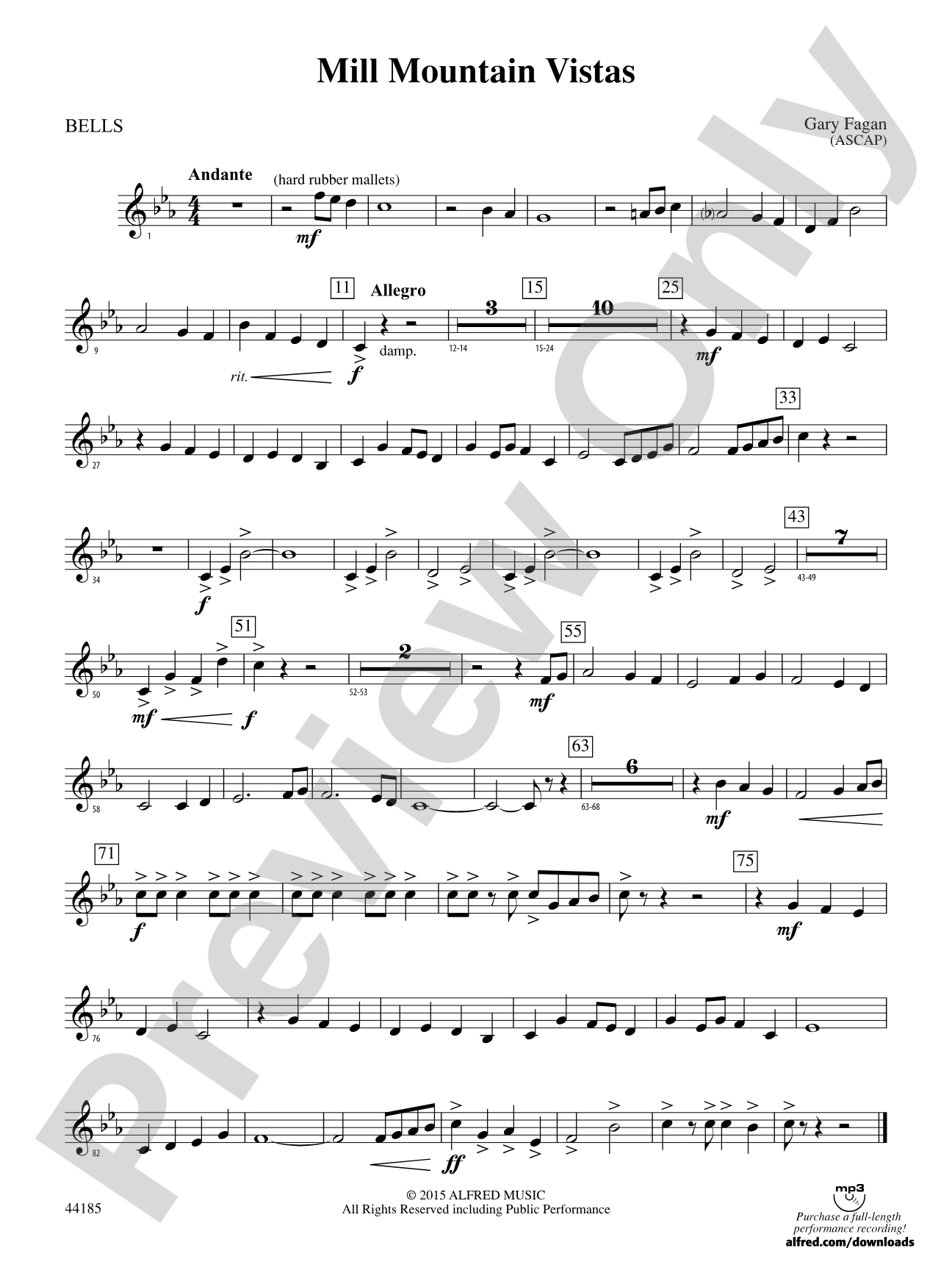
Mill Mountain Vistas: Bells Sheet Music Preview

Mill Mountain Vistas: Bells

By Gary Fagan

Grade: 2 (Medium Easy)

Item: 00-PC-0017035_B

Digital Download
$3.00
Description
This spirited composition for concert band is inspired by Mill Mountain, which is located on the outskirts of Roanoke, VA and provides a wonderful elevated view of both the city of Roanoke and the beautiful Shenandoah Valley. Of particular interest, the mountaintop contains a structure known as the Mill Mountain Star, the world's largest freestanding illuminated man-made star, visible for 60 miles from the air and 1,045 feet above the city of Roanoke. (3:00)

Don't just read it, hear it, play along with it, and watch your students grow with it. In MakeMusic Cloud, Mill Mountain Vistas: Bells comes alive with professional accompaniment, adjustable tempo, and built-in practice tools that turn solo practice into real progress.

Sample Audio
0:00
0:00
Sample Video
Additional Details
Series: Young Symphonic
Publisher: Alfred Music
Page Count: 148
SKU: 00-PC-0017035_B

More about this title

About the Composer: Gary Fagan

Gary Fagan

Gary Fagan brings four decades of band direction experience to his work as a composer and arranger. A graduate of Bridgewater College and James Madison University, he spent 36 years leading bands in Albemarle County before transitioning to university supervision and teaching at JMU, where he guides students in arranging and composition.

Fagan's music has reached audiences at prestigious venues including the Midwest Band and Orchestra Clinic, the White House, and gubernatorial ceremonies. His contributions to music education have been recognized with Central Virginia Outstanding Middle School Teacher honors, Outstanding Educator Awards from the Virginia Governor's School for the Visual and Performing Arts and the Piedmont Council of the Arts, and two listings in Who's Who Among America's Teachers. Active as a clinician, adjudicator, and performer, he serves as Assistant Director of the Charlottesville Band and maintains memberships in ASCAP, Phi Beta Mu Bandmasters Fraternity, and the National Band Association.

Why we love this

Mill Mountain Vistas captures the energy and visual grandeur of its Virginia landmark without overwhelming a Grade 2 ensemble. Fagan's orchestration feels spacious and musical rather than padding out basic harmonic content, giving young musicians real material to sink their teeth into while remaining accessible for early-season programming.

What to expect

The piece radiates optimism and forward motion, evoking both the physical ascent of the mountain and the sweeping views from its peak. Melodic phrases soar over accessible harmonic support, creating a sense of elevation and openness that reflects the natural landscape inspiring the composition.

Who it's for

This work suits Grade 2 concert bands seeking substantial material that builds musicianship without excessive technical demands. It serves as an excellent choice for early-year concerts, festival programming, or as a confidence builder for younger ensembles.

How to get the most out of it

  • Balance the thematic material across sections; the piece's geographic inspiration should shine through clear voice leading rather than one section dominating the texture.
  • Maintain steady pulse and articulation in the rhythmic figures to capture the spirited character without rushing the natural phrasing.
  • Let dynamics shape the elevation imagery of the work; resist the urge to play loudly throughout, using contrast to suggest the vista's expansiveness.

How to use it

Position Mill Mountain Vistas as an opener or early-season concert feature where its spirited character energizes audiences and provides young musicians a chance to showcase growing musicianship. The three-minute duration makes it ideal for festival rotations or balanced concert programming alongside heavier or more contemplative selections.

Skills your students will build

  • Sustaining lyrical melodic lines with consistent breath support and phrasing
  • Balancing textural layers and supporting harmonic material within ensemble context
  • Managing dynamic contrast to shape musical narrative and structural clarity
  • Responding to program music and connecting musical content to extra-musical imagery

You May Also Like