
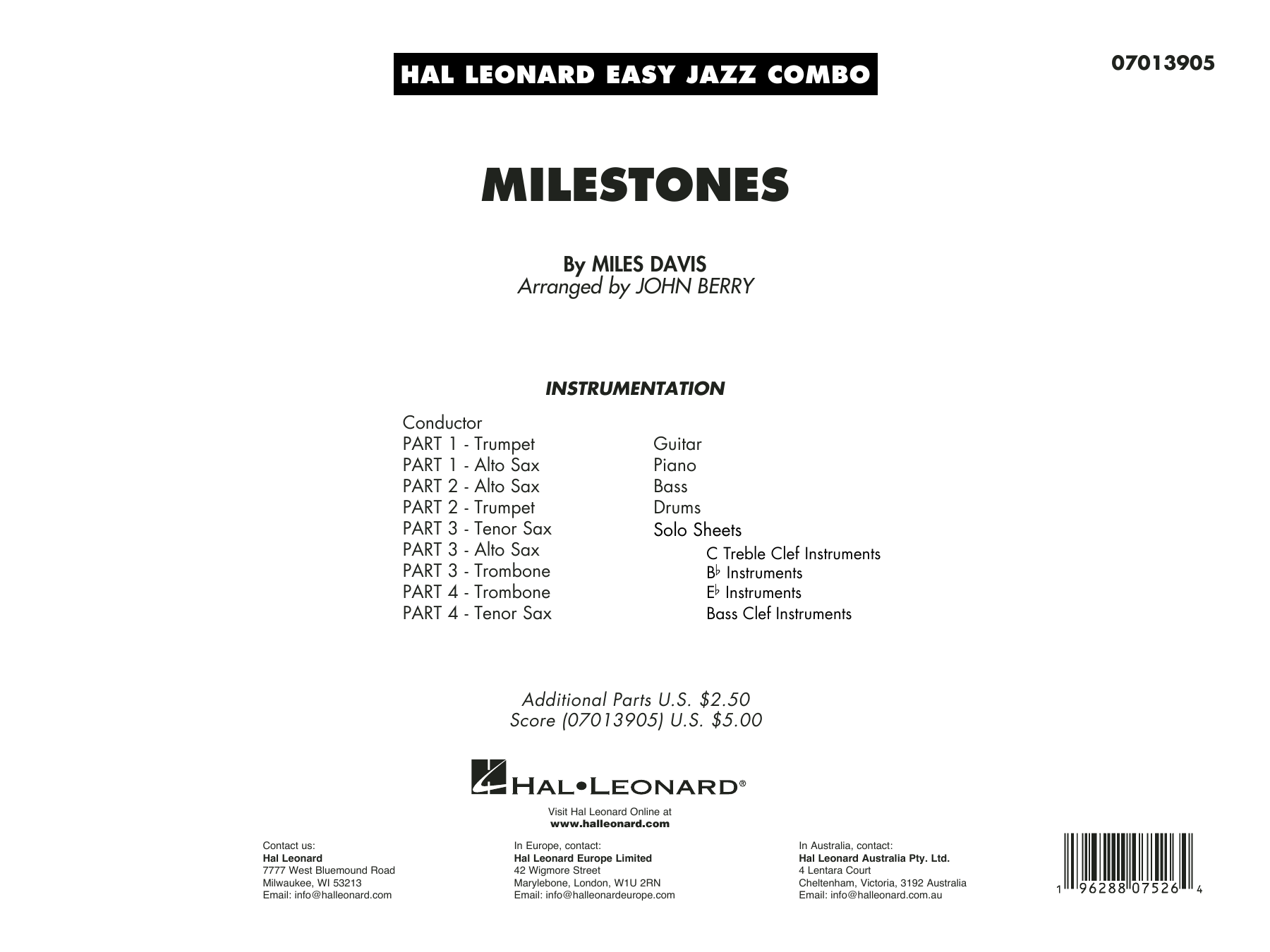

Milestones (arr. John Berry): Jazz Ensemble Conductor Score & Parts
Arranged by John Berry
Grade: 2
Item: 35-PK01116196
$30.00
Pickup currently not available
Buy Extra Parts (Digital PDF Download)
Parts Added to Cart!
Description
Arranged here in a medium swing style, this tune is a great way to introduce the music of Miles Davis to young players. The modal style makes soloing easier and a perfect opportunity to get everyone involved.


Milestones (arr. John Berry): Jazz Ensemble Conductor Score & Parts isn't in MakeMusic Cloud just yet...but it could be. Let us know you'd like to see it, and you'll help shape what comes next. In the meantime, start a free trial and dive into thousands of interactive titles your students can play along with today.
Request This Title
Tell us you want it.
Start Your Free Trial
Explore everything that's ready to play right now.
Sample Audio
No sample audio found.
Sample Video
No sample videos found.
Additional Details
Publisher:
Hal Leonard
SKU:
35-PK01116196
More about this title
About the Arranger: John Berry
John Berry is a prolific arranger whose work appears regularly in jazz education settings, from middle school ensembles through college programs. His arrangements are known for respecting the integrity of the original compositions while making them accessible to developing players, a balance that keeps his catalog in high demand among jazz directors.
Why we love this
Berry's treatment strips away complexity without sacrificing the essence of Davis's composition. The modal harmony opens genuine soloing opportunities for your section players rather than locking everyone into predetermined chord changes, which means your students actually learn how to think through a solo instead of just reading one.
What to expect
Coolly grounded and hypnotic. The modal harmony creates a floating quality that contrasts beautifully with the propulsive swing rhythm beneath it, giving the piece an introspective quality while remaining undeniably swinging.
Who it's for
Jazz ensembles at the Grade 2 level that are ready to move beyond swing standards into the modal vocabulary that defines modern jazz. Sections with developing soloists benefit most, since the harmonic simplicity lets them focus on tone, phrasing, and feel rather than complex changes.
How to get the most out of it
- Establish the swing feel early by having your rhythm section lock in on the medium tempo before you bring the horns in; the groove carries everything else.
- Give soloists permission to stay in one or two dorian or mixolydian positions rather than requiring them to navigate multiple keys; modal soloing sounds sophisticated even when it's spatially simple.
- Balance the trumpet and tenor lines in the head; neither should overwhelm, and clean articulation will make the modal melody land more clearly than volume will.
- Record a rehearsal and listen back for rhythmic precision in the ensemble hits; small tightness issues vanish in the moment but become obvious on playback.
How to use it
Place this on a concert where you're highlighting the evolution of jazz, pairing it with a Bebop-era standard and a contemporary piece to show the arc. It also works well as an ensemble piece sandwiched between features, giving soloists a moment to shine without requiring a full-length tenor or trumpet solo.
Skills your students will build
- Modal soloing in dorian and mixolydian contexts
- Medium swing articulation and feel
- Listening to and responding to other soloists in real time
- Balancing ensemble unity with individual voice
- Reading and executing contemporary jazz notation