
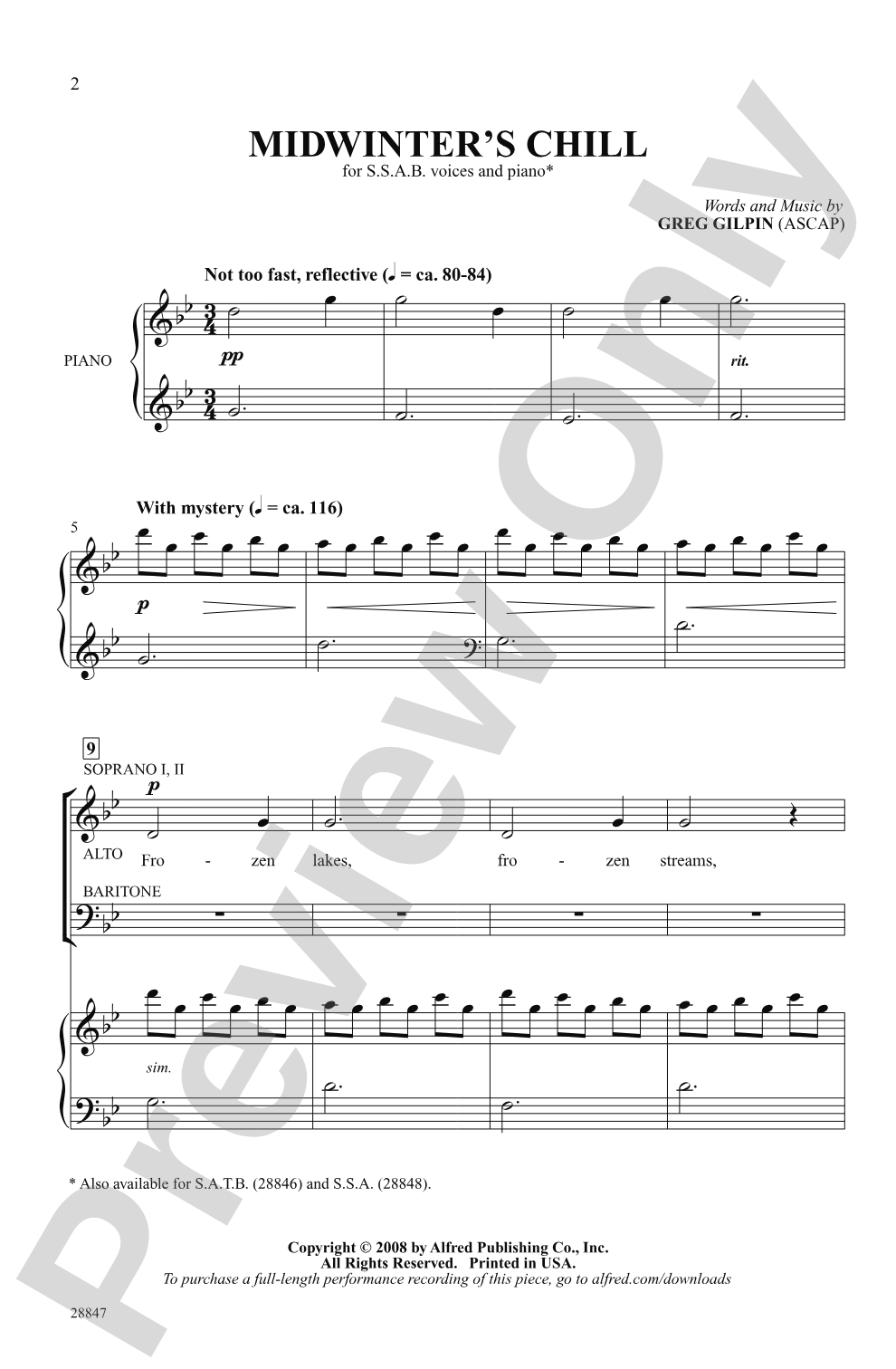
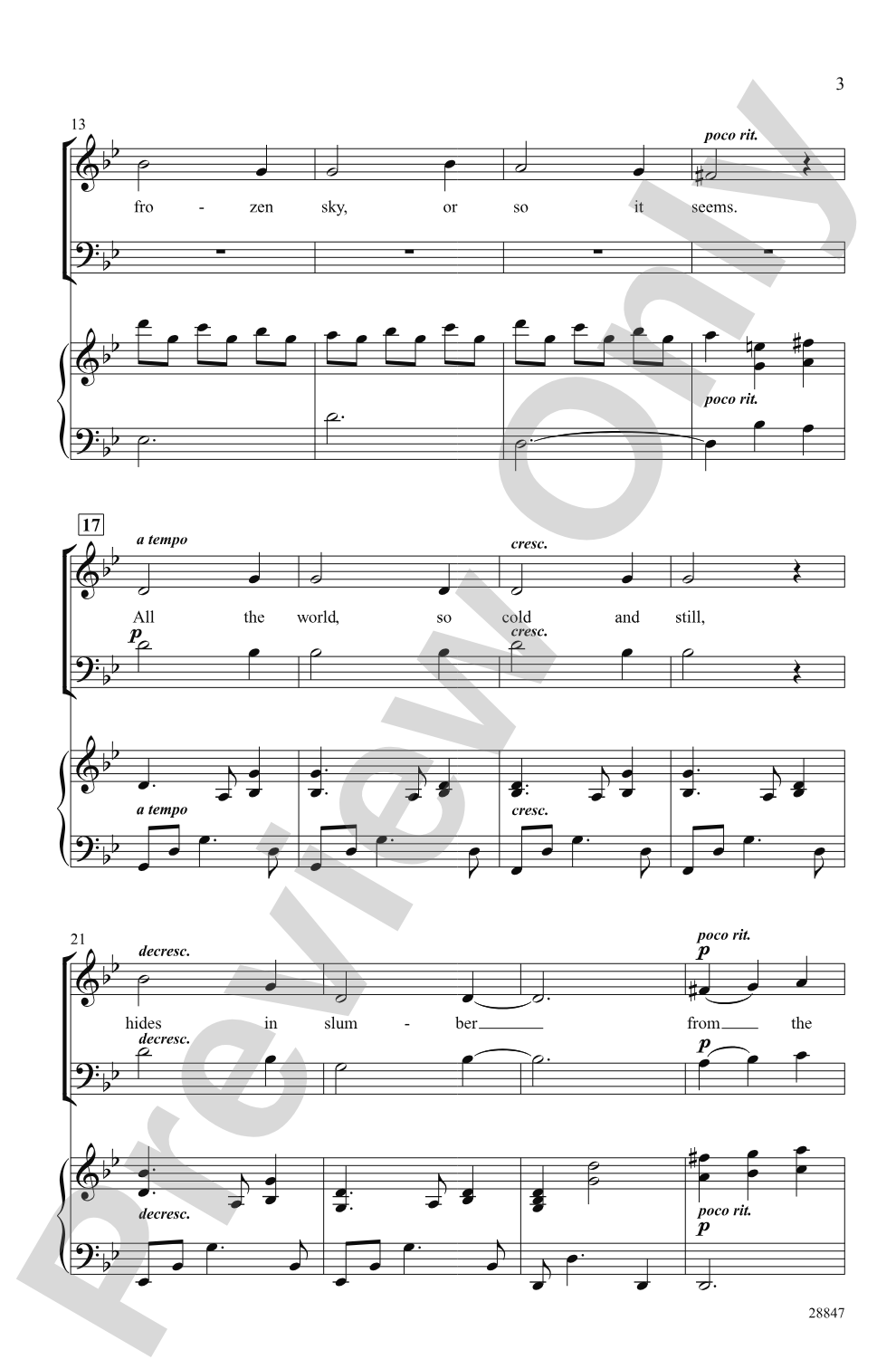
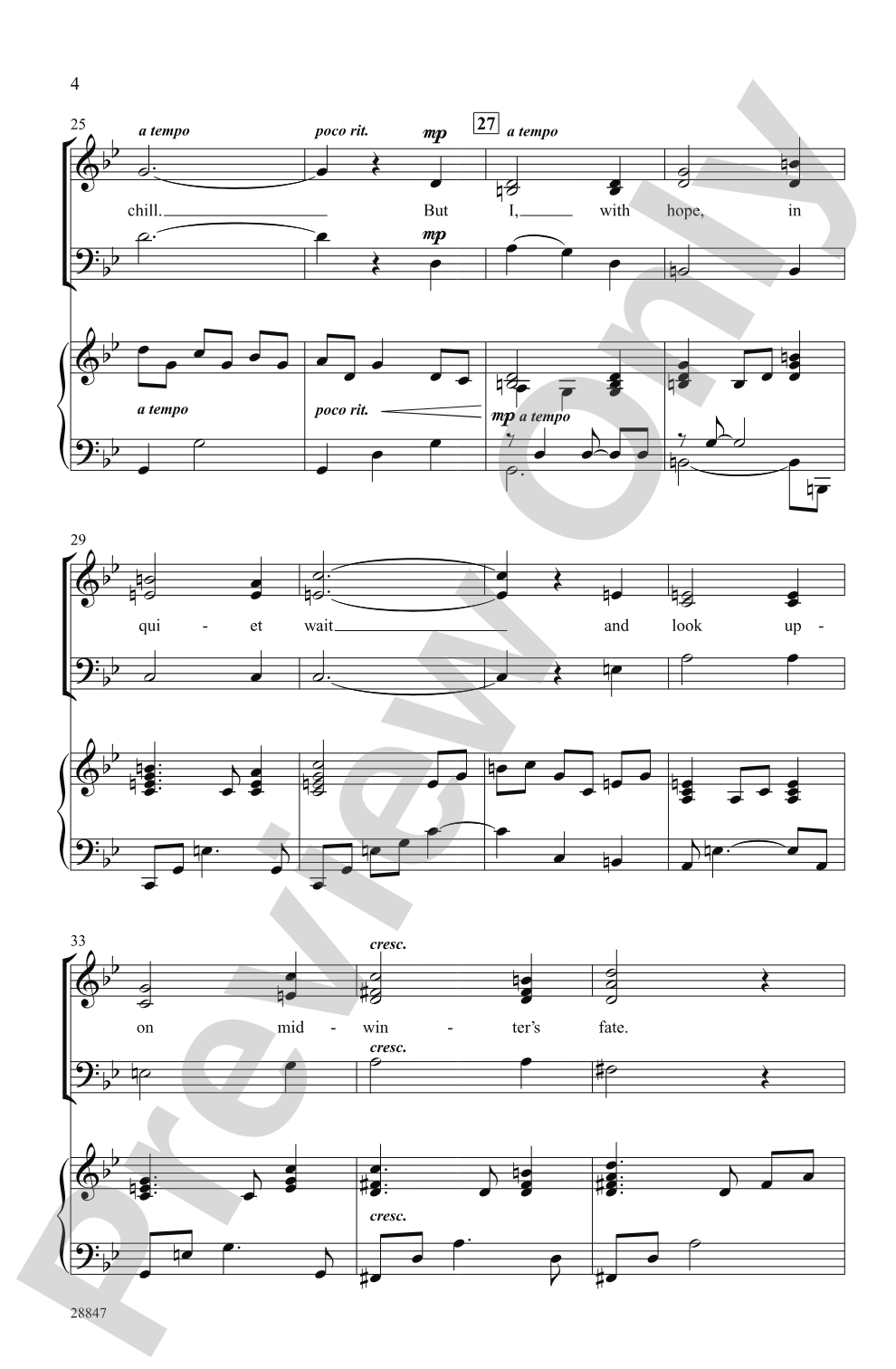

Midwinter's Chill: SSAB Choral Octavo
Words and music by Greg Gilpin
Item: 00-PO-0000590
$2.25
Minimum order quantity: 20 copies
Pickup currently not available
Description
Artistic from start to finish, each of the varied sections of this Gilpin original captures the essence of wintertime. The expressive rubatos, the rich poetry, and the well-placed dissonances will accentuate and cultivate the musicianship of your group. "All the world, cold and still, hides in slumber from the chill."


Midwinter's Chill: SSAB Choral Octavo isn't in MakeMusic Cloud just yet...but it could be. Let us know you'd like to see it, and you'll help shape what comes next. In the meantime, start a free trial and dive into thousands of interactive titles your students can play along with today.
Request This Title
Tell us you want it.
Start Your Free Trial
Explore everything that's ready to play right now.
Sample Audio
1
Audio File
--:--
0:00
0:00
Sample Video
No sample videos found.
Additional Details
Series:
Alfred Choral Designs
Publisher:
Alfred Music
Page Count:
12
SKU:
00-PO-0000590
More about this title
About the Composer: Greg Gilpin

Greg Gilpin's reputation as a choral composer and conductor extends across major performance venues including Carnegie Hall, Lincoln Center, and the Sydney Opera House. His ASCAP-recognized work shapes the landscape of educational choral music as Director of Educational Choral Publications for Shawnee Press, where he continues to craft pieces that challenge and inspire singers at every level.
Beyond the concert stage, Gilpin has expanded his creative reach into film scoring and collaborative projects with accomplished vocalists, while also establishing himself as a certified organizing professional and financial coach. His multifaceted career reflects a commitment to bringing order, artistry, and intention to every endeavor he undertakes.
Why we love this
Gilpin's winter setting avoids sentimentality by grounding the piece in concrete imagery and harmonic sophistication. The strategic use of dissonance and rubato gives singers room to shape phrases expressively, which means your group learns to listen deeply to one another rather than simply executing written notes. For a three-part mixed ensemble, this offers genuine artistic challenge without requiring soloistic voices.
What to expect
The piece settles into a world of quietness and introspection, where cold becomes a metaphor for both isolation and clarity. The harmonic language creates moments of unease alongside stretches of calm beauty, mirroring the visual and emotional landscape of deep winter.
Who it's for
This works well for developing treble or mixed choirs seeking repertoire that treats them as serious musicians capable of handling expressive complexity. It suits winter concert programming where you want something artistically substantive rather than purely festive.
How to get the most out of it
- Honor the rubato markings as compositional choices, not as permission to rush or drag unpredictably. Map phrase arcs with your singers so they understand where the music breathes and where it leans forward.
- Balance the dissonances carefully during sectional rehearsals. Have singers sustain the clashing intervals in isolation so they hear the tension as intentional color rather than error.
- Emphasize the poetry throughout rehearsal. Read the text aloud as a group before singing it, paying attention to the images of stillness and cold that shape the musical phrasing.
- Allow the soloists or smaller sections moments of vulnerability in performance. This piece gains its power from contrast between intimate moments and fuller passages.
How to use it
Pair this with contrasting seasonal pieces that emphasize warmth or renewal to create a thoughtful arc across your winter concert. It functions beautifully as a centerpiece that allows audiences to experience a full emotional arc rather than skating through lighter fare.
Skills your students will build
- Expressive use of rubato and phrasing within a through-composed structure
- Intonation control when singing minor seconds and other close intervals
- Interpretation of dissonance as compositional intent rather than technical error
- Blending three-part harmony while maintaining individual line independence
- Textual interpretation and how poetic imagery shapes musical expression