
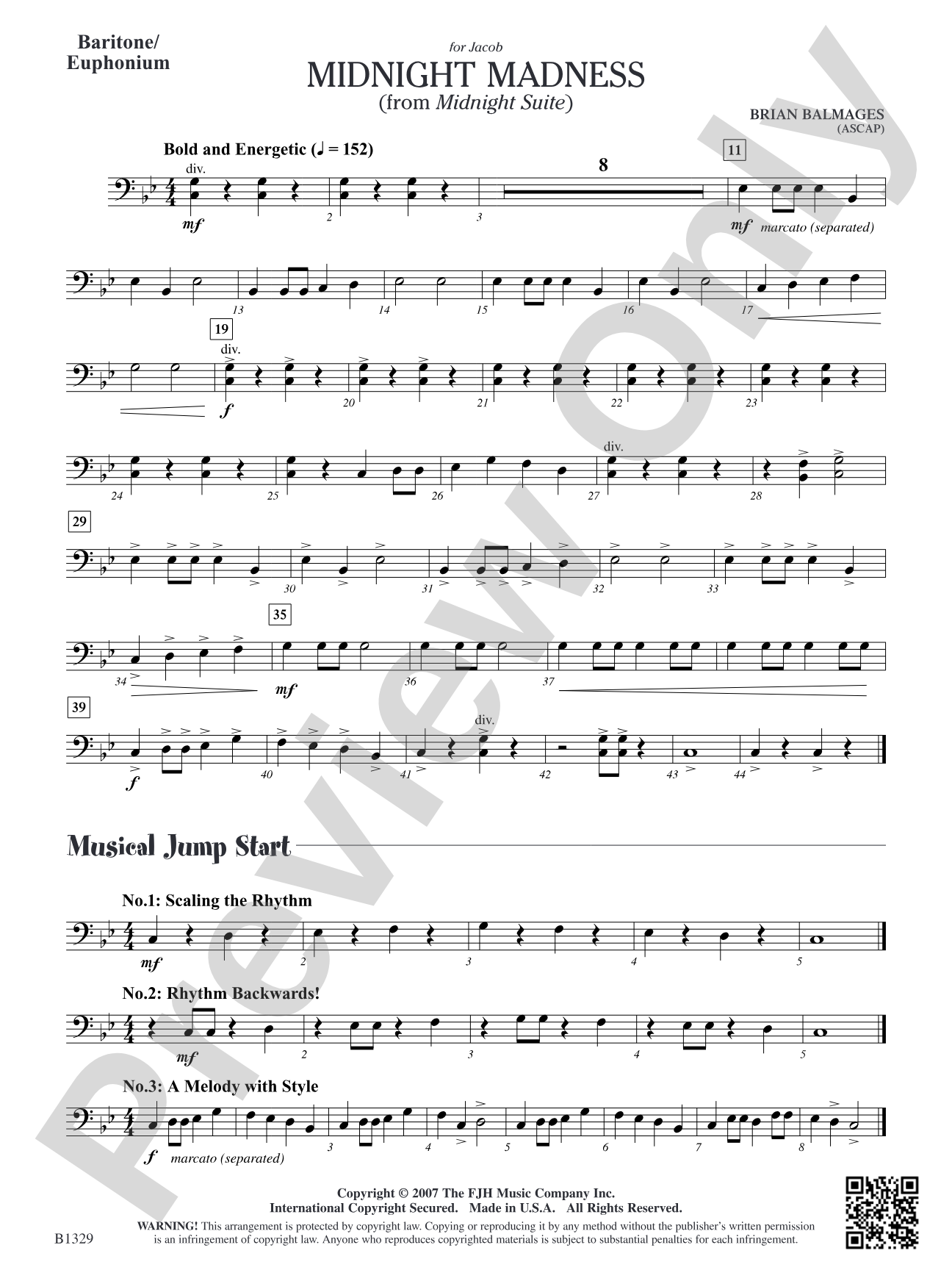

Midnight Madness (from Midnight Suite): Baritone/Euphonium
from Midnight Suite
By Brian Balmages
Level:.5
Item: 98-PC-DB1329_BBC1
$7.00
Pickup currently not available
Description
The third and final movement of Midnight Suite certainly lives up to its name! With the first two movements having become favorites of directors around the world, the final movement includes fanfares and short recurring rhythmic motives that really drive the music forward. Experience all the madness of this work, playable alone or with the first two movements, Midnight Mission and Midnight Sky.


Don't just read it, hear it, play along with it, and watch your students grow with it. In MakeMusic Cloud, Midnight Madness (from Midnight Suite): Baritone/Euphonium comes alive with professional accompaniment, adjustable tempo, and built-in practice tools that turn solo practice into real progress.
Open in the Player
Jump straight in and assign it today.
Start Your Free Trial
Open this title and explore the full library in minutes.
Sample Audio
1
Audio File
--:--
0:00
0:00
Sample Video
No sample videos found.
Additional Details
Series:
FJH Starter Series
Publisher:
The FJH Music Company, Inc.
SKU:
98-PC-DB1329_BBC1
More about this title
About the Composer: Brian Balmages

Brian Balmages has built an international reputation as a composer whose works span orchestral, band, and chamber idioms with equal fluency. His compositions have premiered in prestigious venues including Carnegie Hall, the Kennedy Center, and Sydney Opera House, performed by ensembles ranging from professional orchestras to elementary school groups. He received the A. Austin Harding Award from the American School Band Directors Association and won the 2020 NBA William D. Revelli Composition Contest. An elected member of the American Bandmasters Association, Balmages has been honored with the inaugural James Madison University Distinguished Alumni Award and was commissioned by the University of Miami to compose for the presidential inauguration ceremony.
As a conductor, Balmages maintains an active schedule guest conducting all-state ensembles, university groups, and professional orchestras across North America, Europe, and Australia. His appearances include engagements at the Midwest Clinic, Western International Band Clinic, and the American School Band Directors Association National Conference. He currently serves as Director of MakeMusic Publications and Digital Education for Alfred and MakeMusic.
Why we love this
Balmages knows what Level 0.5 conductors need: music that sounds dramatic and sophisticated without overwhelming inexperienced players. The recurring rhythmic motives and fanfare writing create momentum that carries even through exposed passages, and the fact that it can stand alone or connect to the earlier movements gives you programming flexibility without forcing a commitment to the full suite.
What to expect
Midnight Madness erupts with fanfares and propulsive rhythmic figures that feel both playful and confident. The recurring motives create a sense of forward momentum and inevitability, painting a soundscape of controlled excitement rather than chaos.
Who it's for
Beginning and developing concert bands at the middle school and early high school level will find this finale accessible and rewarding. The Level 0.5 scoring removes the technical barriers while preserving the character and drive that make this movement exciting to perform and hear.
How to get the most out of it
- Shape the fanfares with clarity rather than speed; young players will lock in better if you isolate the rhythmic kernel first, then add the melodic contour.
- Let the recurring motives breathe as they cycle through different sections; resist the urge to accelerate incrementally, as the forward drive comes from the writing itself, not tempo inflation.
- Balance the energy of the madness against moments of rest; even brief pauses between motive statements give the band room to reset and hear their own contribution.
- Rehearse the transitions between thematic areas separately so that momentum builds through intentional orchestration choices, not just conductor enthusiasm.
How to use it
Program this as a concert finale or showcase piece in a contest or festival setting where directors want to end on an energetic note. If you have performed Midnight Mission or Midnight Sky in an earlier concert, this movement provides an elegant capstone, though its standalone character makes it equally effective as a single-movement feature.
Skills your students will build
- Playing fanfare figures with rhythmic precision and clear articulation
- Tracking recurring melodic motives as they pass between sections
- Maintaining ensemble energy and momentum through multiple repetitions of thematic material
- Balancing individual part clarity with overall band texture in accessible ranges