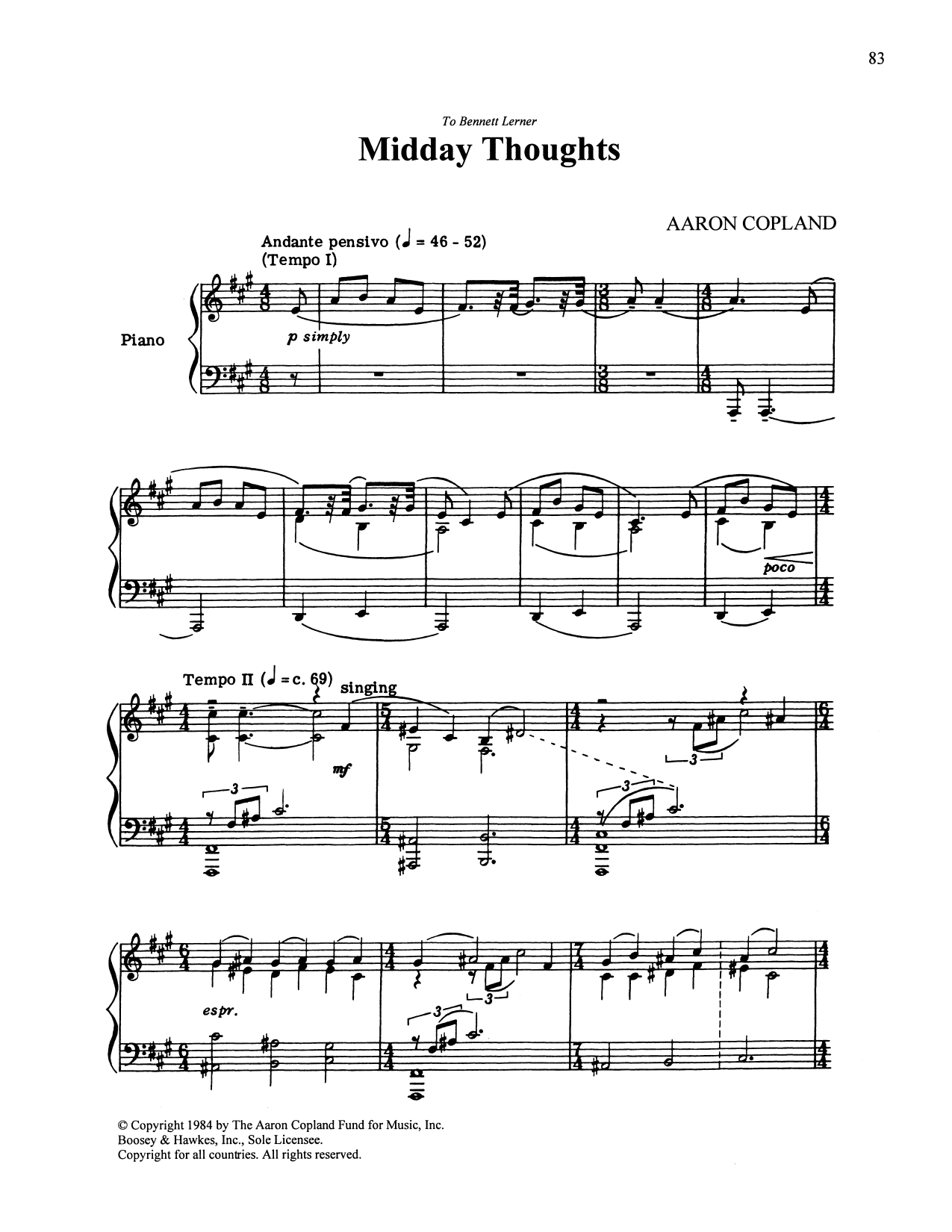
Midday Thoughts Sheet Music Preview

Midday Thoughts: Piano Solo

By Aaron Copland

Item: 35-DS01979711

Digital Download
$5.99
One moment…
Description

Discover MakeMusic Cloud: thousands of interactive titles your students can play along with today.

Sample Audio
No sample audio found.
Sample Video
Additional Details
Publisher: Hal Leonard
Page Count: 3
SKU: 35-DS01979711

More about this title

About the Composer: Aaron Copland

Aaron Copland (1900-1990) shaped American classical music by grounding his compositions in vernacular idioms: folk melodies, hymns, and popular song. His gift was making concert music feel accessible without sacrificing sophistication, a balance that made him one of the most performed American composers in the classroom and concert hall.

Copland's piano works span his entire career and offer pianists direct access to his compositional voice. These pieces reward close attention to harmonic color and rhythmic nuance, and they remain essential touchstones for understanding twentieth-century American music.

Why we love this

Copland's gift for distilling big emotional ideas into elegant musical statements shines here. Students get a genuine encounter with modernist harmony and form in a piece compact enough to learn thoroughly, making it ideal for recitals, festivals, or simply showing what thoughtful American composition sounds like.

What to expect

Quiet introspection punctuated by moments of clarity. The harmonic language feels modern yet grounded, contemplative without sentimentality. There is space in this piece; silence and simplicity matter as much as the notes themselves.

Who it's for

This solo works well for late intermediate to advanced pianists preparing contest or recital material. It suits students ready to engage with twentieth-century idiom and those studying American composers across the curriculum.

How to get the most out of it

  • Allow the harmonic language to breathe. Copland's chords often contain unexpected color; resist rushing through passage work and give listeners time to hear the sonorities.
  • Shape the melodic line with long-range direction rather than phrase-by-phrase dynamics. This piece rewards a performer who thinks architecturally.
  • Attend carefully to pedal marking and changes. The sustain pedal becomes a compositional tool here, not an ornament.

How to use it

Pair this with other American piano works from the twentieth century to create a coherent concert segment. A recital featuring Copland, Barber, and Gershwin tells a clean story about how American composers engaged with modernism. It also works as a thoughtful closing piece on a mixed program.

Skills your students will build

  • Interpreting twentieth-century harmonic language and voice leading
  • Balancing modernist aesthetics with lyrical expression
  • Pedal technique and how sustain shapes harmonic color
  • Long-range phrasing and structural direction
  • Sight-reading and performance of early-to-mid twentieth-century notation

You May Also Like