
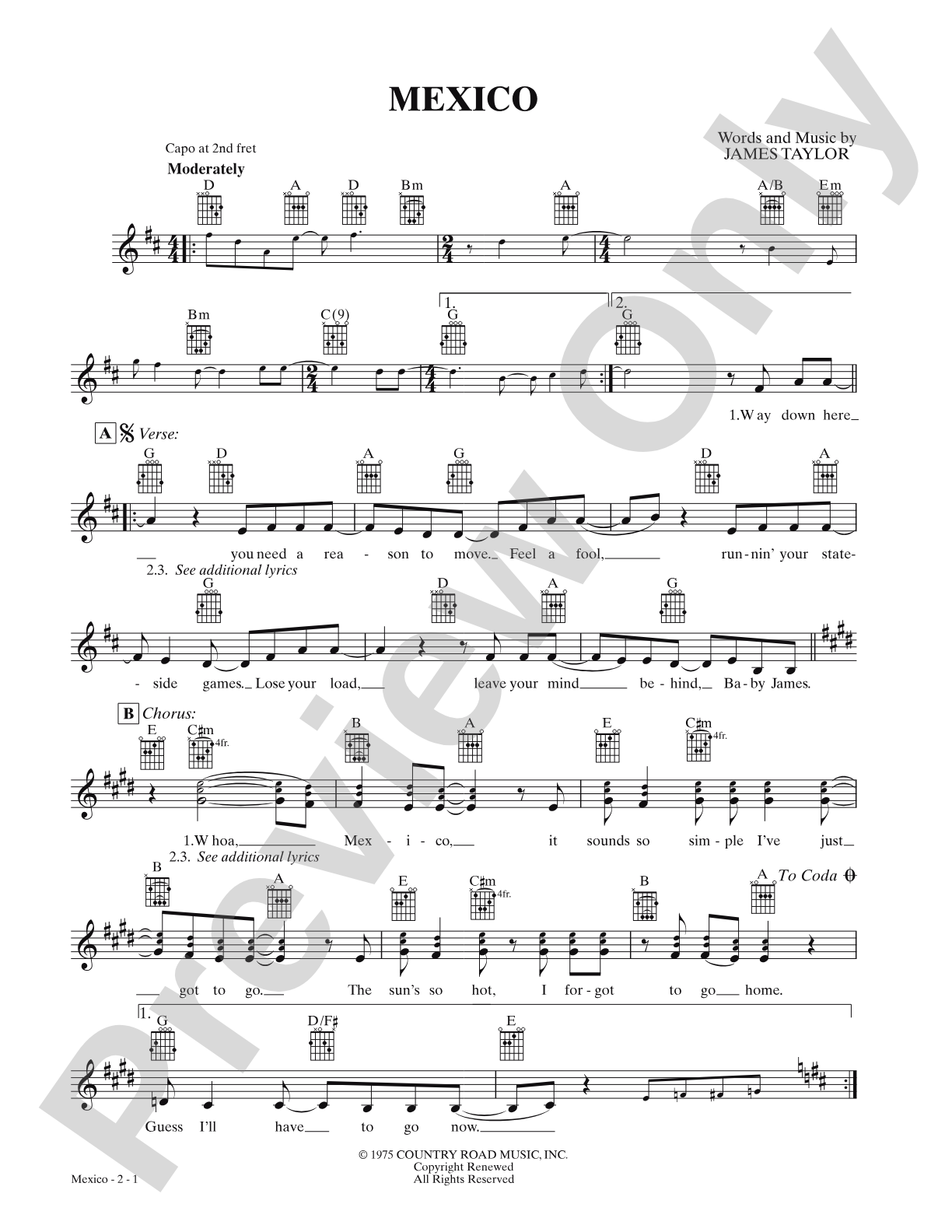

Mexico: Lead Sheet
James Taylor
Item: 00-PSL-000576
$4.99
One moment…
Description
Sweet Baby James * Traffic Man * Handy Man * Your Smiling Face * Secret O' Life * Shed a Little Light * Everybody Has the Blues * Steamroller Blues * Mexico * Millworker * Country Road * Fire and Rain * Shower the People * How Sweet It Is * New Hymn * Walking Man * Riding on a Railroad * Something in the Way She Moves * Sun on the Moon * Up on the Roof * Don't Let Me Be Lonely Tonight * She Thinks I Still Care * Copperline * Slap Leather * Only One * You Make It Easy * Carolina in My Mind * I Will Follow * You've Got a Friend * That Lonesome Road.


Mexico: Lead Sheet isn't in MakeMusic Cloud just yet...but it could be. Let us know you'd like to see it, and you'll help shape what comes next. In the meantime, start a free trial and dive into thousands of interactive titles your students can play along with today.
Request This Title
Tell us you want it.
Start Your Free Trial
Explore everything that's ready to play right now.
Sample Audio
No sample audio found.
Sample Video
No sample videos found.
Additional Details
Publisher:
Alfred Music
Page Count:
148
SKU:
00-PSL-000576
More about this title
About the Artist: James Taylor
James Taylor emerged as one of America's most distinctive singer-songwriters in the early 1970s, bringing introspective lyrics and fingerstyle guitar work to the forefront of popular music. His catalog spans five decades of songwriting, from intimate ballads to uptempo pop-rock, and his influence on contemporary music education extends across piano, guitar, and vocal instruction worldwide.
Why we love this
This collection gives pianists and vocalists access to some of the most singable, emotionally direct melodies in the American songbook. The repertoire ranges from reflective material like 'Fire and Rain' to groovy, rhythmically engaging pieces like 'Steamroller Blues,' making it equally valuable for recital programming, jazz ensemble charts, or capturing your singers' genuine engagement with contemporary song.
What to expect
These songs inhabit a conversational, often introspective world where every phrase feels genuinely meant. Whether navigating the wistful geography of 'Carolina in My Mind,' the steady resilience of 'You've Got a Friend,' or the rhythmic warmth of 'How Sweet It Is,' performers encounter melodies designed around natural speech patterns and emotional authenticity rather than vocal display.
Who it's for
Piano and voice students seeking repertoire that bridges classical training with contemporary songwriting deserve music that rewards both technical skill and emotional honesty. This collection serves pianists accompanying vocalists, student pianists building a recital program, and voice students wanting to develop interpretive maturity through well-crafted popular material.
How to get the most out of it
- Study the chord voicings closely; Taylor's harmonic language often favors open intervals and suspended chords that require thoughtful voice leading at the piano to sound natural rather than cluttered.
- Lock into the rhythmic pocket of each tune before layering melody and lyric; many of these songs have subtle grooves that feel flat without precise rhythmic intention from the accompanist.
- Shape phrases around Taylor's lyrical phrasing rather than strict melodic contour; the text often determines breath points and dynamic shape more than the notated melody alone.
- Experiment with minimal accompaniment first, especially on ballads; adding texture and fullness comes after establishing what the song truly needs at its core.
How to use it
Build a recital or concert featuring Taylor's work as a thematic program, pairing contrasting moods across the thirty songs included here. These pieces also integrate well into chamber music or collaborative piano contexts, and several selections work particularly well for student showcases or informal performance settings where storytelling and connection matter more than technical virtuosity.
Skills your students will build
- Reading and interpreting chord symbols with jazz-influenced voicings (suspended chords, added ninths, modal borrowing)
- Coordinating melody and accompaniment when the vocal line and harmonic rhythm operate independently
- Building textural arrangement choices at the piano based on lyrical content and phrasing
- Singing or accompanying music in contemporary popular styles with stylistic authenticity
- Developing interpretive choices around dynamics, tempo, and phrasing in singer-songwriter material