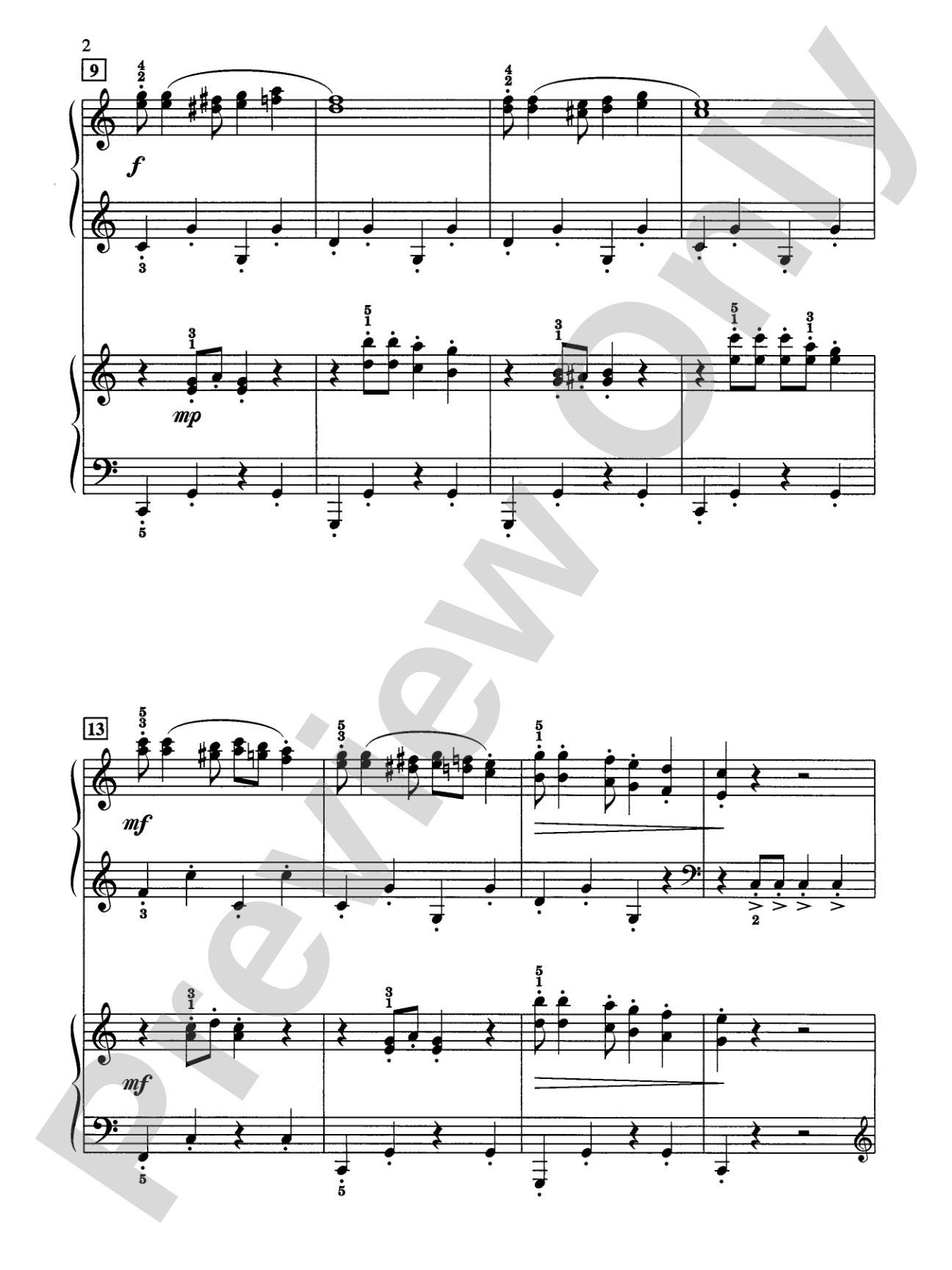
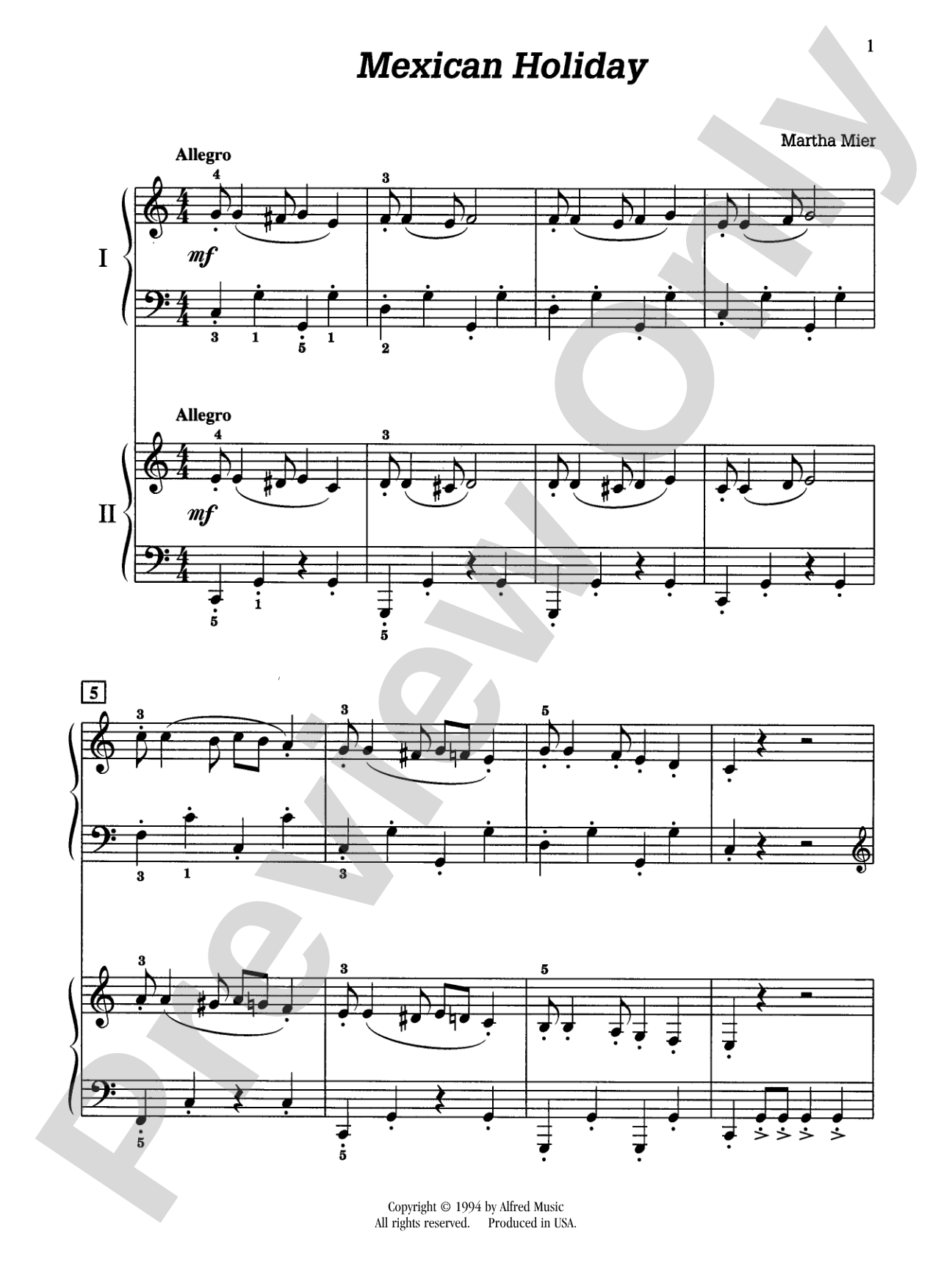
Mexican Holiday - Piano Duo (2 Pianos, 4 Hands) Sheet Music Preview

Mexican Holiday - Piano Duo (2 Pianos, 4 Hands): Piano Duo (2 Pianos, 4 Hands)

By Martha Mier

Level: Intermediate

Item: 00-PS-0017453

Digital Download
$4.99
Description
This is a perfect ensemble piece for performance on 2 pianos, with 2 intermediate level performers. It is arranged in C major, with festive Latin rhythms, staccatos, accents, and nice dynamic contrasts. Two copies are included. A Federation Festivals 2024-2028 selection.

Mexican Holiday - Piano Duo (2 Pianos, 4 Hands): Piano Duo (2 Pianos, 4 Hands) isn't in MakeMusic Cloud just yet...but it could be. Let us know you'd like to see it, and you'll help shape what comes next. In the meantime, start a free trial and dive into thousands of interactive titles your students can play along with today.

Sample Audio
No sample audio found.
Sample Video
Additional Details
Publisher: Alfred Music
Page Count: 8
SKU: 00-PS-0017453

More about this title

About the Composer: Martha Mier

Martha Mier

Martha Mier has shaped music education for decades through her prolific output of accessible, engaging piano repertoire. Since joining Alfred Music Publishing in 1989, she has become one of the most performed educational composers worldwide, with works ranging from the Jazz, Rags & Blues series to Romantic Impressions collections. Her students span the globe and play her music daily in practice rooms and recitals.

Mier's credentials run deep: she holds a degree from Florida State University, maintained a private studio in Lake City, Florida for many years, and remains an active church musician and accompanist. She serves on multiple professional boards including the Music Teachers National Association, the Florida State Music Teachers Association, and the National Guild of Piano Teachers. As a frequent clinician and adjudicator, she has led workshops internationally and at major conferences, and she co-authored Alfred's Premier Piano Course alongside over 200 other educational publications.

Why we love this

Mier writes for two pianos with real understanding of how intermediate players interact at separate instruments. The rhythmic vitality keeps both performers engaged without requiring unequal technical demand, and the festive character makes this a natural choice for holiday programming or year-end celebrations without feeling saccharine. Its Federation recognition signals that adjudicators recognize this as solid, purposeful writing.

What to expect

The piece radiates celebration. C major brightness combined with Latin rhythmic drive creates an immediate sense of festivity, while the staccatos give it a playful bounce and the dynamic contrasts prevent any section from feeling flat. Two pianos fill the room with color and momentum.

Who it's for

Intermediate pianists ready to experience the energy of ensemble performance without the complexity of coordinating unmatched technical demands. This works well for recital partners, duet competitions, or studio showcase events where you want material that showcases both players' abilities equally.

How to get the most out of it

  • Establish the Latin pulse together before performance. The staccatos and accents create the dance feel only if both players lock into the same rhythmic foundation from rehearsal one.
  • Balance the dynamic contrasts by mapping them in a shared score study first. With two instruments, one can easily overshadow the other; marking where you pull back matters as much as where you push forward.
  • Let the festive character breathe. These rhythms have built-in energy; resist the temptation to rush through the sections marked with staccato figures.

How to use it

Book this for holiday or year-end student recitals where you need something more substantial than background music but equally joyful in spirit. The eight pages make it a satisfying mid-program piece that energizes an audience without extending a concert unnecessarily.

Skills your students will build

  • Coordinating independent rhythmic lines while maintaining ensemble cohesion
  • Executing staccatos and accents with precision and consistency
  • Managing dynamic contrast across two separate instruments
  • Reading and interpreting Latin rhythmic figures and their stylistic conventions
  • Responding to another performer's tempo and phrasing in real time

You May Also Like