
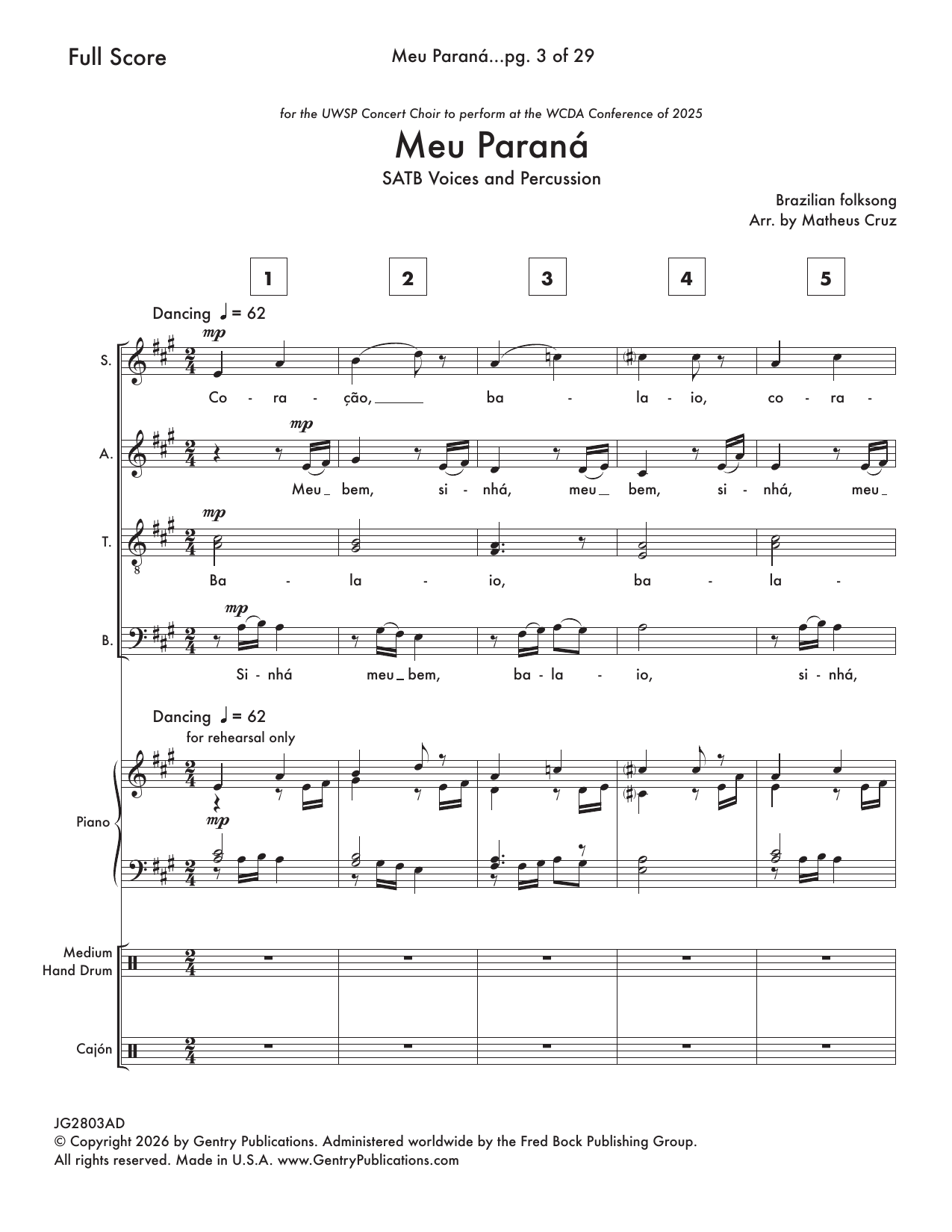

Meu Parana: Choral Instrumental Pak
Arranged by Matheus Cruz
Item: 35-PK01912702
$25.00
Pickup currently not available
Buy Extra Parts (Digital PDF Download)
| Product | Price | Quantity |
|---|---|---|
| Meu Parana - Full Score: Choral Instrumental Pak | $7.00 | |
| Meu Parana - Hand Drum: Choral Instrumental Pak | $7.00 | |
| Meu Parana - Cajon: Choral Instrumental Pak | $7.00 |
Parts Added to Cart!
Description
Featured in the series Choral Music of Latin America and the Caribbean, Matheus Cruz's "Meu Paraná" celebrates the energy and spirit of Brazilian music. This lively SATB work with percussion brings together three well-known Brazilian songs - Balaio, Gralha Azul, and Paranáuê. Each song is introduced on its own before coming together in an exciting final section. The rhythms are energetic and dance-like, with percussion adding color and drive. Clear voice leading and singable melodies make the piece accessible for developing choirs, while its musical depth keeps it engaging for more advanced ensembles. With a clear structure and strong sense of style, "Meu Paraná" works well as a featured piece or as part of a concert or festival program.


Meu Parana: Choral Instrumental Pak isn't in MakeMusic Cloud just yet...but it could be. Let us know you'd like to see it, and you'll help shape what comes next. In the meantime, start a free trial and dive into thousands of interactive titles your students can play along with today.
Request This Title
Tell us you want it.
Start Your Free Trial
Explore everything that's ready to play right now.
Sample Audio
No sample audio found.
Sample Video
No sample videos found.
Additional Details
Publisher:
Hal Leonard
SKU:
35-PK01912702
More about this title
About the Arranger: Matheus Cruz
Matheus Cruz is a Brazilian composer and arranger whose work centers on celebrating the musical traditions of Latin America and the Caribbean. His arrangements honor folk melodies and regional styles while crafting them for ensemble performance in educational and concert settings.
Why we love this
Cruz structures this piece to teach your singers how three distinct Brazilian melodies coexist and build on each other, moving from isolation to integration without ever feeling rushed. The percussion writing is neither decorative nor overpowering; it anchors the rhythmic vocabulary your students need to feel and execute Brazilian grooves authentically.
What to expect
Bright, propulsive energy animates this piece from start to finish. The familiar Brazilian melodies create an immediate sense of joy and celebration, while the carefully layered final section brings a satisfying sense of arrival and unity.
Who it's for
This arrangement serves developing and intermediate SATB choirs seeking authentic Latin repertoire with genuine musical depth. Directors programming concert series, festival competitions, or culturally centered showcases will find it both accessible and substantial.
How to get the most out of it
- Isolate each song section in separate rehearsals before combining them. Have your singers learn and own Balaio, Gralha Azul, and Paranáuê as individual entities first so they understand where each melody sits in the final medley.
- Let your percussionists drive the rhythmic foundation during early rehearsals. Their patterns inform how the voices should breathe and where the syncopation truly lands.
- Work the final section as a layering exercise. Add voice parts in staggered entries so students hear how the three melodies weave together rather than colliding.
- Embrace the dance-like quality in your interpretation. These rhythms need physical engagement from your singers; encourage them to feel the pulse in their bodies, not just their ears.
How to use it
Open a concert section or festival set with this work to establish an upbeat tone and connect audiences to Brazilian musical traditions. It also pairs well alongside other Latin or multicultural pieces in a thematic program, or stands alone as your evening's anchor of rhythmic vitality.
Skills your students will build
- Singing syncopated rhythms in Latin/Brazilian styles
- Maintaining individual melodic lines while hearing other simultaneous melodies
- Responding to and coordinating with percussion-driven accompaniment
- Interpreting stylistic articulation and phrasing in non-English text
- Building ensemble blend across SATB voicing in a contemporary choral context