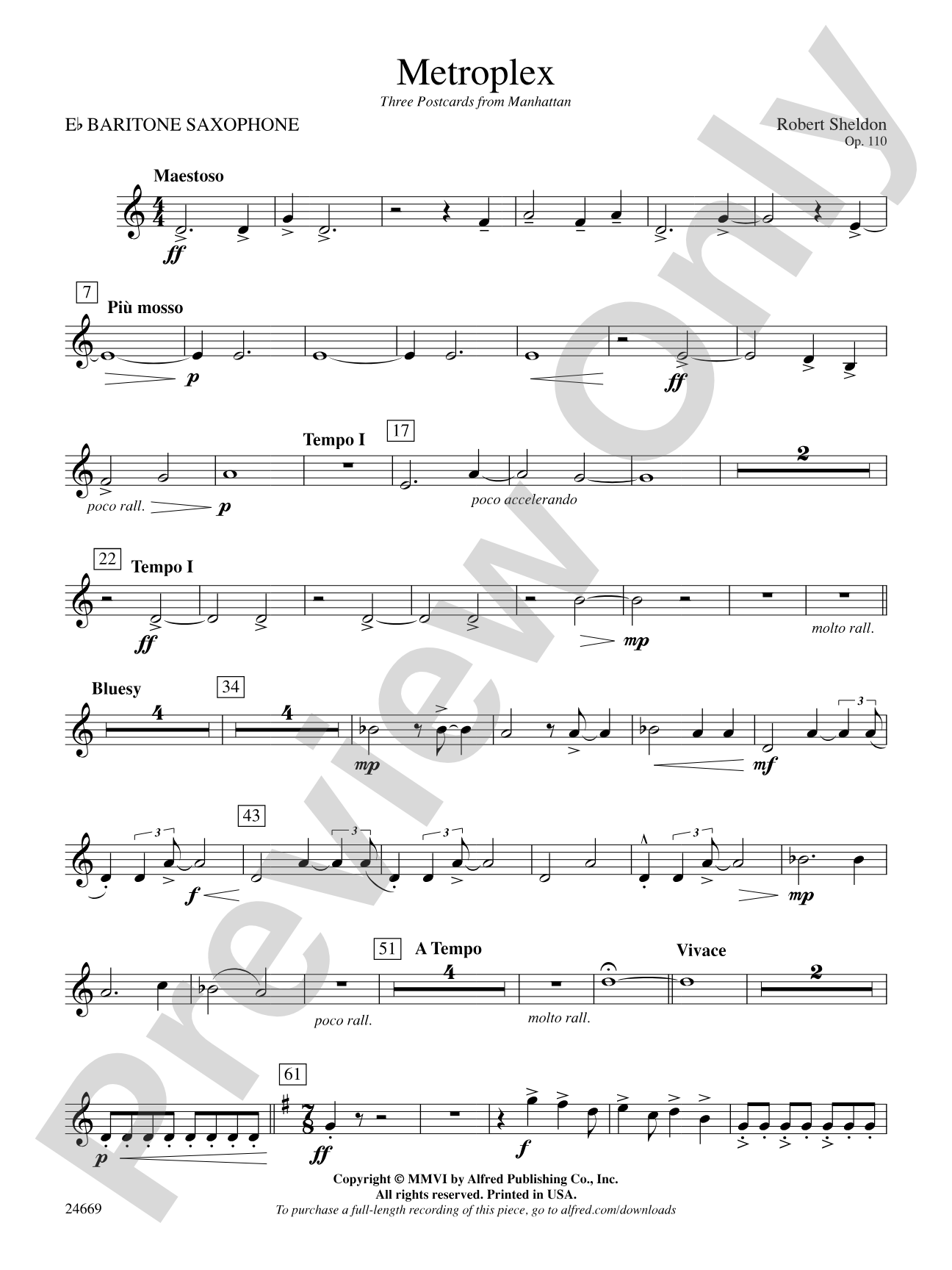
Metroplex: Three Postcards from Manhattan: E-flat Baritone Saxophone Sheet Music Preview

Metroplex: Three Postcards from Manhattan: E-flat Baritone Saxophone

By Robert Sheldon

Grade: 4.5 (Medium Difficult)

Item: 00-PC-0000837_BTX

Digital Download
$3.00
Description
A musical portrait of Manhattan's cityscape, Metroplex opens with a vision of the New York skyline, tall buildings, and concrete canyons. This leads to an urban jazz scene in one of Harlem's clubs. Finally, the music takes us on a wild taxi ride through the heavy traffic of this incredible city. The skyline is seen once more as we leave Manhattan, hopefully to return again soon. This title is available in MakeMusic Cloud.

Don't just read it, hear it, play along with it, and watch your students grow with it. In MakeMusic Cloud, Metroplex: Three Postcards from Manhattan: E-flat Baritone Saxophone comes alive with professional accompaniment, adjustable tempo, and built-in practice tools that turn solo practice into real progress.

Sample Audio
0:00
0:00
Sample Video
Additional Details
Series: Alfred Concert Band
Publisher: Alfred Music
Page Count: 302
SKU: 00-PC-0000837_BTX

More about this title

About the Composer: Robert Sheldon

Robert Sheldon

Robert Sheldon stands among the most frequently performed composers in the wind band repertoire. His works appear on contest lists and concert programs internationally, and he has conducted his own compositions at venues including Carnegie Hall, the Kennedy Center, and the Sydney Opera House. His compositions have earned recognition from the American School Band Director's Association, Phi Beta Mu, and the American Society of Composers, Authors and Publishers.

Why we love this

Sheldon crafts vivid musical narratives that challenge mid-advanced ensembles without losing accessibility. Metroplex works as both a standalone concert piece and a festival contender, and the programmatic arc (skyline, Harlem jazz, urban energy, departure) gives students a compelling reason to care about character and shape in every section.

What to expect

Urban energy pulses through the score, starting with contemplative grandeur as the Manhattan skyline rises before you, then shifting into the swagger and syncopation of a Harlem jazz club. The taxi ride that follows is kinetic and playful, full of orchestral traffic and momentum, before the music releases into a quiet, satisfied reflection on the city left behind.

Who it's for

Grade 4.5 concert bands with solid fundamentals in rhythm reading, jazz vocabulary, and style flexibility. This work suits ensembles preparing for festival competition or seeking a substantial concert piece that builds technical skill while maintaining musical storytelling.

How to get the most out of it

  • Establish the opening skyline as an atmospheric foundation; resist the urge to rush. Let the tall buildings breathe before the jazz section introduces rhythmic momentum.
  • The Harlem club scene demands tight rhythmic precision from the ensemble, especially where jazz phrasing and syncopation appear. Isolate these passages in sectionals to ensure clarity without stiffness.
  • Balance the taxi ride's energy and excitement with orchestration awareness. The rapid figuration can easily blur if parts aren't heard in their proper weight; conduct with clear gesture to anchor the pulse through the traffic.
  • Return to the skyline with the same atmospheric quality as the opening, allowing the journey to feel complete and reflective rather than simply cycling through material.

How to use it

Program Metroplex as a centerpiece on a concert celebrating American cities or urban jazz influences, pairing it with contrasting Americana or folk-based works. Its festival pedigree also makes it ideal for a dedicated contest performance where students benefit from the challenge of balancing technical demands with character work across three distinct musical landscapes.

Skills your students will build

  • Jazz phrasing, syncopation, and articulation in a concert band context
  • Dynamic control across large-scale changes in musical character (introspective to energetic and back)
  • Ensemble precision in rapid, interlocking rhythmic figures
  • Style and tone flexibility within a single work

You May Also Like