
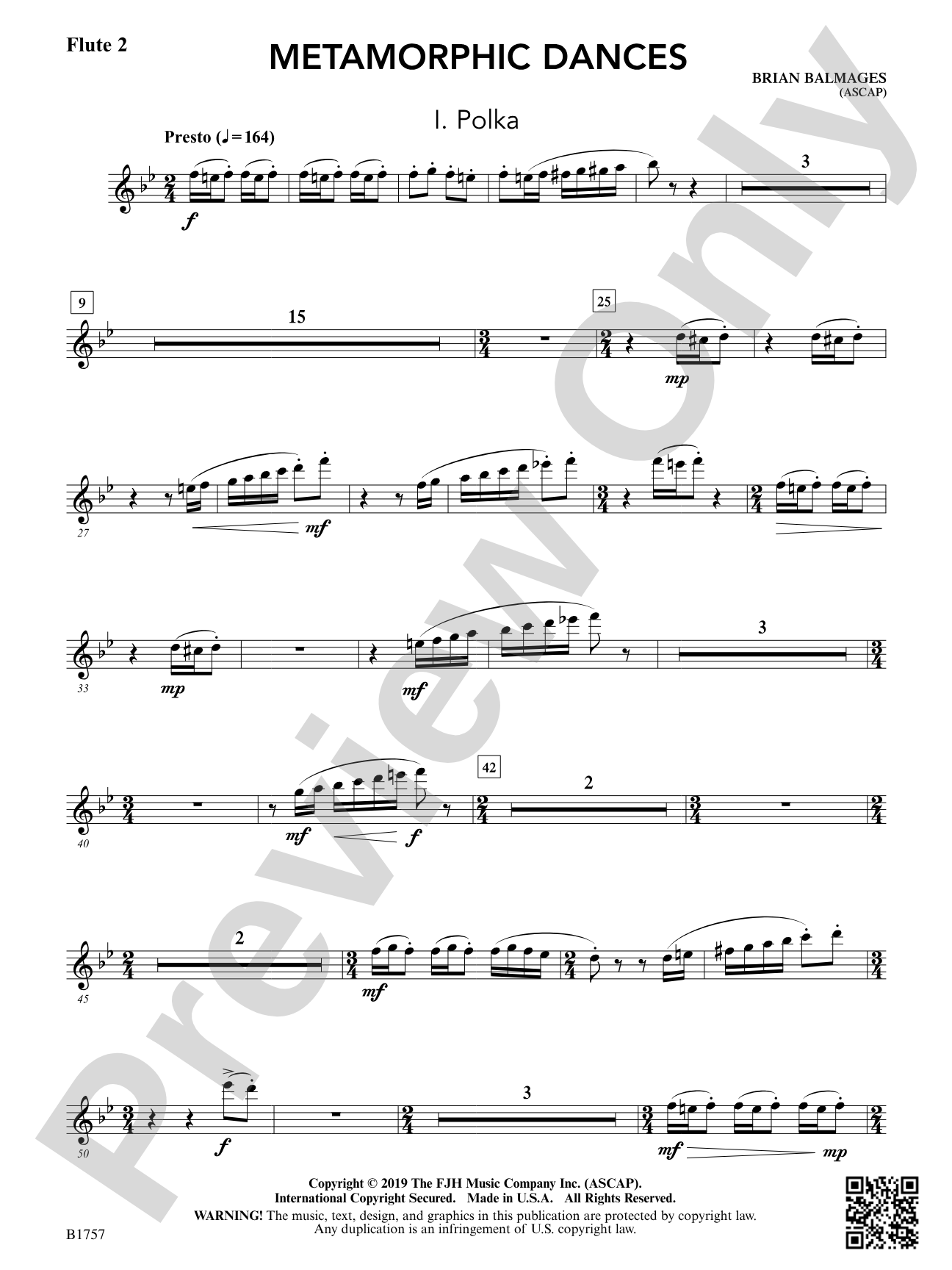

Metamorphic Dances: Flute 2
By Brian Balmages
Grade: 5
Item: 98-PC-DB1757_F2
$7.00
Pickup currently not available
Description
This short, four-movement work is based on traditional dances that have each gone through some type of transformation to bring them roaring into the 21st century. Playable individually or all together, movements include the fun Polka, playful Waltz, passionate Tango, and the whimsical, yet extremely energetic Cakewalk.


Don't just read it, hear it, play along with it, and watch your students grow with it. In MakeMusic Cloud, Metamorphic Dances: Flute 2 comes alive with professional accompaniment, adjustable tempo, and built-in practice tools that turn solo practice into real progress.
Open in the Player
Jump straight in and assign it today.
Start Your Free Trial
Open this title and explore the full library in minutes.
Sample Audio
1
Audio File
--:--
0:00
0:00
Sample Video
Additional Details
Series:
FJH Symphonic Band
Publisher:
The FJH Music Company, Inc.
SKU:
98-PC-DB1757_F2
More about this title
About the Composer: Brian Balmages

Brian Balmages has established himself as a composer and conductor working across orchestral, band, and chamber repertoires at every level, from professional symphony orchestras to elementary school ensembles. His works have premiered in landmark venues including Carnegie Hall, the Kennedy Center, Sydney Opera House, and Toronto Centre for the Arts. He received the A. Austin Harding Award from the American School Band Directors Association and won the 2020 NBA William D. Revelli Composition Contest for Love and Light. An elected member of the American Bandmasters Association, he holds the inaugural James Madison University Distinguished Alumni Award and was commissioned by the University of Miami to compose music for the inauguration of its sixth president.
Balmages maintains an active conducting schedule with all-state ensembles, university groups, and regional bands worldwide. His guest conducting appearances have included the Midwest Clinic, Western International Band Clinic, and the College Band Directors Conference, among many others. His music was performed at the 2013 Presidential Inaugural Prayer Service attended by President Obama and Vice President Biden. He currently serves as Director of MakeMusic Publications and Digital Education for Alfred and MakeMusic.
Why we love this
Balmages delivers a four-movement suite that combines accessibility with genuine musicality, making it equally valuable for festival programming or concert finale. Each movement stands alone, giving you flexibility in how you present the work while encouraging students to engage with contrasting orchestration, rhythmic vocabularies, and stylistic idioms without overwhelming rehearsal schedules.
What to expect
Each movement undergoes its own reinvention. The Polka crackles with modern energy beneath its folk roots; the Waltz plays with texture and accent in unexpected ways; the Tango pulses with intensity and emotional depth; the Cakewalk dances with infectious, almost mischievous exuberance. The overall effect is sophisticated enough to engage serious musicians while remaining accessible to younger ensembles.
Who it's for
Grade 5 concert bands seeking repertoire that balances technical growth with immediate musical reward. This suite works for directors building toward contest season, programming a concert with stylistic variety, or introducing students to how traditional idioms can be reimagined through contemporary orchestration and harmonic language.
How to get the most out of it
- Establish clear articulation during the Polka's running passages; the transformation from traditional folk idiom to modern context depends on crisp, energized tongue work that keeps the piece bouncing rather than plodding.
- Balance the Tango's passion against sentimentality by anchoring the ensemble in a steady, felt pulse rather than rushing into the expressive lines; let the rhythm section drive.
- Highlight individual sections during the Cakewalk's energetic moments to showcase the whimsy; unison doesn't mean uniformity here.
- Use the option to program movements individually in different concert spots if time or rehearsal demands it, but consider the full arc if you have the bandwidth to prepare all four.
How to use it
Program all four movements as a thematic block to showcase your band's versatility across styles and moods, or distribute individual movements throughout a concert to anchor different sections. This works equally well as an opening piece to establish your band's contemporary sensibility or as a closer that leaves audiences smiling.
Skills your students will build
- Stylistic contrast and articulation across four distinct idioms
- Rhythmic precision in modern reinterpretations of traditional dance forms
- Balance between ensemble sections during varied orchestrations
- Tempo control and expressive phrasing within energetic contexts
- Technical facility in polka-style passages and syncopated rhythms