
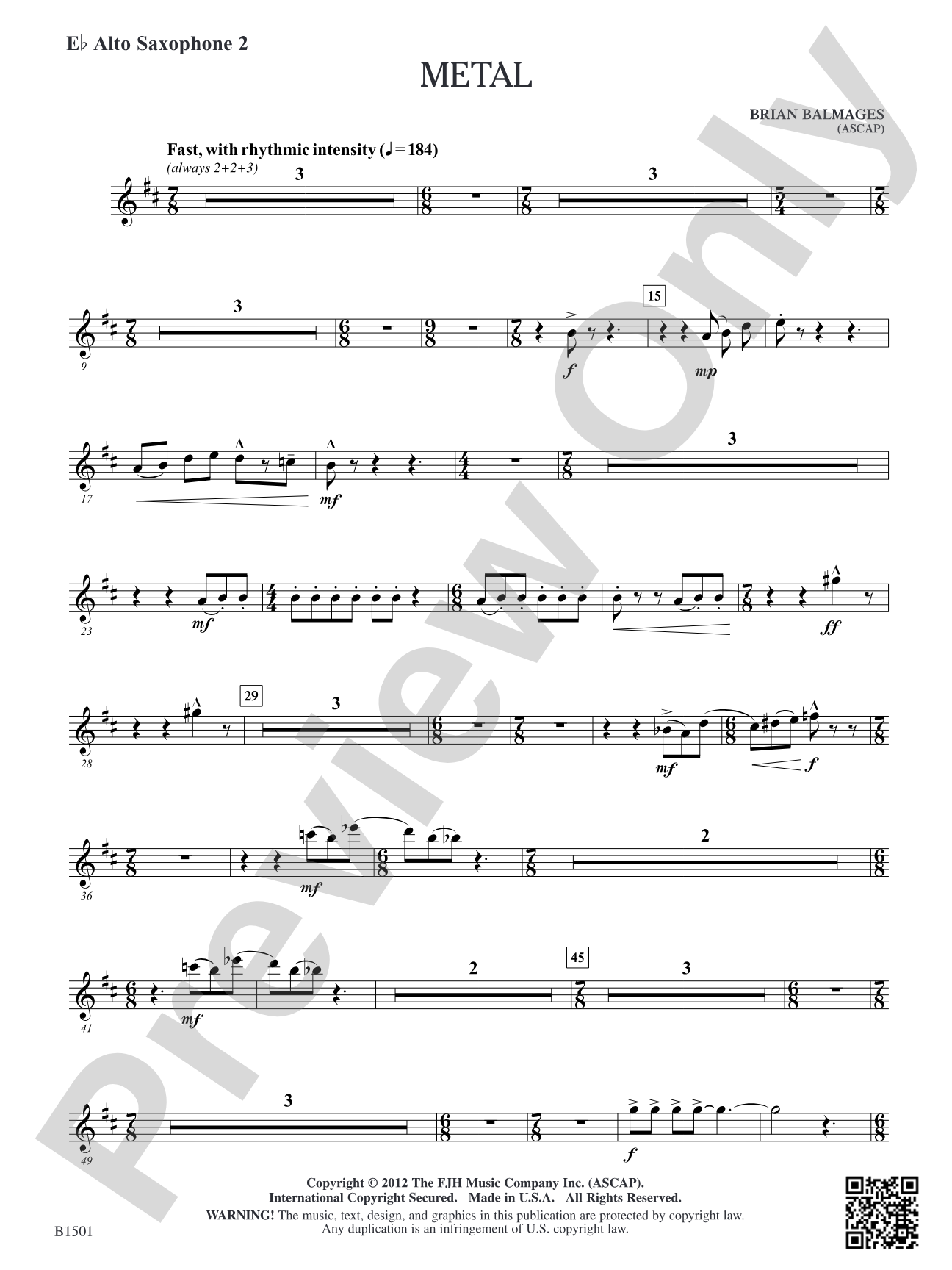

Metal: E-flat Alto Saxophone 2
By Brian Balmages
Grade: 5
Item: 98-PC-DB1501_AX2
$7.00
Pickup currently not available
Description
Inspired by both metallic sounds and heavy metal, this opener or closer is intense in every sense of the word! Aggressive multi-meter passages soon move into dazzling fanfares that play with shifting tonalities before eventually resolving to a brilliant and powerful final chord. Extremely intense and invigorating!


Don't just read it, hear it, play along with it, and watch your students grow with it. In MakeMusic Cloud, Metal: E-flat Alto Saxophone 2 comes alive with professional accompaniment, adjustable tempo, and built-in practice tools that turn solo practice into real progress.
Open in the Player
Jump straight in and assign it today.
Start Your Free Trial
Open this title and explore the full library in minutes.
Sample Audio
1
Audio File
--:--
0:00
0:00
Sample Video
No sample videos found.
Additional Details
Series:
FJH Symphonic Band
Publisher:
The FJH Music Company, Inc.
SKU:
98-PC-DB1501_AX2
More about this title
About the Composer: Brian Balmages

Brian Balmages has established himself as a composer and conductor whose work spans orchestral, band, and chamber music on an international stage. His compositions have been performed in prestigious venues including Carnegie Hall, the Kennedy Center, and Sydney Opera House, from professional orchestras down to elementary school ensembles. He received the A. Austin Harding Award from the American School Band Directors Association and won the 2020 NBA William D. Revelli Composition Contest for his composition Love and Light. He holds elected membership in the American Bandmasters Association.
Beyond composition, Balmages maintains an active conducting schedule with all-state and regional ensembles, university groups, and professional orchestras worldwide. He has guest conducted at the Midwest Clinic, Western International Band Clinic, and numerous state and national conferences. Currently serving as Director of MakeMusic Publications and Digital Education for Alfred and MakeMusic, he was recognized with the inaugural James Madison University Distinguished Alumni Award from the School of Visual and Performing Arts.
Why we love this
Balmages delivers an opener that actually earns the word intense through compositional craft, not just volume. The shifting meters and tonal centers create genuine harmonic tension that rewires listeners' expectations, while the fanfare sections showcase your strongest players in a way that feels musically earned rather than gratuitous. This works beautifully as a festival or contest selection because it demonstrates musical maturity and technical control across the full ensemble.
What to expect
Metallic textures collide with the raw energy of heavy metal, creating something both jagged and exhilarating. The piece throbs with instability through its multi-meter sections, then unleashes fanfares that seem to arrive from unexpected harmonic directions, before finally solidifying into a cathartic, brilliant resolution that validates all the tension that preceded it.
Who it's for
Grade 5 concert bands ready for aggressive, modern compositional language and the technical demands of shifting meters and tonal ambiguity. This works for ensembles with strong rhythm sections and brass players comfortable navigating harmonic complexity without traditional tonal anchors.
How to get the most out of it
- Nail the transitions between metric sections by having the rhythm section lock in first; once percussion and low brass establish the pulse shift, the rest of the band settles into the new meter more securely.
- Balance the fanfare passages so individual sections cut through the texture without drowning each other out. Brass will naturally want to blaze, so check that woodwinds maintain their presence in the harmonies.
- Shape the tonal shifts deliberately rather than letting them land as accidents. Slight tempo flexibility and dynamic contouring at key harmonic changes make the compositional intent audible to the audience.
- Build to that final chord with genuine momentum; resist the temptation to slow down before the resolution. The power comes from driving straight through to the end.
How to use it
Program this as your opener to seize immediate attention and set a sophisticated musical tone for the concert. It also serves as a powerful closer when you want to send the audience out energized. For contest or festival play, it demonstrates the ensemble's range and contemporary musicianship in under four minutes.
Skills your students will build
- Reading and executing shifting meters (polymetric passages)
- Navigating tonal centers and harmonic ambiguity without resolution
- Dynamic control and balance in fanfare textures
- Rhythmic precision under aggressive articulation demands
- Following dramatic harmonic movement and tonal shifts