
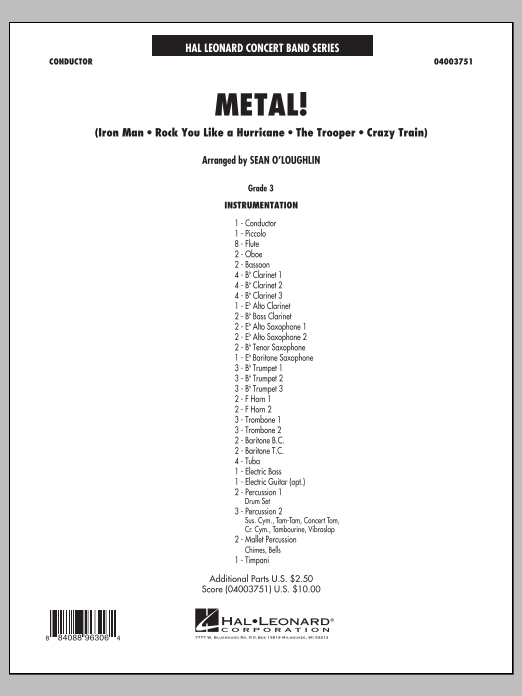

Metal!: Concert Band Conductor Score & Parts
Arranged by Sean O'Loughlin
Grade: 3
Item: 35-PK00285175
$80.00
Pickup currently not available
Buy Extra Parts (Digital PDF Download)
| Product | Price | Quantity |
|---|---|---|
| Metal! - Conductor Score (Full Score) | $12.50 | |
| Metal! - Piccolo | $6.00 | |
| Metal! - Flute | $6.00 | |
| Metal! - Oboe | $6.00 | |
| Metal! - Bassoon | $6.00 | |
| Metal! - Bb Clarinet 1 | $6.00 | |
| Metal! - Bb Clarinet 2 | $6.00 | |
| Metal! - Bb Clarinet 3 | $6.00 | |
| Metal! - Eb Alto Clarinet | $6.00 | |
| Metal! - Bb Bass Clarinet | $6.00 | |
| Metal! - Eb Alto Saxophone 1 | $6.00 | |
| Metal! - Eb Alto Saxophone 2 | $6.00 | |
| Metal! - Bb Tenor Saxophone | $6.00 | |
| Metal! - Eb Baritone Saxophone | $6.00 | |
| Metal! - Bb Trumpet 1 | $6.00 | |
| Metal! - Bb Trumpet 2 | $6.00 | |
| Metal! - Bb Trumpet 3 | $6.00 | |
| Metal! - F Horn 1 | $6.00 | |
| Metal! - F Horn 2 | $6.00 | |
| Metal! - Trombone 1 | $6.00 | |
| Metal! - Trombone 2 | $6.00 | |
| Metal! - Baritone B.C. | $6.00 | |
| Metal! - Baritone T.C. | $6.00 | |
| Metal! - Tuba | $6.00 | |
| Metal! - Electric Bass | $6.00 | |
| Metal! - Electric Guitar | $6.00 | |
| Metal! - Percussion 1 | $6.00 | |
| Metal! - Percussion 2 | $6.00 | |
| Metal! - Mallet Percussion | $6.00 | |
| Metal! - Timpani | $6.00 |
Parts Added to Cart!
Description
Who knew that vintage hard rock tunes would adapt so well for the concert stage! Sean O'Loughlin's experience working directly with some of the nation's top recording artists gives him a decided edge when it comes to making these timeless "heavy metal" hits sound great for band.
Includes: "Iron Man" (Black Sabbath), "Rock You Like a Hurricane" (Scorpions), "The Trooper" (Iron Maiden) and "Crazy Train" (Ozzy Osbourne).
Dur: 5:30


Metal!: Concert Band Conductor Score & Parts isn't in MakeMusic Cloud just yet...but it could be. Let us know you'd like to see it, and you'll help shape what comes next. In the meantime, start a free trial and dive into thousands of interactive titles your students can play along with today.
Request This Title
Tell us you want it.
Start Your Free Trial
Explore everything that's ready to play right now.
Sample Audio
No sample audio found.
Sample Video
No sample videos found.
Additional Details
Publisher:
Hal Leonard
SKU:
35-PK00285175
More about this title
About the Arranger: Sean O'Loughlin
Sean O'Loughlin brings a rare perspective to concert band arranging: direct experience working with recording artists at the highest levels of the music industry. This background informs every choice he makes when translating rock and metal repertoire for ensemble settings, ensuring that the energy and character of the original recordings translate authentically to the concert stage.
His arrangements prioritize playability without sacrificing impact, a skill that comes from understanding how professional musicians approach difficult material. For band directors seeking contemporary repertoire with genuine street credibility, O'Loughlin's work offers a bridge between what students want to play and what they can actually execute.
Why we love this
These arrangements respect the source material while making genuine pedagogical sense for Grade 3 bands. O'Loughlin captures the unmistakable identity of each track, so your students recognize the songs immediately, yet the voicing and part difficulty remain accessible and musically rewarding for growing ensembles.
What to expect
Powerful, driving, and unapologetic. These arrangements bring the heaviness and intensity of the originals to the concert stage without pretense or irony. Your band will feel the weight of the material as they play it, and that physical engagement translates directly to audience energy.
Who it's for
Concert bands at the Grade 3 level who want to program something with genuine appeal to both players and audiences. Directors working to connect with students who listen to rock and metal outside of school will find this set opens doors for engagement and demonstrates that concert band can own contemporary styles.
How to get the most out of it
- Nail the iconic riffs early in rehearsal. These melodies are what the audience knows, so getting them locked in the brass section builds confidence and momentum for the whole group.
- Treat the rhythm section as the backbone of your sound. The drive and pocket of these tunes depend entirely on your percussion and low brass keeping the groove steady, especially during the heavier sections.
- Balance density against clarity. With four heavy rock tunes in succession, resist the urge to crank the volume in every section. Strategic pulling back makes the bigger moments land harder.
How to use it
Consider programming this as a standalone concert or as a statement piece within a larger show. The 5:30 duration works well as a full set by itself, or you might extract individual tunes to anchor different halves of a concert alongside more traditional repertoire. This is also an excellent choice for spring pops concerts or any program designed to showcase what your band can accomplish beyond classical and contemporary standard literature.
Skills your students will build
- Playing rock and metal idioms with appropriate articulation and tone color
- Maintaining groove and steady subdivision across sustained passages
- Responding to riff-based melodic writing rather than traditional phrase structures
- Balancing individual part independence with ensemble cohesion in densely voiced arrangements
- Reading and executing syncopated rhythmic figures in contemporary contexts