
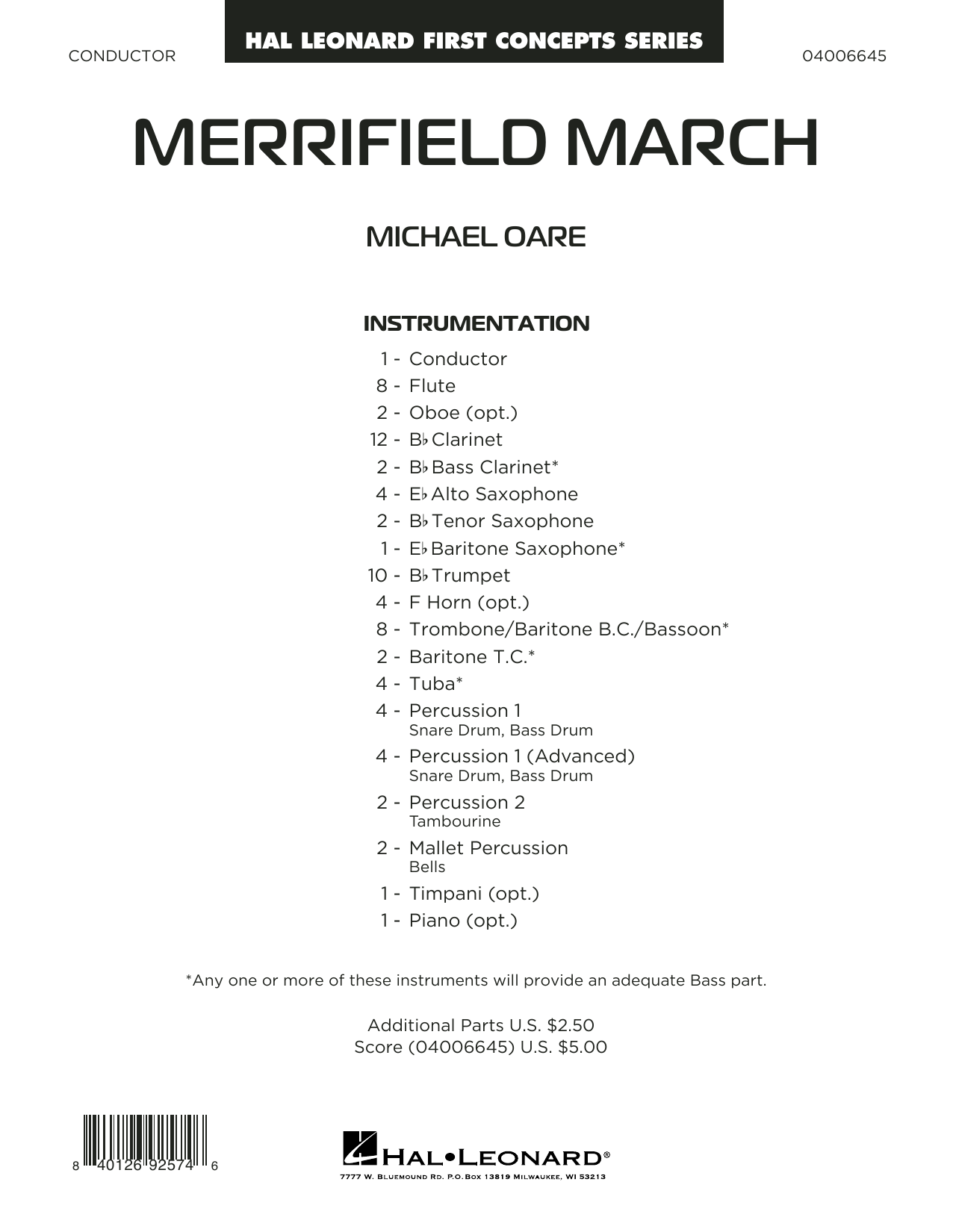

Merrifield March: Concert Band Conductor Score & Parts
By Michael Oare
Grade: 0.5-1
Item: 35-PK00469091
$50.00
Pickup currently not available
Buy Extra Parts (Digital PDF Download)
| Product | Price | Quantity |
|---|---|---|
| Merrifield March - Conductor Score (Full Score) | $7.50 | |
| Merrifield March - Flute | $6.00 | |
| Merrifield March - Oboe | $6.00 | |
| Merrifield March - Bb Clarinet | $6.00 | |
| Merrifield March - Bb Bass Clarinet | $6.00 | |
| Merrifield March - Eb Alto Saxophone | $6.00 | |
| Merrifield March - Bb Tenor Saxophone | $6.00 | |
| Merrifield March - Eb Baritone Saxophone | $6.00 | |
| Merrifield March - Bb Trumpet | $6.00 | |
| Merrifield March - F Horn | $6.00 | |
| Merrifield March - Trombone/Baritone B.C./Bassoon | $6.00 | |
| Merrifield March - Baritone T.C. | $6.00 | |
| Merrifield March - Tuba | $6.00 | |
| Merrifield March - Percussion 1 | $6.00 | |
| Merrifield March - Percussion 1 (Advanced) | $6.00 | |
| Merrifield March - Percussion 2 | $6.00 | |
| Merrifield March - Mallet Percussion | $6.00 | |
| Merrifield March - Timpani | $6.00 | |
| Merrifield March - Piano | $6.00 |
Parts Added to Cart!
Description
Composed for first-year players, Michael's attractive easy march gives every section of the band something interesting to play, and includes a nice variety in scoring and dynamic contrasts. A perfect introduction to march style. The First Concepts Series features simplified instrumentations, unison bass lines, optional advanced snare drum parts, and optional piano accompaniments.


Merrifield March: Concert Band Conductor Score & Parts isn't in MakeMusic Cloud just yet...but it could be. Let us know you'd like to see it, and you'll help shape what comes next. In the meantime, start a free trial and dive into thousands of interactive titles your students can play along with today.
Request This Title
Tell us you want it.
Start Your Free Trial
Explore everything that's ready to play right now.
Sample Audio
No sample audio found.
Sample Video
No sample videos found.
Additional Details
Publisher:
Hal Leonard
SKU:
35-PK00469091
More about this title
About the Composer: Michael Oare

Michael Oare studied composition and music education at Old Dominion University and has built a distinguished career as both educator and composer. For 33 years, he led the band program at Great Bridge Middle School in Chesapeake, Virginia, where his ensembles earned superior ratings consistently, including 30 consecutive years performing advanced literature. His works appear in the GIA Publications Teaching Music Through Performance series, and he currently conducts the Bay Youth Orchestras of Virginia Concert Band.
Oare's contributions to music education extend beyond his own students. He serves as an active adjudicator, maintains memberships in state and national professional organizations, and performs with the Virginia Wind Symphony. Recognized as the 2016 Chesapeake Public Schools Middle School Teacher of the Year and a two-time recipient of the National Band Association's Citation of Excellence, Oare continues to shape young musicians throughout southeastern Virginia and northeastern North Carolina.
Why we love this
Oare understands how to write for students who are just beginning to engage with ensemble textures and march form. Rather than oversimplifying, he distributes melodic and rhythmic material across all sections so that every player feels ownership of the piece. The scoring variety and dynamic contrast keep the band engaged throughout, making it genuinely rewarding to teach.
What to expect
Merrifield March has the snap and forward motion of traditional march style, yet it never feels stiff or overly martial. Dynamic changes and varied scoring create natural peaks and valleys, so students experience shape and contrast rather than a single mood sustained for three minutes.
Who it's for
First-year concert band students and directors building programs from the ground up. Oare's writing gives new players substantive material without demanding advanced technique, making it ideal for programs that need music with genuine musical value at the easiest levels.
How to get the most out of it
- Balance the march character against rushing. First-year players often accelerate during energetic passages, so establish a steady pulse during early rehearsals and refer back to it whenever momentum creeps up.
- Leverage the optional snare drum part to add texture and interest. Even if you use the simplified part initially, consider introducing the advanced part as the ensemble's confidence grows.
- Take advantage of the First Concepts simplified instrumentation to focus on fundamental musical concepts rather than technical struggles. This frees students to listen to phrase shape and ensemble balance.
How to use it
Open a concert with this march to establish energy and confidence early. It works equally well as a mid-program change of pace or a season opener while you're still building ensemble chops. The piece also serves as an excellent teaching tool for introducing march form and style conventions before tackling longer or more complex works.
Skills your students will build
- March form and style conventions (A and B sections, typical harmonic progressions)
- Dynamic contrast and phrasing at the ensemble level
- Independent voice independence while maintaining unison bass lines
- Coordinating across instrumental families during scoring changes