
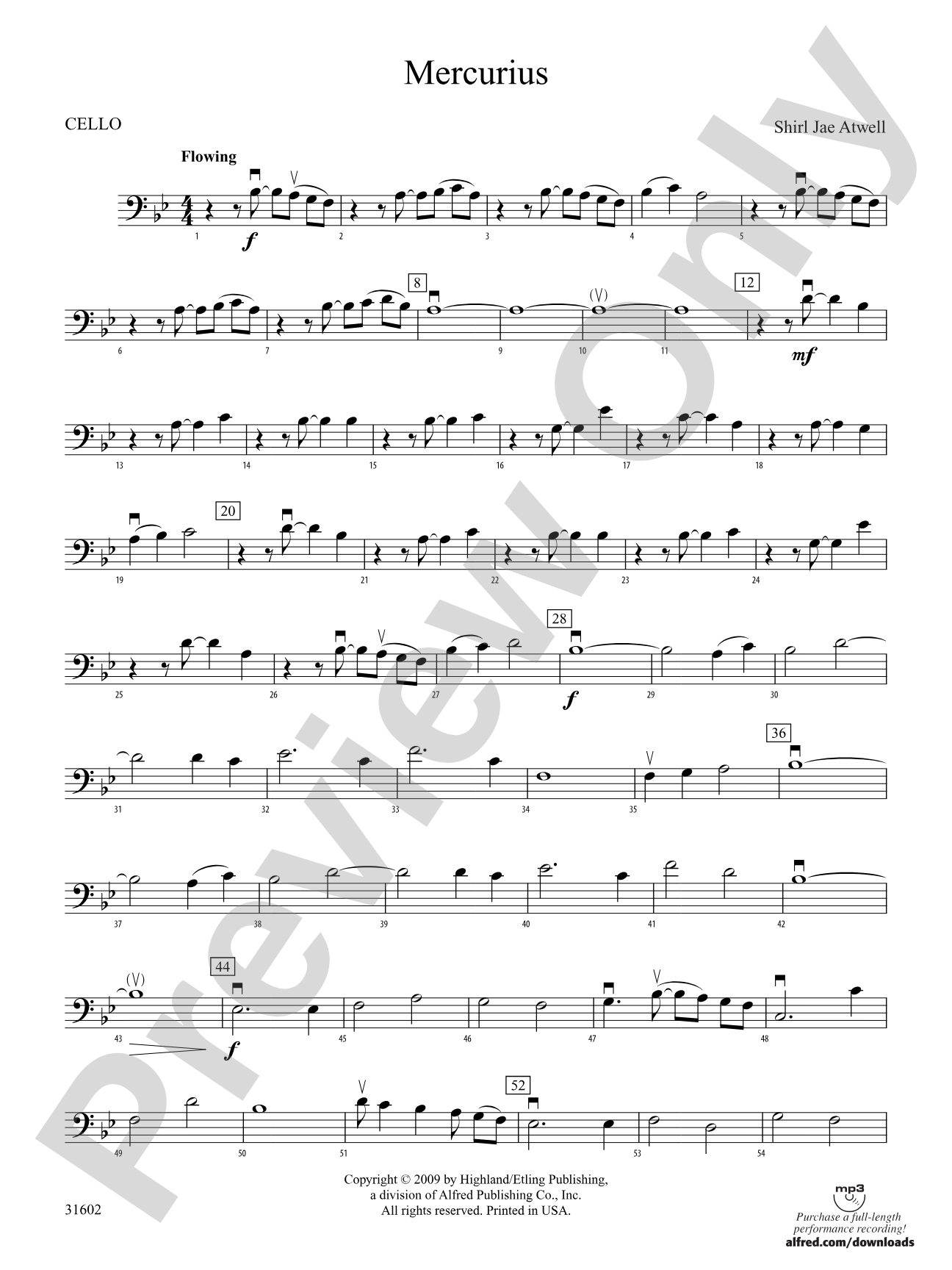

Mercurius: Cello
By Shirl Jae Atwell
Grade: 3.5
Item: 00-PC-0001768_VC1
$5.99
Pickup currently not available
Description
"Mercurius" is a medieval Latin noun used to describe messengers, of which the Roman god Mercury is most famous. Eloquence and swiftness are characteristics attributed to these couriers and that is reflected in this piece. The forward motion of Mercurius is a constant in the bass part while the melody floats above, first in octaves, then as a duet, in a smooth flowing manner. The harmony is realized in conjunction with the rhythmic pattern of the bass to convey the purpose of this "bearer of news." This title is available in MakeMusic Cloud.


Don't just read it, hear it, play along with it, and watch your students grow with it. In MakeMusic Cloud, Mercurius: Cello comes alive with professional accompaniment, adjustable tempo, and built-in practice tools that turn solo practice into real progress.
Open in the Player
Jump straight in and assign it today.
Start Your Free Trial
Open this title and explore the full library in minutes.
Sample Audio
1
Audio File
--:--
0:00
0:00
Sample Video
No sample videos found.
Additional Details
Series:
Highland/Etling String Orchestra
Publisher:
Alfred Music
Page Count:
124
SKU:
00-PC-0001768_VC1
More about this title
About the Composer: Shirl Jae Atwell

Shirl Jae Atwell studied music theory and composition at the University of Louisville and completed four years of advanced composition study at the University of South Carolina, building on her undergraduate training at Kansas State Teachers College. Her body of work spans opera, ballet, and orchestral music; she won the 1996 National School Orchestra Association composition contest and the 1997 Texas Orchestra Directors Association contest, both for string orchestra pieces. Her ballet Lucy, created in collaboration with choreographer Alun Jones and premiered by the Louisville Ballet in 1999, earned an Emmy Award for its televised production and recognition from the National Catholic Association for Communicators.
Atwell's compositions have been performed by regional orchestras and school ensembles across the United States, and six of her scores are held in the permanent collection of the Paris Bibliothèque Internationale de Musique Contemporaine. Her experience writing for student orchestras and her consistent recognition within music education circles make her a trusted voice for educators seeking repertoire that balances musicality with pedagogical clarity.
Why we love this
Atwell captures the essential character of her title through a driving bass line that propels the entire texture forward, while the melody remains lyrical and accessible. The piece works equally well as a concert opener that demonstrates student control and musicality, or as a contest selection that stands out without demanding virtuosity. The orchestration rewards careful ensemble listening; young players learn to balance independent voices while serving a unified musical purpose.
What to expect
Mercurius moves with purposeful energy and forward momentum, evoking the swift delivery of important news. The floating melodic line brings grace and eloquence to an otherwise driving texture, creating a sense of purposeful elegance rather than urgency or agitation. There is clarity and lightness to the sound, with a medieval harmonic character that feels both accessible and slightly timeless.
Who it's for
This piece suits string orchestras at the intermediate level (around Grade 3-4) that are ready to manage rhythmic independence between sections while maintaining expressive control. It works for ensembles seeking repertoire that demonstrates musical maturity without extreme technical demands, making it ideal for contest preparation or concert performance where clarity and musicality matter more than flash.
How to get the most out of it
- Establish the relentless forward motion of the bass part early in rehearsal. The constant rhythmic energy defines the character, so lock the cello and bass section into a steady, confident pulse that never wavers.
- Shape the melodic line with careful attention to phrase breathing. Though the melody floats above the active bass, each phrase needs clear direction and a gentle arrival point to sing through the accompaniment.
- Balance the octave writing in the first melodic statement. Violins and violas must blend seamlessly so the listener hears one pure line, not competing voices.
- Bring out the duet section with transparency. As the melody transforms into a two-part exchange, ensure both voices have equal presence so the dialogue remains clear over the continuing bass motion.
How to use it
Open a concert with this piece to establish energy and musicality from the first moment. Pair it with works of contrasting tempo and texture to showcase the range of your ensemble's abilities. Its programmatic title and clear narrative make it an engaging selection for student composers studying orchestration or for discussions about how harmonic language and rhythmic patterns work together to convey meaning.
Skills your students will build
- Maintaining rhythmic independence between the bass line and melodic voices
- Balancing multiple layers of texture while sustaining forward momentum
- Ensemble listening and blend in octave doublings and duet passages
- Phrasing and shaping melody over a static harmonic foundation
- Responding to programmatic intent through musical interpretation