Mendelssohn's 5th Symphony "Reformation," 4th Movement: Bassoon Sheet Music Preview

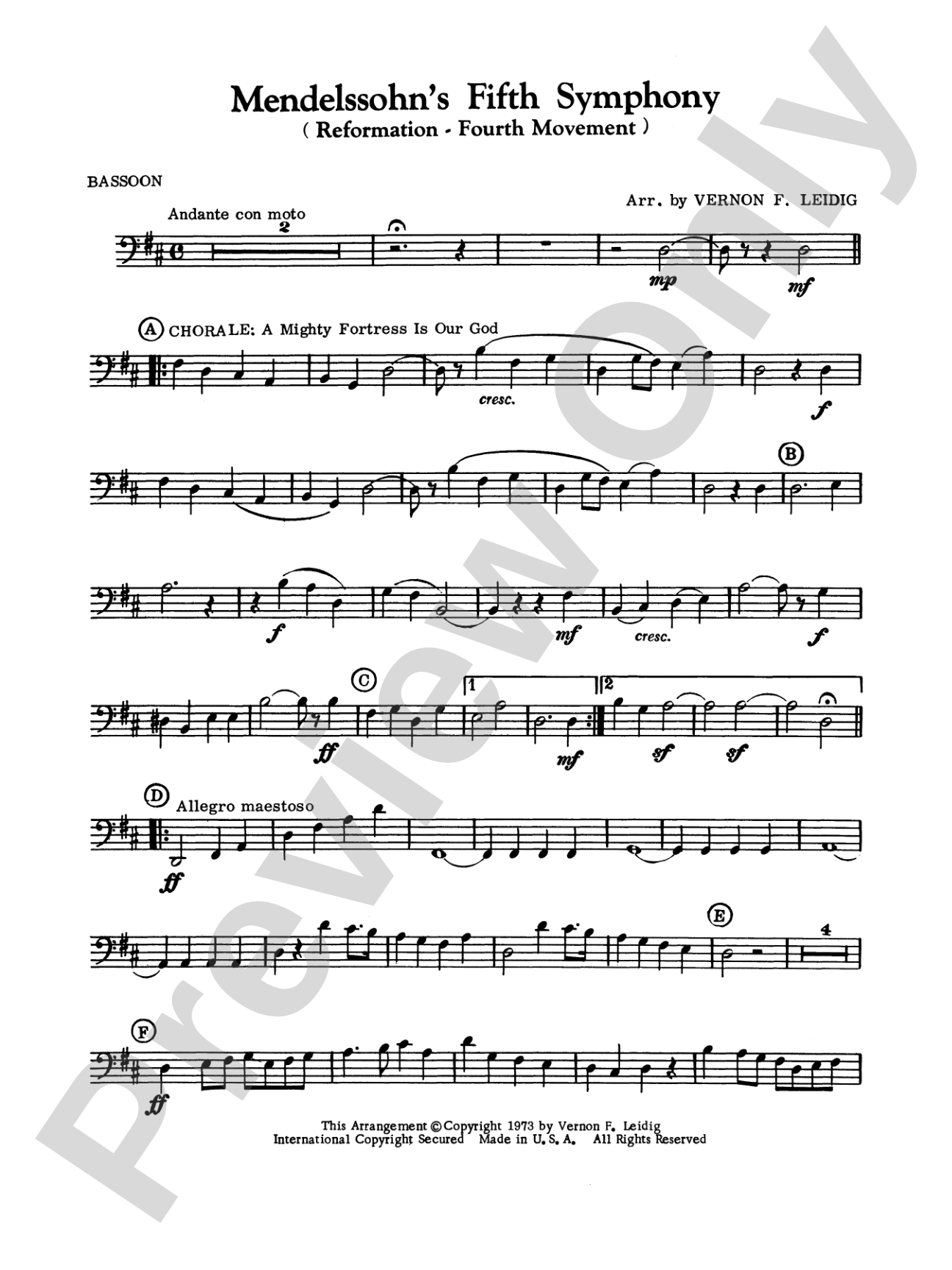
Mendelssohn's 5th Symphony "Reformation," 4th Movement: Bassoon

By Felix Mendelssohn / arr. Vernon Leidig

Grade: 3

Item: 00-PC-0000065_B1

Digital Download
$3.00
Description
A great selection for festival and contest, this one has been a proven winner for decades and is sure to be the perfect addition to your concert program. Tastefully and artistically arranged by one of Highland/Etling's legendary educational arrangers. (6:57)

Don't just read it, hear it, play along with it, and watch your students grow with it. In MakeMusic Cloud, Mendelssohn's 5th Symphony "Reformation," 4th Movement: Bassoon comes alive with professional accompaniment, adjustable tempo, and built-in practice tools that turn solo practice into real progress.

Sample Audio
0:00
0:00
Sample Video
Additional Details
Series: Highland/Etling Full Orchestra
Publisher: Alfred Music
Page Count: 108
SKU: 00-PC-0000065_B1

More about this title

About the Arranger: Vernon Leidig

Vernon Leidig earned recognition as one of Highland/Etling's most accomplished educational arrangers, developing a reputation for transforming standard orchestral repertoire into accessible versions for student ensembles. His arrangements balance fidelity to the original composer's intent with practical considerations for grade-level instrumentation and player development, making canonical works engaging without sacrificing musical substance.

Why we love this

Leidig's handling of Mendelssohn's muscular finale preserves the driving energy and structural clarity of the original while keeping the orchestration transparent enough for Grade 3 players to hear themselves within the texture. The arrangement has stood the test of time as a festival and contest staple because it delivers real musical impact without impossible demands, giving young orchestras a legitimate shot at a work that sounds substantial and rewarding.

What to expect

Triumphant and propulsive, the movement radiates the celebratory character Mendelssohn intended. You hear sweeping dynamic gestures, rhythmic vitality, and clear melodic lines that build cumulative force through orchestral weight rather than individual virtuosity.

Who it's for

Grade 3 orchestras seeking repertoire that delivers festival-quality sound without requiring advanced technical facility across all sections. Directors programming concerts that include a major orchestral work will find this arrangement gives students a genuine connection to the Romantic canon while maintaining musical credibility.

How to get the most out of it

  • Establish the primary theme's rhythmic profile early in rehearsal; the syncopated figures in the opening need precision to cut through the orchestration, so isolate these in sectionals before bringing the full score together.
  • Shape the dynamic architecture across the full 6:57 arc. The dramatic swells and contrasts that define the movement's character will flatten if dynamics are treated as local rather than structural events.
  • Balance the inner voices carefully. String sections should hear the woodwind countermelodies without drowning them, and brass needs to support harmonic motion without overwhelming the melodic line.
  • Conduct with clear subdivision through rhythmically complex passages. Young orchestras benefit from confident gesture work that delineates larger phrase units rather than beat-by-beat direction.

How to use it

Reserve this for the closing slot of a concert or festival appearance where impact and finish matter most. The arrangement's structural solidity and emotional directness work particularly well as a capstone to a program mixing contemporary and standard repertoire, giving audiences a tangible sense of orchestral maturity.

Skills your students will build

  • Balancing independent voice parts within larger harmonic textures
  • Interpreting dynamic architecture across extended formal structures
  • Ensemble precision in syncopated rhythmic figures
  • Responding to clear conducting patterns through sectional transitions
  • Sustaining musical momentum across the full duration of a major work

You May Also Like