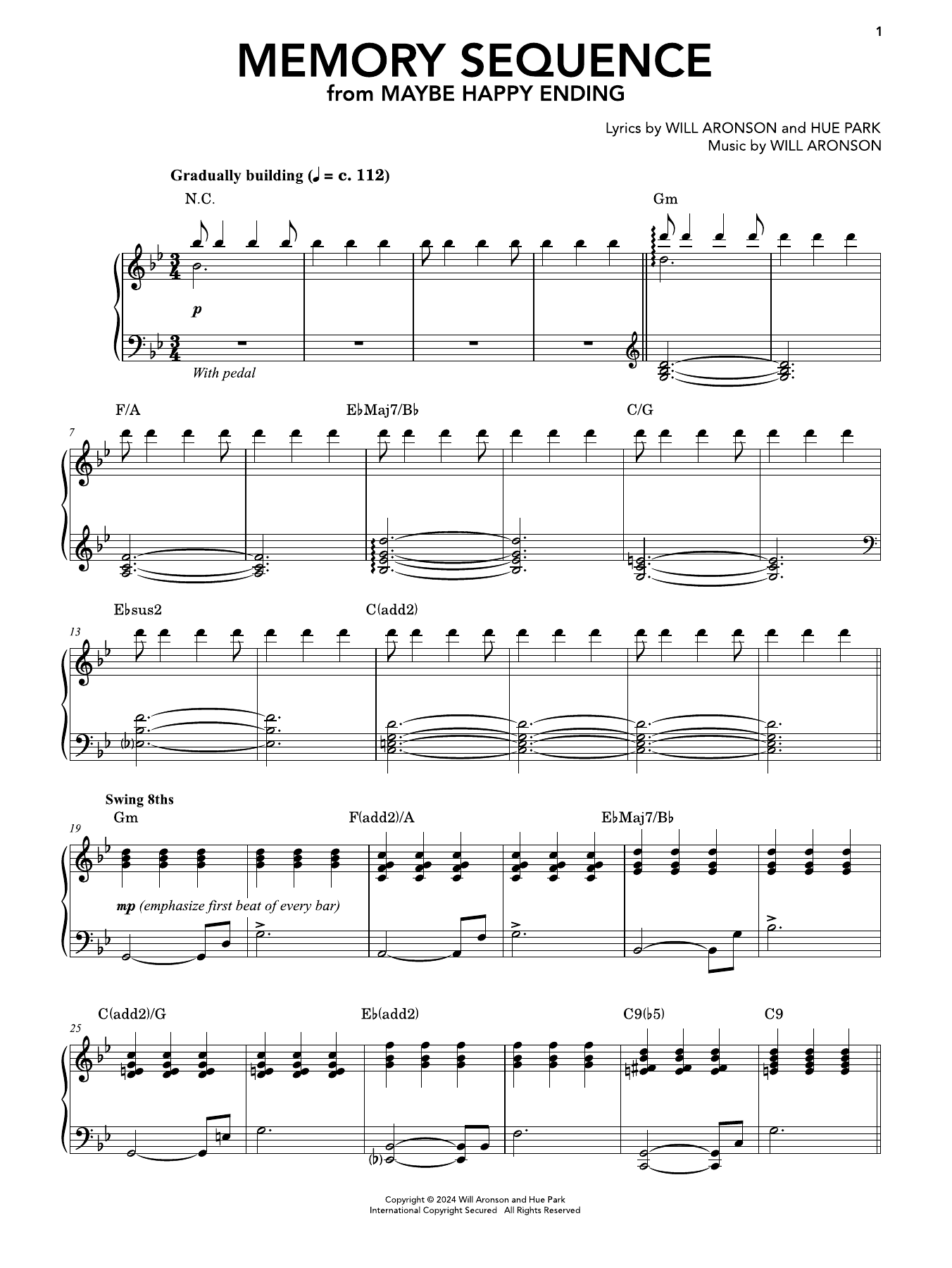
Memory Sequence (from Maybe Happy Ending) Sheet Music Preview

Memory Sequence (from Maybe Happy Ending): Piano Vocal

Item: 35-DS01851517

Digital Download
$5.99
Description

Memory Sequence (from Maybe Happy Ending): Piano Vocal isn't in MakeMusic Cloud just yet...but it could be. Let us know you'd like to see it, and you'll help shape what comes next. In the meantime, start a free trial and dive into thousands of interactive titles your students can play along with today.

Sample Audio
No sample audio found.
Sample Video
Additional Details
Publisher: Hal Leonard
Page Count: 3
SKU: 35-DS01851517

More about this title

About the Creator: Stephen Schwartz

Stephen Schwartz is a composer and lyricist whose work spans five decades of musical theatre. His gift for crafting emotionally resonant melodies paired with introspective lyrics has made him one of Broadway's most performed writers, with a catalog that ranges from intimate character moments to sweeping ensemble numbers.

Schwartz brings particular sensitivity to songs that explore memory, loss, and human connection. His ability to distill complex emotional terrain into music that feels both sophisticated and accessible has earned him a devoted following among performers and audiences alike.

Why we love this

This song captures something quietly devastating about how we hold onto moments that matter. The piano part provides enough harmonic sophistication to keep pianists engaged without overshadowing the vocal line, and the text painting throughout makes the lyrical content feel inevitable rather than imposed.

What to expect

Introspective and tender, with moments of wistfulness that hover between resignation and hope. The music has an unhurried quality that mirrors the act of remembering; there's space within the forward motion, like pausing to let a memory crystallize before moving on.

Who it's for

Soloists and singers building their contemporary musical theatre repertoire will find this piece both vocally manageable and emotionally substantial. Pianists who accompany in recital, audition, or lesson settings will appreciate the compositional craft and moderate technical demands.

How to get the most out of it

  • Let the accompaniment breathe; resist the urge to rush through passages where the vocalist has space. These silences carry as much weight as the notes themselves.
  • Color the piano part with attention to dynamics marked in the score. Small gradations in volume create an intimate atmosphere even in a large venue.
  • Find the conversational quality in the vocal line. Treat it less as a formal performance and more as someone reflecting aloud.
  • Balance the singer's voice so the lyrical detail remains clear without requiring unnatural projection; the song thrives on vulnerability.

How to use it

This works beautifully as a standalone recital piece or as part of a contemporary musical theatre concert focusing on character songs and intimate moments. It pairs well with other reflective material and serves as a palate cleanser between more energetic numbers.

Skills your students will build

  • Sustaining a legit vocal line with controlled breath and dynamic shaping
  • Interpreting lyrical subtext and translating it into musical choices
  • Reading and executing contemporary accompaniment patterns with rhythmic precision
  • Balancing vulnerability with technical command
  • Collaboration between vocalist and pianist to achieve ensemble cohesion

You May Also Like