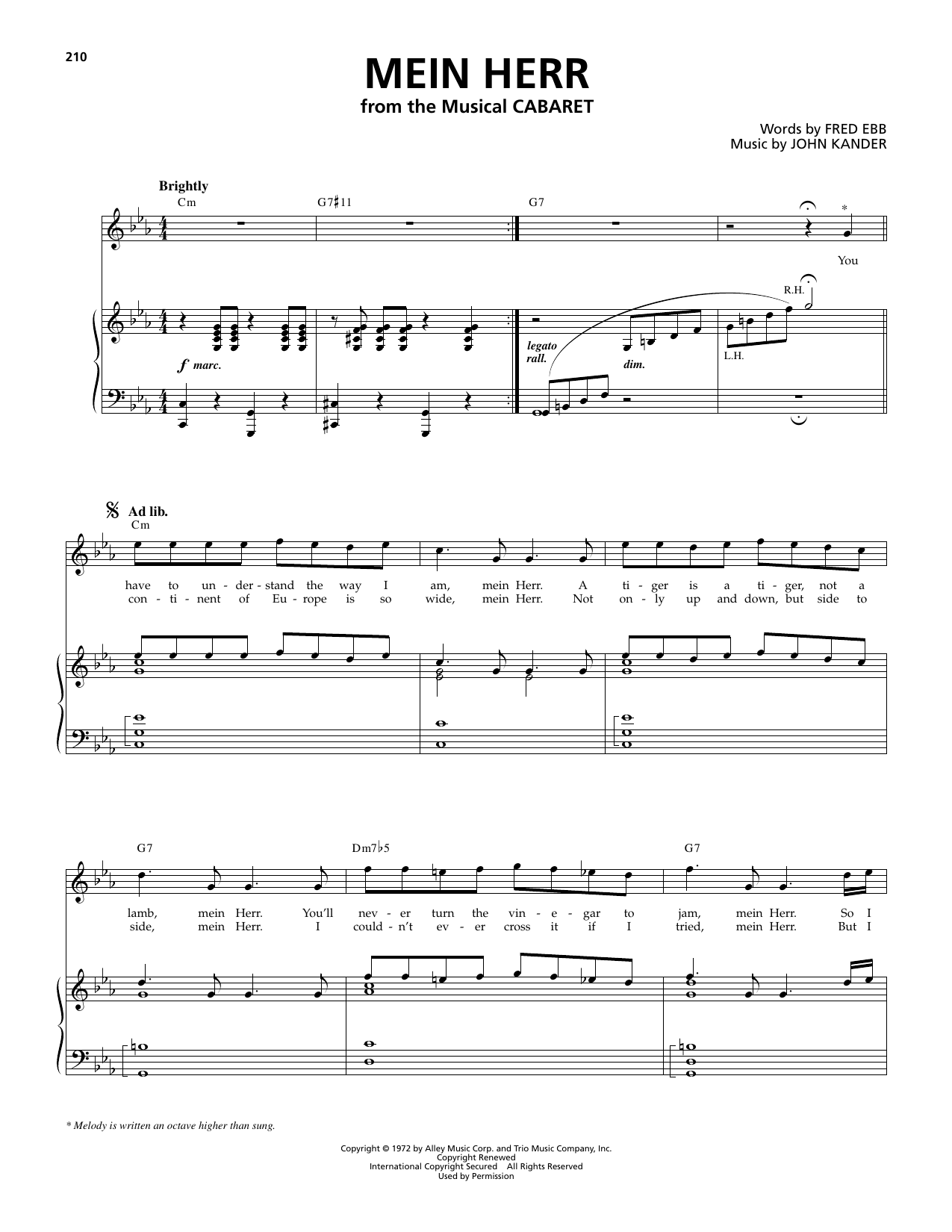
John Kander composed the score for Cabaret alongside lyricist Fred Ebb, creating one of musical theatre's most sophisticated and unsettling soundscapes. Working in the early 1970s, Kander crafted music that mirrored the moral ambiguity and decadence of Weimar Berlin, earning the show eight Tony Awards and establishing himself as a master of character-driven songwriting.
Why we love this
This number demands real dramatic commitment from your vocalist, but the payoff is substantial. The accompaniment sits perfectly across piano, voice, and guitar without feeling cramped, making it accessible for smaller ensembles or intimate concert settings where big ensemble pieces won't work.
What to expect
Cabaret's world materializes in this number: decadent, morally complex, and wrapped in false charm. The music luxuriates in minor key territory with jazz inflections, creating an atmosphere where seduction and menace coexist. Performers walk a tightrope between vulnerability and calculated performance.
Who it's for
This arrangement works beautifully for voice students exploring character song interpretation, pianists or guitarists developing accompaniment skills in a theatrical context, and programs seeking a sophisticated solo that reads as fully staged within minimal resources. The five pages of material suit both solo recital contexts and ensemble concerts.
How to get the most out of it
Establish the sultry, deliberate tempo early. The song's power comes from restraint, not rushing through the lyrical passages.
Shape the dynamics around the character's emotional arc rather than treating each phrase identically. The seduction intensifies as the number progresses.
Balance the vocal line with the accompaniment so the piano and guitar enhance rather than overshadow the lyrical storytelling.
Commit fully to the character's voice and intentions. Half-hearted delivery flattens the song's theatrical edge.
How to use it
Pair this with other character songs from Broadway's darker catalogue for an evening exploring psychological complexity in musical theatre. It also serves as an excellent audition piece for music theatre programs or as a centerpiece in a solo recital that needs a moment of genuine theatrical sophistication.
Skills your students will build
Sustaining dramatic character across a complete song arc
Navigating the relationship between vocal line and jazz-inflected accompaniment
Interpreting subtext through phrasing and dynamic choice
Reading standard Broadway sheet music formats with piano and guitar parts
You May Also Like
Scan to Complete Your Purchase
Use your phone's camera to scan the code below
You'll log in on your phone and the order will be added to your account