
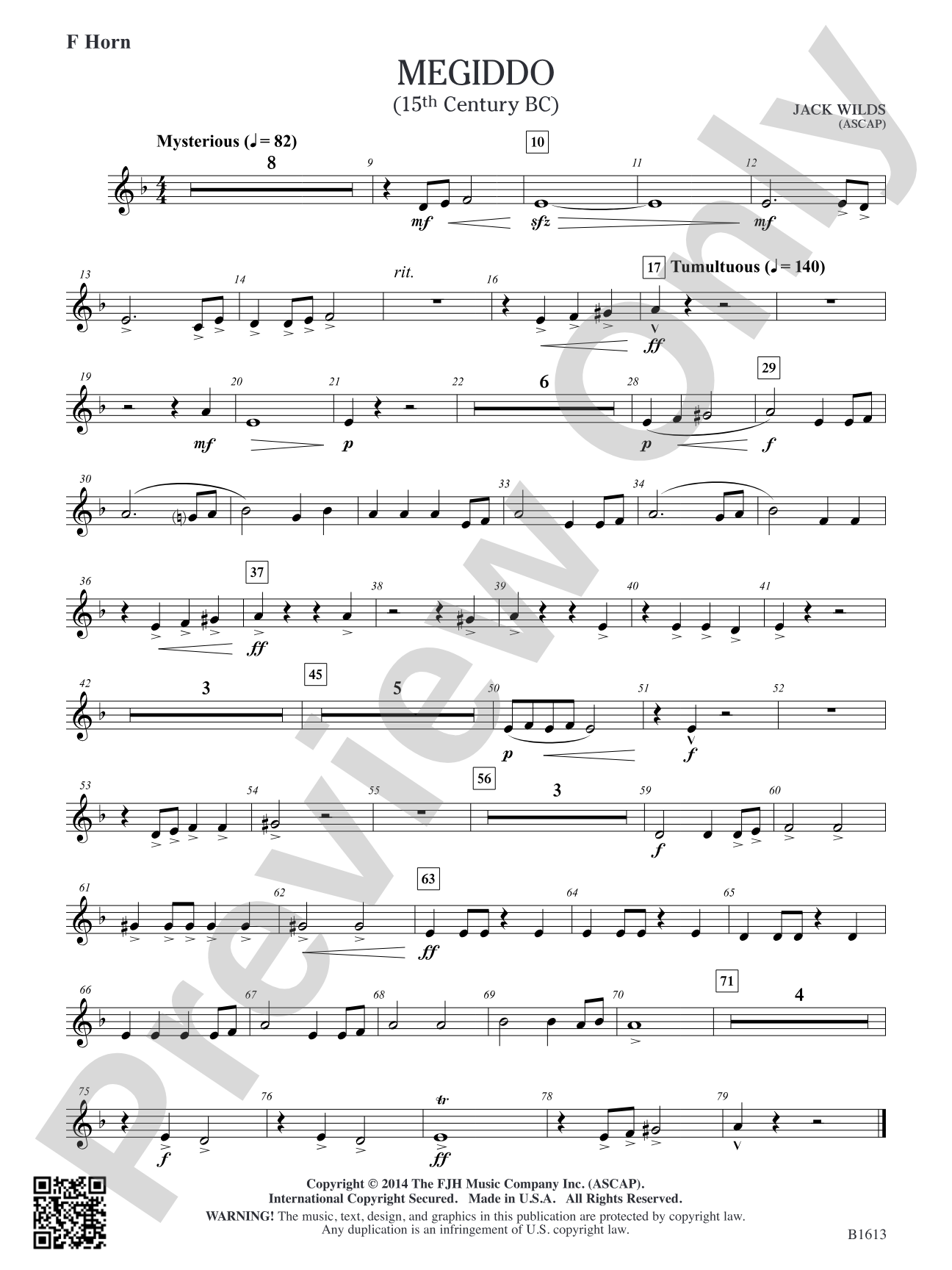

Megiddo: F Horn
By Jack Wilds
Grade: 1.5
Item: 98-PC-DB1613_H1
$7.00
Pickup currently not available
Description
During the 15th century BC, Megiddo became the site of the first recorded battle in history. The records of this clash are scrawled in hieroglyphics in the Hall of Annals at the Temple of Amun-Rah. The music relies on the D Phrygian mode and primitive percussion sounds to capture the essence of this historic battle.


Don't just read it, hear it, play along with it, and watch your students grow with it. In MakeMusic Cloud, Megiddo: F Horn comes alive with professional accompaniment, adjustable tempo, and built-in practice tools that turn solo practice into real progress.
Open in the Player
Jump straight in and assign it today.
Start Your Free Trial
Open this title and explore the full library in minutes.
Sample Audio
1
Audio File
--:--
0:00
0:00
Sample Video
No sample videos found.
Additional Details
Series:
FJH Developing Band
Publisher:
The FJH Music Company, Inc.
SKU:
98-PC-DB1613_H1
More about this title
About the Composer: Jack Wilds

Jack Wilds brings composition experience across an unusually wide age range, from elementary ensembles through professional orchestras. His output spans children's choirs, developing wind bands, collegiate ensembles, and chamber groups that have included members of the New York Philharmonic and Atlanta Symphony. He draws inspiration from visual art, philosophical texts, and poetry alongside purely musical ideas, creating works that balance accessibility with artistic integrity.
Wilds spent years as a public school band director before moving into full-time composition and teaching. He currently lectures at Texas State University in composition, theory, and music technology, and serves as Co-Director of Music at First Presbyterian Church in San Marcos. His wind band works appear regularly on festival required lists across multiple continents and have been heard at the Midwest Clinic and major educator conferences. He studied composition with Michael Ippolito, Chris Trapani, and Donald Grantham.
Why we love this
Wilds captures genuine historical atmosphere without relying on bombast or cliché. The D Phrygian mode and period-appropriate percussion create sonic authenticity that young players recognize as something real, not just a generic battle fanfare. At Grade 1.5, the orchestration remains clean enough for developing sections while delivering genuine artistic content that makes students feel they're playing something that matters.
What to expect
Ancient and austere. The D Phrygian mode creates an exotic minor-inflected soundscape that feels distant in time, while primitive percussion echoes across the texture like whispers from the Temple of Amun-Rah. There's momentum and conflict here, but expressed through color and modal darkness rather than aggressive loudness.
Who it's for
Developing concert bands working at Grade 1.5 who want genuine musical content beyond standard pedagogical fare. Programs seeking festival or contest repertoire that teaches musicianship while telling a story. Ensembles interested in non-Western scales and historical contexts as teaching tools.
How to get the most out of it
- Explore the D Phrygian mode with your ensemble before rehearsals begin. Have brass and woodwinds play a unison D Phrygian scale to internalize its darker, minor-inflected character and how it differs from natural minor.
- Give the percussion section ownership of the primitive sounds. These aren't afterthoughts; they anchor the historical identity. Work with percussionists on tone quality and articulation so their colors emerge clearly.
- Balance transparency with intensity. The piece should feel focused and deliberate rather than loud. Younger ensembles often push dynamics too hard when describing conflict; restrain and let the modal colors do the work.
- Shape phrases in longer arcs rather than section by section. Even at this level, conductor gesture that shows forward motion will help players hear the narrative arc of the battle.
How to use it
Program this alongside other pieces that explore non-Western scales or historical narratives to create a concert theme exploring music and civilization. It works well as a festival or contest selection where the combination of authentic character and manageable difficulty impresses judges. Consider pairing it with a more lyrical work to show your band's range in a single concert.
Skills your students will build
- Reading and internalizing modes outside major and minor (D Phrygian)
- Balancing ensemble sound across contrasting tone colors (melodic vs. percussive voices)
- Interpreting historical and cultural context in musical performance
- Executing nuanced dynamic control in music that relies on timbre rather than volume for effect
- Part independence in developing arrangements with less doubling than traditional Grade 1.5 repertoire