
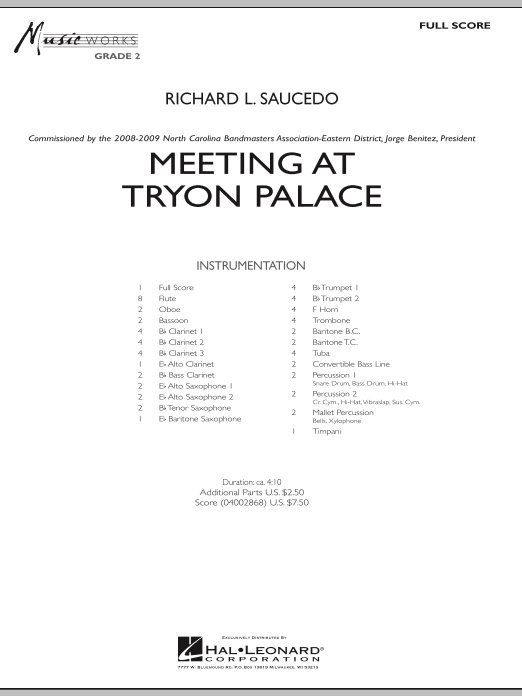

Meeting at Tryon Palace: Concert Band Conductor Score & Parts
By Richard L. Saucedo
Grade: 2
Item: 35-PK00126742
$60.00
Pickup currently not available
Buy Extra Parts (Digital PDF Download)
Parts Added to Cart!
Description
Described by the composer as "bombastic, but with a groove" this work for young players opens with striking percussion statements. The band enters gradually, first with unison figures along with the percussion, and then additional layers. A contrasting slow section with flowing lines and minor harmonies sets the stage for the dramatic final section. A great way to showcase your percussion section. Dur: 4:10 (Grade 2)


Meeting at Tryon Palace: Concert Band Conductor Score & Parts isn't in MakeMusic Cloud just yet...but it could be. Let us know you'd like to see it, and you'll help shape what comes next. In the meantime, start a free trial and dive into thousands of interactive titles your students can play along with today.
Request This Title
Tell us you want it.
Start Your Free Trial
Explore everything that's ready to play right now.
Sample Audio
No sample audio found.
Sample Video
No sample videos found.
Additional Details
Publisher:
Hal Leonard
SKU:
35-PK00126742
More about this title
About the Composer: Richard L. Saucedo

Richard L. Saucedo spent 31 years building one of Indiana's most decorated band programs at Carmel High School, where his ensembles earned consistent state, regional, and national recognition across concert, jazz, and marching formats. His Wind Symphony I appeared at the Music for All National Concert Band Festival three times and claimed the Indiana State Champion title in 2013, while the Carmel Marching Greyhounds finished in the BOA Grand National Championship top ten for 17 consecutive years, capturing national titles in 2005 and 2012.
Beyond the high school podium, Saucedo has shaped competitive drum corps as brass arranger and composer for the Cavaliers (five DCI world championships) and currently serves as music ensemble coordinator for the Blue Devils. He was named Indiana's Bandmaster of the Year in 1998-99, honored as an Outstanding Music Educator in 2010, and inducted into the Music for All Hall of Fame (2015) and Drum Corps International Hall of Fame (2022). His compositional work spans marching bands, concert bands, choral groups, and orchestras, and he serves as Senior Educational Consultant for Music for All and Bands of America.
Why we love this
Saucedo understands exactly how Grade 2 bands tick. The opening percussion statements grab attention immediately, then he brings the full band in with a structure that rewards careful listening and builds genuine momentum. The middle section's contrasting slow material proves he can write meaningful lyrical passages at this level, not just filler between louder moments.
What to expect
Bombastic yet grounded, this piece opens with percussive swagger before mellowing into something more introspective. The journey from rhythmic boldness to lyrical reflection to a climactic payoff creates a satisfying arc that keeps audiences engaged.
Who it's for
Grade 2 concert bands ready to tackle a work with real personality and architectural sophistication. Directors seeking a piece that challenges students to balance precision with groove while giving the percussion section meaningful solo material.
How to get the most out of it
- Let your percussion section own the opening. These are their statements, so give them space to establish the character before the band enters.
- Shape the entrance carefully as unison figures build texture. Each new layer should feel intentional rather than crowded.
- The slow section's minor harmonies need singing tone from your winds. This is where you get breath support and phrase direction front and center.
- Build the dramatic final section by tracking dynamic clarity. Students should hear where the climax lives and pull toward it together.
How to use it
Position this as your opening concert piece to establish energy and personality early in the program. It pairs well alongside more traditional Grade 2 fare because the contrasting slow section gives you tonal and dynamic variety without requiring advanced technical demands.
Skills your students will build
- Layered ensemble entrances and texture building
- Sustained legit tone in lyrical passages with minor harmonic coloring
- Rhythmic precision and groove coordination between sections
- Balance and blend when combining unison figures with percussion accompaniment
- Dynamic contrast and phrasing across distinct musical sections