
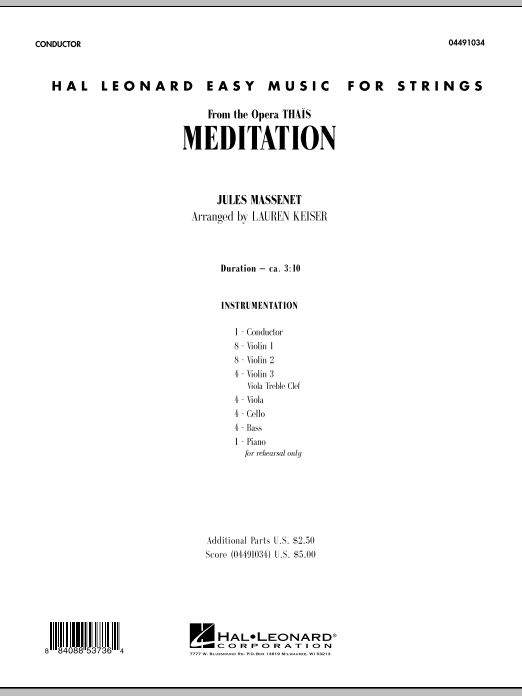

Meditation: String Orchestra Conductor Score & Parts
By Jules Massenet / Arranged by Lauren Keiser
Grade: 2
Item: 35-PK00159082
$40.00
Pickup currently not available
Buy Extra Parts (Digital PDF Download)
| Product | Price | Quantity |
|---|---|---|
| Meditation - Full Score | $6.00 | |
| Meditation - Violin 1 | $7.00 | |
| Meditation - Violin 2 | $7.00 | |
| Meditation - Violin 3 (Viola Treble Clef) | $7.00 | |
| Meditation - Viola | $7.00 | |
| Meditation - Cello | $7.00 | |
| Meditation - Bass | $7.00 | |
| Meditation - Piano | $7.00 |
Parts Added to Cart!
Description
This famous melody from the opera "Thais" has been performed by countless violinists, including Itzhak Perlman and Josh Bell. Now you can feature a young soloist in the opening section of this new edition for string orchestra by Lauren Keiser. Dur: 3:10


Meditation: String Orchestra Conductor Score & Parts isn't in MakeMusic Cloud just yet...but it could be. Let us know you'd like to see it, and you'll help shape what comes next. In the meantime, start a free trial and dive into thousands of interactive titles your students can play along with today.
Request This Title
Tell us you want it.
Start Your Free Trial
Explore everything that's ready to play right now.
Sample Audio
No sample audio found.
Sample Video
No sample videos found.
Additional Details
Publisher:
Hal Leonard
SKU:
35-PK00159082
More about this title
About the Composer: Jules Massenet
Jules Massenet (1842-1912) was a prolific French composer whose gift for melody made him one of the most performed opera composers of his era. His works emphasize lyrical beauty and emotional directness, qualities that have kept pieces like the Méditation from Thais in the standard repertoire for over a century. Massenet's ability to craft singable, memorable lines serves as a masterclass in orchestration for musicians learning how to balance simplicity with sophistication.
For music educators, Massenet represents a bridge between Romantic grandeur and accessibility. His orchestrations demonstrate how careful voice leading and transparent textures can achieve emotional power without complexity, making his work invaluable for teaching young musicians what mature musicianship sounds like.
Why we love this
This arrangement gives young string players immediate access to one of classical music's most recognizable melodies without the technical barriers of traditional soloistic versions. Keiser's orchestration preserves the piece's lyrical essence while creating natural performance opportunities for developing musicians, making it possible to feature a soloist who may not yet have the virtuosic chops required for the violin original.
What to expect
The Méditation unfolds with quiet introspection and gentle longing. Its unhurried pace and vocal quality invite listeners into an intimate space, creating a meditative mood that justifies the title. The piece never rushes; instead it breathes, allowing each phrase to resonate with the simplicity and eloquence that defines Massenet's melodic gift.
Who it's for
Directors seeking to program a recognizable masterwork for students in grades 2-3 string orchestras, particularly those wanting a vehicle for a young soloist who has musicality and tone but may lack advanced technique. It works equally well as a soothing ensemble piece for concert programming or as a listening and conducting study in French operatic style.
How to get the most out of it
- Shape the opening solo line with unhurried phrasing; younger soloists often rush beautiful melodies from nervousness, so rehearse breathing and bow distribution separately from technique.
- Balance the orchestral accompaniment so it supports rather than overwhelms the featured soloist. String orchestra players should listen actively to the soloist's tempo and dynamic shaping.
- Attend to the transitions between solo and tutti sections. Mark these clearly in the parts and conduct them deliberately so the ensemble knows when to take ownership of the melody.
- Bring out the harmonic movement in the accompanimental voices. Even in a supporting role, second violins, violas, and cellos shape the emotional arc through their voicing choices.
How to use it
This piece fits naturally on a concert featuring lighter repertoire or serving as a contemplative centerpiece within a mixed program. It also works as an excellent preparation for younger orchestras before tackling longer Romantic works, since it teaches phrase architecture and dynamic control in a contained, forgiving format. Consider pairing it with other French orchestral works or with Massenet opera excerpts if you're building a thematic concert.
Skills your students will build
- Lyrical phrasing and sustained tone production
- Listening to and supporting a featured soloist within ensemble texture
- Dynamic control and balance between solo and accompaniment
- Transparency in harmonic voicing and voice independence
- Phrase architecture and breathing in non-text-based music