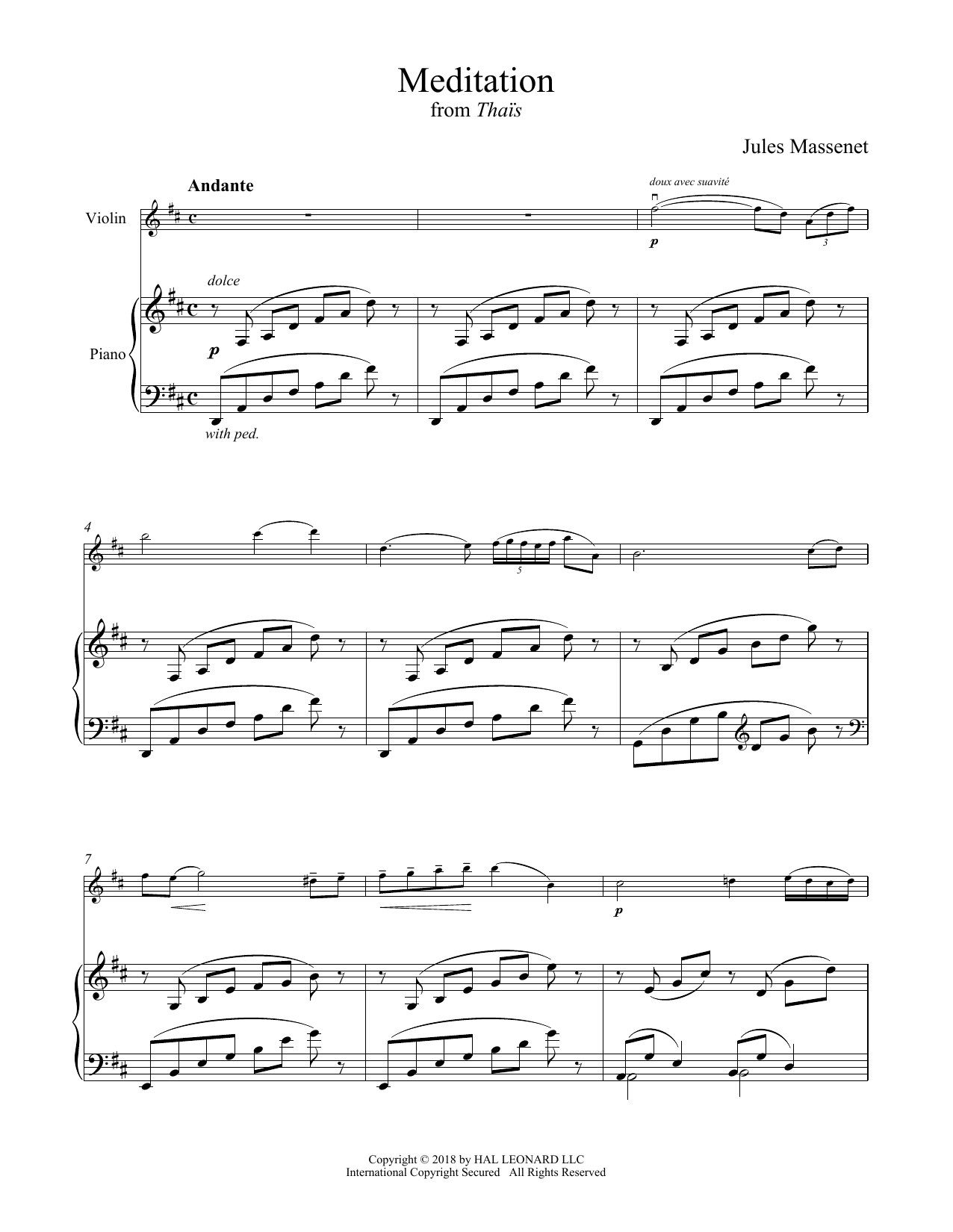
Meditation Sheet Music Preview

Meditation: Violin and Piano

By Jules Massenet

Item: 35-DS00428053

Digital Download
$5.99
Description

Discover MakeMusic Cloud: thousands of interactive titles your students can play along with today.

Sample Audio
No sample audio found.
Sample Video
Additional Details
Publisher: Hal Leonard
Page Count: 6
SKU: 35-DS00428053

More about this title

About the Composer: Jules Massenet

Jules Massenet (1842–1912) was a prolific French composer whose gift for melody made him one of the most performed opera composers of his era. His works span operas, ballets, oratorios, and instrumental pieces, all marked by lyrical beauty and emotional directness that connected immediately with audiences. In the concert hall and studio, his shorter instrumental works remain essential teaching and performance repertoire because they demonstrate how to sustain a singing line with elegance and restraint.

Massenet's compositional voice prioritizes accessibility without sacrificing sophistication. His Meditation from Thaïs, alongside other character pieces and operatic excerpts, has become foundational material for string students and violinists seeking repertoire that builds musicianship through pure melodic expression. Teachers return to his writing again and again because it teaches phrasing, tone production, and the discipline of supporting long lines.

Why we love this

This arrangement arrives at a moment when many programs need elegant, tasteful pieces for ceremonies and formal occasions. The violin and piano combination is universally available in studio and school settings, yet genuinely beautiful examples at this level remain limited. Massenet's Meditation delivers musical substance alongside its ceremonial function, asking both players to sing rather than simply accompany.

What to expect

Quiet dignity and emotional transparency. The piece unfolds across a gentle harmonic landscape, never rushing; instead, it invites the listener into intimate, unguarded expression. There is no drama here, only the steady warmth of a melody that seems to exist without effort.

Who it's for

Wedding musicians, studio teachers preparing students for recitals, and violinists looking for six pages of repertoire that rewards disciplined practice without excessive technical demand. This works equally well for the performer seeking a reliable encore or the director pairing chamber music with a broader program.

How to get the most out of it

  • Treat the violin line as a vocalist would: shape phrases in breath-length units rather than metrically, allowing the piano accompaniment to flex with your phrasing.
  • Support the sustained high passages with vibrato that communicates warmth without wavering the pitch; let the vibrato deepen during arrivals on important harmonic moments.
  • Balance the violin and piano so the melody reads clearly even when the accompaniment grows in texture; avoid the trap of matching dynamic levels when you should remain the foreground voice.
  • Practice the ritardandi marked in the score with your collaborative pianist beforehand, finding the exact amount of give that feels natural rather than abrupt.

How to use it

Open a chamber concert with this piece to establish an atmosphere of refinement before moving into more dramatic or energetic works. It also serves as an elegant interlude between larger ensemble selections or as the centerpiece of a recital focused on 19th century violin and piano repertoire.

Skills your students will build

  • Sustaining long melodic lines without loss of tone or pitch center
  • Coordinating vibrato with phrase structure and harmonic arrival points
  • Adjusting ensemble balance between two instruments of different timbral weights
  • Interpreting written ritardandi and fermatas with musical judgment rather than mechanical exactness
  • Collaborating with a pianist to shape tempo and rubato as a unified statement

You May Also Like