
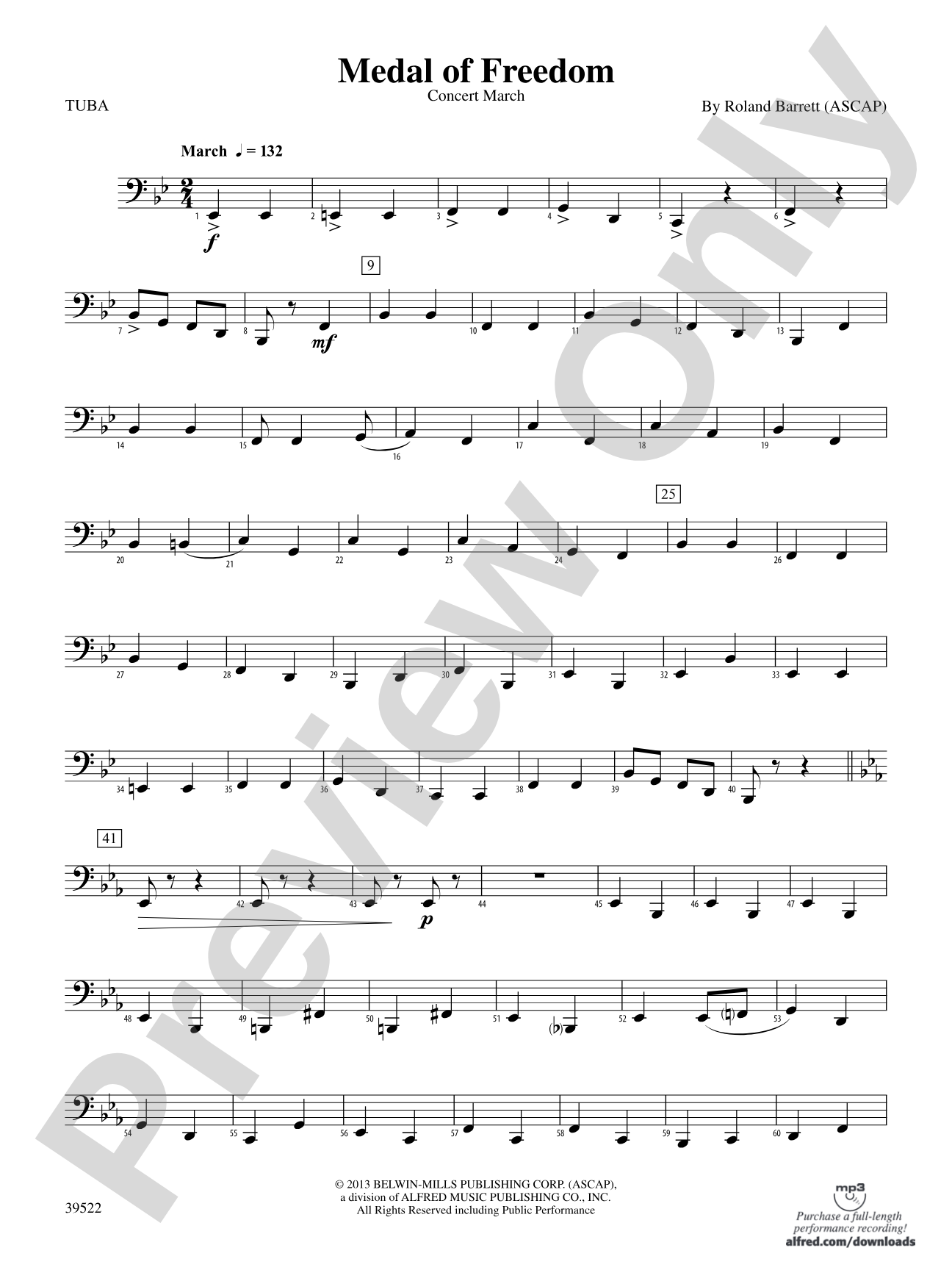

Medal of Freedom: Tuba
Concert March
By Roland Barrett
Grade: 2 (Easy)
Item: 00-PC-0015837_TB1
$3.00
Pickup currently not available
Description
The Presidential Medal of Freedom is the highest civilian award in the United States. Bestowed by the President, the award recognizes those individuals who have made "an especially meritorious contribution to the security or national interests of the United States, world peace, cultural or other significant public or private endeavors." This bright, contemporary 2/4 march pays tribute to all past, present, and future winners of the award, and salutes their numerous achievements and contributions. (2:00) This title is available in MakeMusic Cloud.


Don't just read it, hear it, play along with it, and watch your students grow with it. In MakeMusic Cloud, Medal of Freedom: Tuba comes alive with professional accompaniment, adjustable tempo, and built-in practice tools that turn solo practice into real progress.
Open in the Player
Jump straight in and assign it today.
Start Your Free Trial
Open this title and explore the full library in minutes.
Sample Audio
1
Audio File
--:--
0:00
0:00
Sample Video
No sample videos found.
Additional Details
Series:
Belwin Young Band
Publisher:
Alfred Music
Page Count:
238
SKU:
00-PC-0015837_TB1
More about this title
About the Composer: Roland Barrett

Roland Barrett holds the position of music theory and composition faculty member at the University of Oklahoma, where he has taught since 2001. His career includes fifteen years as Assistant Director of Bands prior to joining the university, and he currently arranges music for the Pride of Oklahoma marching band. Barrett has published over two hundred original compositions and arrangements across symphonic band, chamber ensembles, and marching band repertoire.
His works have earned performances by the Dallas Wind Symphony, All-State and All-Region honor bands, and regional festivals. Barrett is a multiple recipient of the ASCAPlus award and has received recognition at the Midwest Band & Orchestra Convention, the National Trumpet Competition, and the International Trumpet Guild convention. His music has been featured on NPR and USA network programming.
Why we love this
Barrett writes in a voice that feels contemporary without losing the dignity that ceremonial music demands. The straightforward Grade 2 setting means your students can deliver a polished, confident performance without compromise, and the patriotic subject matter gives young musicians something substantive to play for rather than simply executing technical demands.
What to expect
Bright and forward-moving, with the character of a ceremonial tribute rendered in contemporary musical language. The march idiom carries formality and dignity, but Barrett's orchestration feels fresh and direct rather than archival. It plays as both respectful acknowledgment and celebration.
Who it's for
Band directors seeking accessible, meaningful repertoire for Grade 2 ensembles. This piece works equally well for groups developing their march performance skills and for directors looking to program patriotic music with substance rather than cliché. The full score and parts format makes it ideal for groups of any size.
How to get the most out of it
- Maintain clarity in the articulation of the march rhythm; the 2/4 meter should feel propulsive and deliberate, not rushed. Lock the rhythm section early in rehearsals to establish the pulse that everything else hangs from.
- Balance the melodic content across sections. This piece celebrates achievement, so when themes pass between instruments, ensure each voice projects fully and the handoff feels intentional rather than accidental.
- Shape the dynamics with purpose. Marches thrive on contrast, and subtle growth and release in dynamics will help the form emerge naturally for listeners.
How to use it
Program this as a concert opener that sets a patriotic tone without consuming significant rehearsal time. It also fits naturally into concert programs pairing with other American-themed works, or as the centerpiece of a program built around service and civic recognition. The two-minute length makes it useful for festivals where time is limited but impact matters.
Skills your students will build
- Marching idiom performance and character interpretation
- Sectional balance and voice leading in hymn-like and melodic writing
- Reading concert band instrumentation and part coordination
- Dynamic shaping and musical phrasing in 2/4 meter