
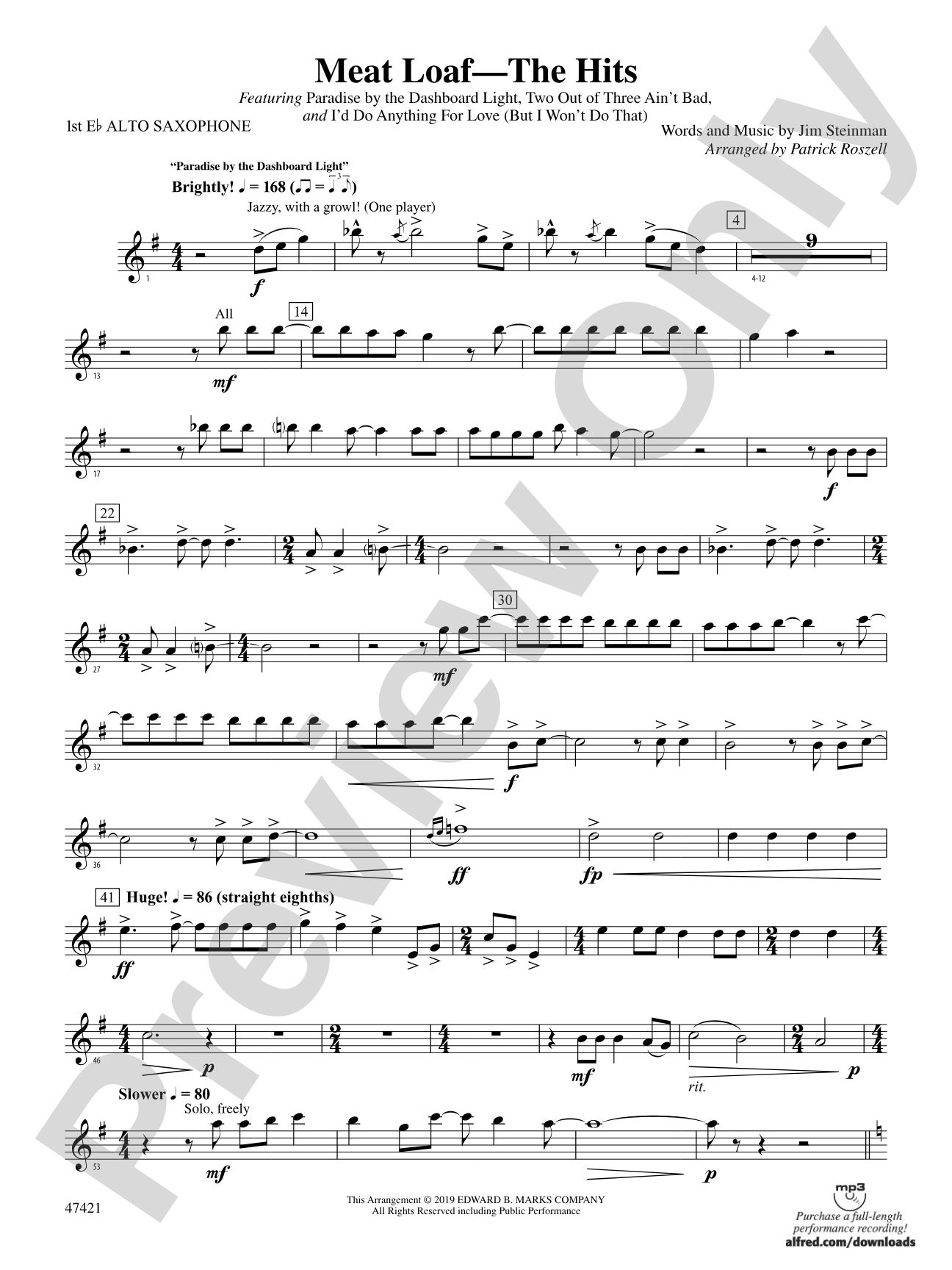

Meat Loaf---The Hits: E-flat Alto Saxophone
Featuring: Paradise by the Dashboard Light / Two Out of Three Ain't Bad / I'd Do Anything For Love (But I Won't Do That)
Words and music by Jim Steinman / arr. Patrick Roszell
Grade: 3 (Medium Easy)
Item: 00-PC-0017952_AX1
$5.99
Pickup currently not available
Description
He's big and over the top in his music and his performances. Three memorable hits written by Meat Loaf's longstanding songwriter Jim Steinman including, "Paradise by the Dashboard Light," "Two Out of Three Ain't Bad," and "I'd Do Anything For Love (But I Won't Do That)," compose this feel-good medley. Like his performances, go big and over the top, but be sure to have fun! (6:00)


Don't just read it, hear it, play along with it, and watch your students grow with it. In MakeMusic Cloud, Meat Loaf---The Hits: E-flat Alto Saxophone comes alive with professional accompaniment, adjustable tempo, and built-in practice tools that turn solo practice into real progress.
Open in the Player
Jump straight in and assign it today.
Start Your Free Trial
Open this title and explore the full library in minutes.
Sample Audio
1
Audio File
--:--
0:00
0:00
Sample Video
Additional Details
Series:
Pop Concert Band
Publisher:
Alfred Music
Page Count:
256
SKU:
00-PC-0017952_AX1
More about this title
About the Composer: Jim Steinman
Jim Steinman composed and wrote the lyrics for some of rock music's most theatrical and ambitious songs, beginning in the 1970s. His partnership with Meat Loaf produced some of the era's most recognizable hits, marked by Steinman's gift for operatic arrangements, complex narratives, and unapologetic emotional intensity. His work has influenced generations of songwriters working at the intersection of rock, musical theater, and progressive music.
Beyond his chart success, Steinman's compositions reveal a deep knowledge of orchestration and dramatic structure. His ability to build climactic moments and create memorable hooks within large-scale arrangements makes his catalog especially rewarding for concert band settings, where dynamics and sectional balance become tools for storytelling.
Why we love this
Patrick Roszell's arrangement captures the theatrical DNA of these songs while keeping the orchestration accessible for Grade 3 players. The medley format gives your band a chance to perform three instantly recognizable tunes in one cohesive performance, and the instruction to "go big and over the top" gives everyone permission to embrace the drama and have genuine fun with the material. Rock and pop repertoire at this level rarely feels this substantial.
What to expect
Theatrical, energetic, and unafraid of its own ambition. The arrangement swells with the same kind of dramatic momentum as the original recordings, combining driving rock grooves with lush orchestral moments. It's the kind of piece that makes an audience lean forward and reminds performers why they chose band.
Who it's for
Band directors who want to program contemporary hits for concert audiences while keeping rehearsal demands reasonable. Students benefit from playing recognizable, emotionally engaging music that rewards commitment to style and dynamics without requiring advanced technical facility.
How to get the most out of it
- Balance the emotional peaks. Each song builds to a climactic moment; resist the urge to play everything at full volume from the start. Let the band crescendo into the big moments so the power lands.
- Lock the opening of each tune. The transition between songs matters as much as the songs themselves. Use rehearsal time to nail the rhythmic confidence at the beginning of "Paradise," "Two Out of Three," and "I'd Do Anything."
- Highlight the solo voices and featured sections. This arrangement likely gives moments to front-line players. Make sure those parts cut through and don't get buried in the surrounding harmony.
- Commit to the style. These songs belong to the rock world, not the concert world. Punch the rhythms, let the drums breathe, and trust that theatrical delivery is the point.
How to use it
Program this medley as a concert closer or second-half opener when you want to shift the energy and connect with audiences beyond traditional concert band repertoire. It pairs well with a mix of classic band classics and contemporary works, giving concerts shape and variety. The 6-minute runtime fits comfortably into most concert programs.
Skills your students will build
- Interpreting style and character in rock and pop idioms
- Managing dynamic contrast and theatrical phrasing across large sections
- Maintaining rhythmic cohesion in syncopated, driving grooves
- Balancing featured solos with ensemble support
- Executing smooth transitions between distinct musical sections