Maybe (from Oh, Kay!) Sheet Music Preview

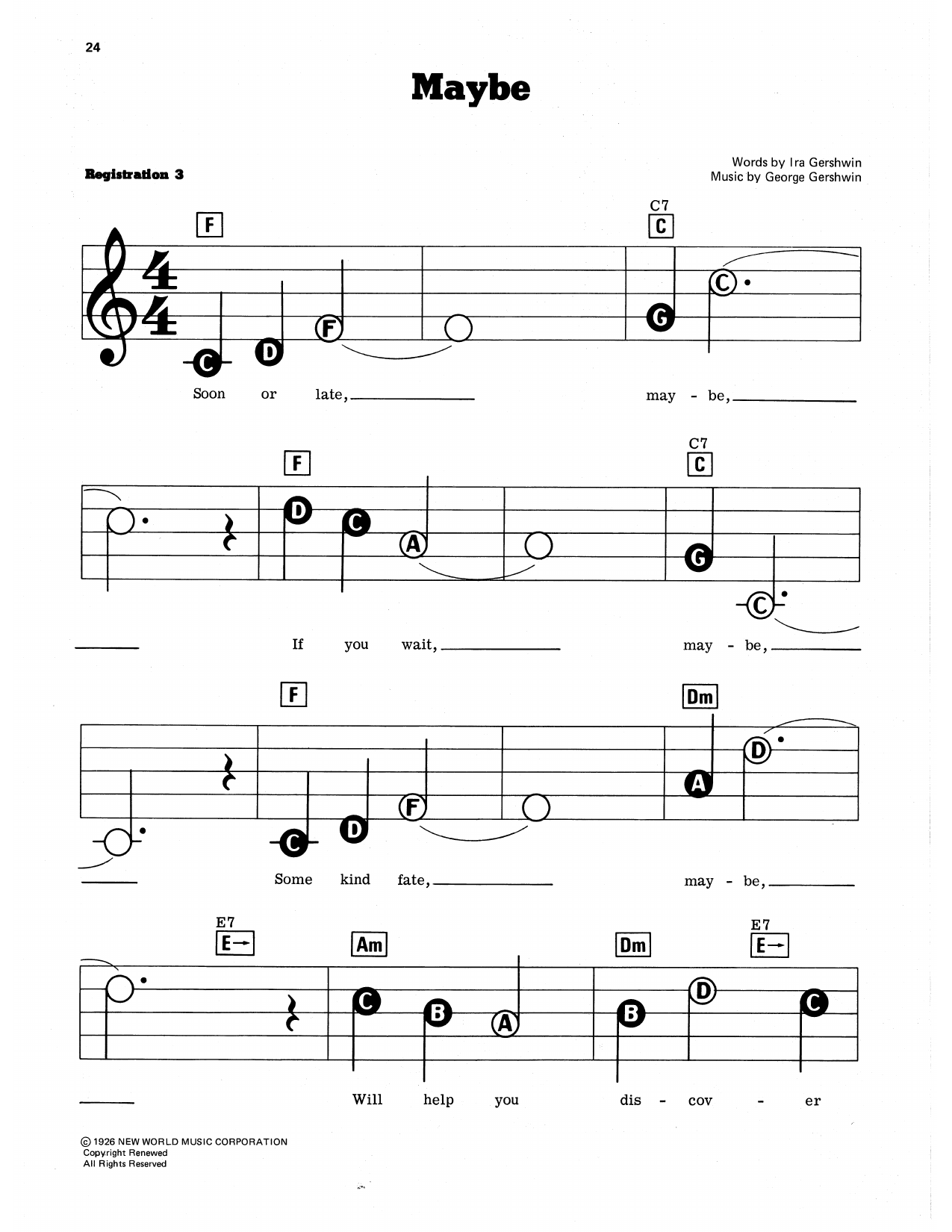
Maybe (from Oh, Kay!): E-Z Play Today

Item: 35-DS01959293

Digital Download
$4.99
Description

Maybe (from Oh, Kay!): E-Z Play Today isn't in MakeMusic Cloud just yet...but it could be. Let us know you'd like to see it, and you'll help shape what comes next. In the meantime, start a free trial and dive into thousands of interactive titles your students can play along with today.

Sample Audio
No sample audio found.
Sample Video
Additional Details
Publisher: Hal Leonard
Page Count: 2
SKU: 35-DS01959293

More about this title

About the Creator

George Gershwin and Ira Gershwin created "Maybe" for their 1926 musical comedy "Oh, Kay!" The song emerged during a remarkably fertile period in American musical theater, when the Gershwins were defining a new sophistication in Broadway songwriting. Ira's lyrical restraint and George's melodic gift combine here to create something deceptively simple: a song about uncertainty that resonates through its harmonic subtlety and gentle forward momentum.

The piece exemplifies what made Gershwin standards endure. Rather than rely on theatrical bombast, "Maybe" trusts its melody and the vulnerability in its harmonic language to carry the emotional weight. For pianists and singers alike, it remains one of those songs that sounds easier than it actually is to perform with genuine style.

Why we love this

This E-Z Play arrangement strips away unnecessary complexity while preserving the song's essential harmonic character and lyrical shape. Piano students often struggle with jazz standards because traditional chord voicings feel either too simple or too demanding; this version calibrates perfectly for the intermediate player who wants to sound genuinely musical without getting lost in reharmonization.

What to expect

"Maybe" carries the bittersweet warmth of a song written in a major key that somehow doesn't feel entirely optimistic. There's a wistful quality: the melody drifts gently through its phrases while the harmony provides subtle emotional complexity. Playing it feels like a conversation; you're not declaring certainty but rather thinking aloud about possibility.

Who it's for

Pianists working toward their first jazz standards repertoire will find this arrangement approachable without being patronizing. Teachers can use it effectively with intermediate students who want to explore American songbook material but aren't yet ready for complex chord symbol reading or sophisticated voicing.

How to get the most out of it

  • Let the melody breathe. Resist the urge to rush; this song asks for space between phrases, and that restraint is what gives it poignancy.
  • Pay attention to the harmonic movement in the accompaniment. Even in a simplified arrangement, the chord changes carry emotional information; your touch should reflect slight shifts in color.
  • Approach the rhythm with a gentle swing feel rather than strict metronomic precision. The song was written for theater, and that theatrical lightness should remain present in your interpretation.

How to use it

This works beautifully as a solo feature in a recital or concert that explores American songwriting across genres. Pair it with other Gershwin standards or use it as a stylistic bridge between classical and jazz repertoire. It's also ideal for student recitals where musicians are building confidence with popular song literature.

Skills your students will build

  • Interpreting chord symbols and creating accompaniment textures in a simplified jazz context
  • Balancing melody and harmony so that neither overwhelms the other
  • Applying swing rhythm and jazz phrasing to a standard popular song
  • Reading and performing across two staves with mixed rhythmic complexity

You May Also Like