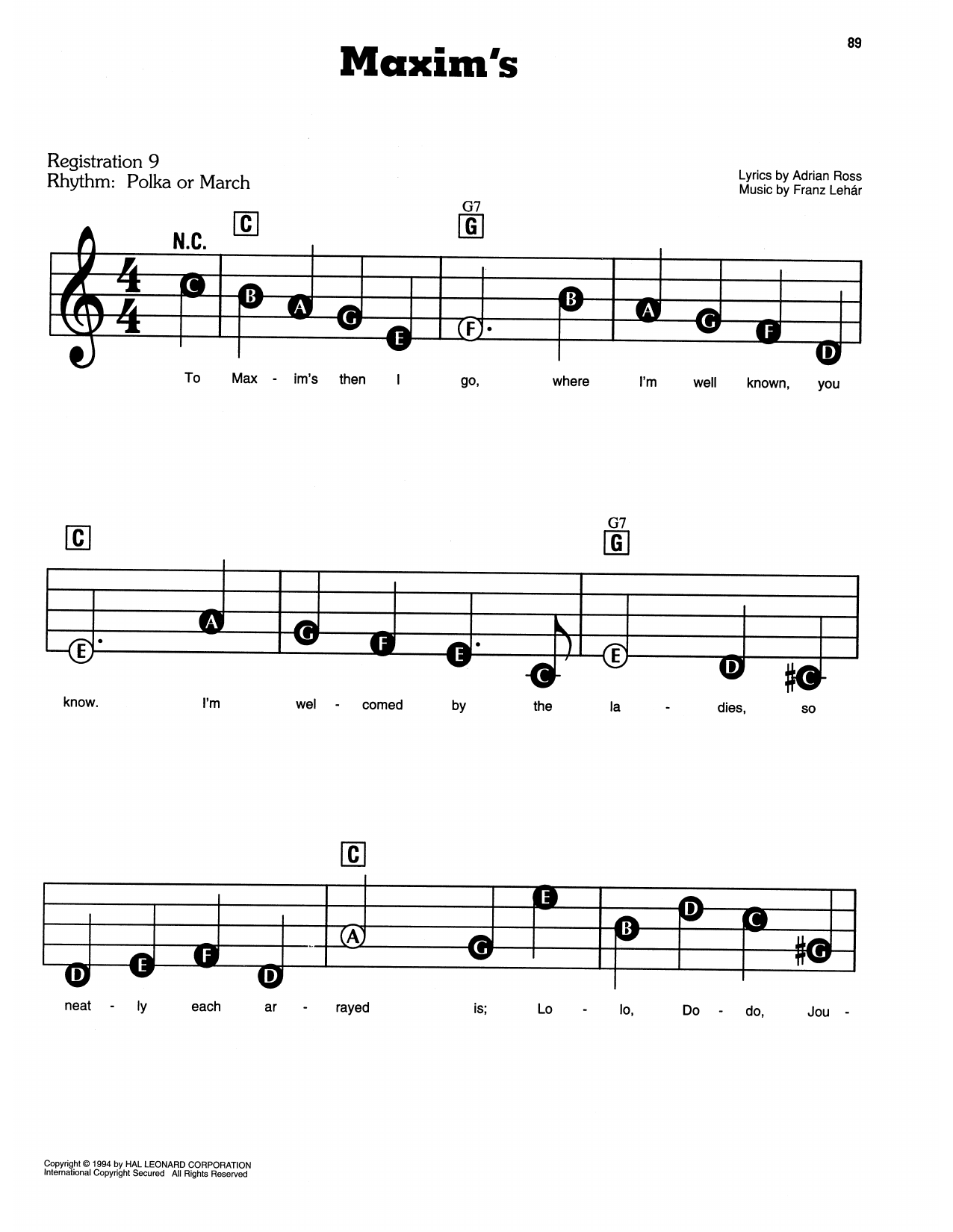
Maxim's (from The Merry Widow) Sheet Music Preview

Maxim's (from The Merry Widow): E-Z Play Today

By Franz Lehar

Item: 35-DS01867019

Digital Download
$4.99
Description

Maxim's (from The Merry Widow): E-Z Play Today isn't in MakeMusic Cloud just yet...but it could be. Let us know you'd like to see it, and you'll help shape what comes next. In the meantime, start a free trial and dive into thousands of interactive titles your students can play along with today.

Sample Audio
No sample audio found.
Sample Video
Additional Details
Publisher: Hal Leonard
Page Count: 3
SKU: 35-DS01867019

More about this title

About the Composer: Franz Lehar

Franz Lehár (1870–1948) was a Hungarian composer who defined the operetta genre in the early 20th century. His gift for melody and theatrical orchestration made him one of the most performed composers of his era, and his works remain central to the operetta repertoire today.

Lehár's ability to blend folk idioms with sophisticated harmonic language created music that appeals across skill levels. For educators, his output offers accessible yet musically substantial material that engages students in the pleasures of tonal melody and theatrical expression.

Why we love this

Lehár's most famous waltz deserves a place in any pianist's repertoire, and this E-Z Play arrangement makes it genuinely playable for intermediate players without sacrificing the elegance that makes the original irresistible. The three-page length keeps students engaged without overwhelming them, and the simplified voicings still preserve enough harmonic color to sound complete.

What to expect

Elegant and buoyant, with the lightness of a Viennese ballroom. The melody floats effortlessly above a straightforward waltz accompaniment, inviting players into the world of early 20th century operetta without pretense. There is genuine sophistication here, delivered with charm and directness.

Who it's for

Intermediate pianists ready to tackle a genuine showstopper without the technical demands of the concert grand version. Piano students in general music programs or those seeking repertoire that trains musicality alongside reading skills will find this accessible and rewarding.

How to get the most out of it

  • Shape each phrase with gentle rubato; the Viennese waltz style lives in those small, expressive timing variations between melody and accompaniment.
  • Balance the left-hand accompaniment so it supports without drowning the melody line. The three-beat pulse should feel conversational, not mechanical.
  • Listen for the moment when the melody peaks in each section, and let that peak arrive slightly ahead of where notation alone might suggest. This lifts the characteristic lilting quality of the waltz.

How to use it

Consider this for a spring pops concert or a program exploring early musical theatre. It pairs well alongside other Lehár selections or other operetta numbers, and works equally as a solo recital piece that demonstrates a student's ability to play with style and historical awareness. The accessible arrangement makes it a natural choice for ensemble or student matinee performances.

Skills your students will build

  • Shaping lyrical phrases with appropriate rubato
  • Maintaining steady accompaniment patterns while supporting a floating melody
  • Understanding Viennese waltz rhythm and style conventions
  • Balancing texture between melody and supporting voices

You May Also Like